Free sample lesson · How Large Language Models (LLMs) Work
Text to Numbers
How can a computer, which only knows numbers, understand the words you're reading right now?
Lesson 1 of the Wondering course How Large Language Models (LLMs) Work
Computers Only Read Numbers
Right now you are reading words. A computer looking at the same screen sees nothing meaningful.
Computers cannot directly understand human language. They only process numbers.
So before any AI system can work with your sentence, that sentence has to become numbers.
This translation is the very first step inside every large language model.
The Bridge Is a Vector
The bridge between words and math has a name: the vector.
A vector is a single-dimensional array of numbers. Think of it as one straight list, like 0.2, -1.4, 0.9, and so on.
AI systems convert words and sentences into these arrays.
Once text is a vector, a neural network can finally work with it.
- Human text
- Vector
What an Array Looks Like
An array is just an ordered list of values held together as one item.
A vector is the single-dimensional kind. One row, no grid, no stacking.
The order matters. Position one is not interchangeable with position five.
That fixed shape is what lets a network do the same math on every piece of text it receives.
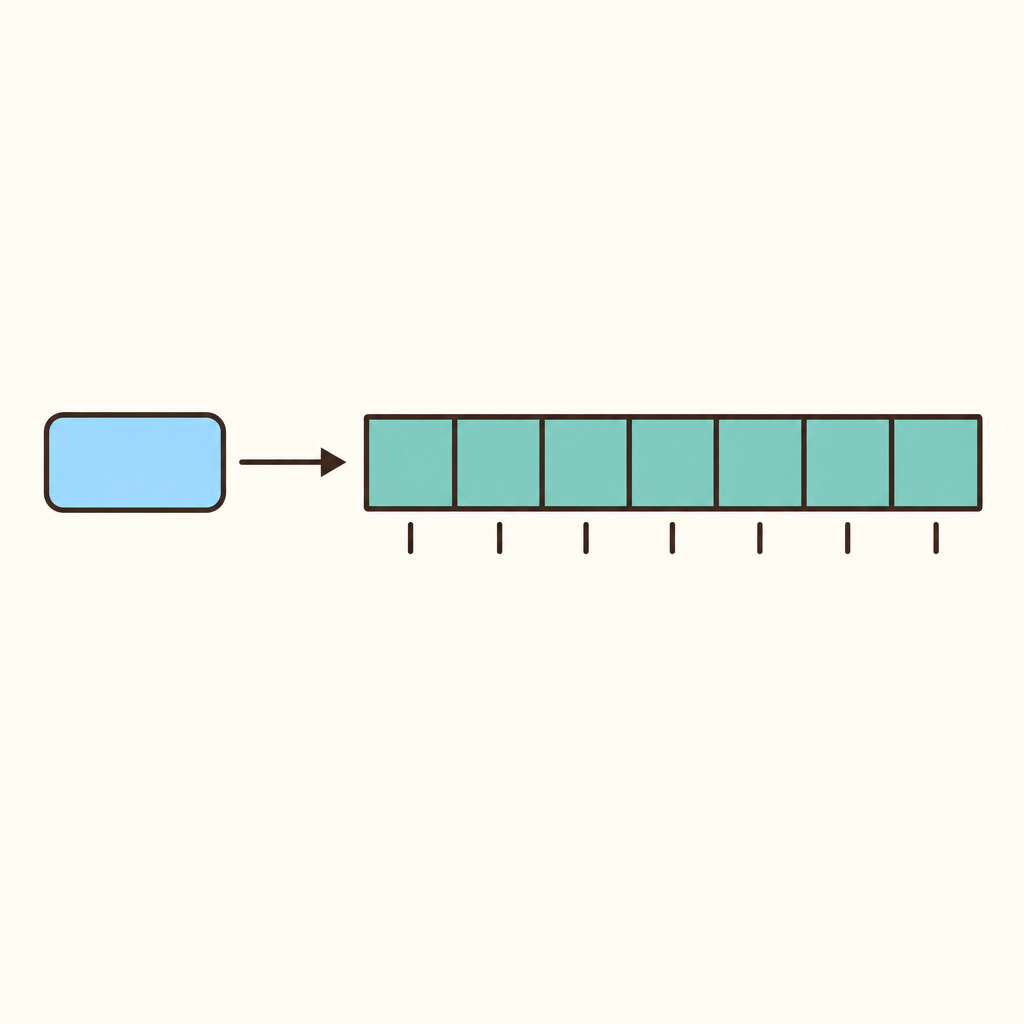
Notice that the word maps to one straight row of numbered slots, not a grid or a stack.
From Sentence to Numbers
The conversion follows a clear path.
Text arrives. The AI system turns words and sentences into vectors. Those vectors then enter the neural network.
Nothing skips this order. A raw sentence never reaches the math directly.
Every step after this point works only on numbers.
- Text arrives: A human word or sentence enters the system.
- Convert: The AI system converts the text into vectors.
- Array formed: The result is an array of numbers representing that text.
- Network processes: The neural network performs mathematical operations on the vector.
Vectors Flow Through Every Layer
Vectors are not a one-time entry ticket.
They are the fundamental data structure that flows through every layer of a large language model.
A layer receives numbers, does math, and passes numbers onward.
So the same format that let the text enter is also the format used all the way through.
- Human text
- Vector: Text is converted into an array of numbers.
- Network layer: The layer performs mathematical operations on the vector.
- More layers?
- Language output
- converted
- enters
- still numbers
Why Numbers Enable Understanding
Numbers are not a downgrade from words. They are what makes processing possible.
Because text is stored as vectors, the model can run mathematical operations on it.
Those operations are what ultimately produce intelligent language understanding.
Meaning is not thrown away in the conversion. It is carried in the numbers.
- Human language: Words and sentences a computer cannot read directly.
- Mathematical operations: The math a network runs on numbers.
- Neural network: The system that processes the numbers.
- Language understanding: The intelligent result the operations produce.
Common Misreadings
A vector is not a secret code word or a picture of a letter.
It is also not a two-dimensional grid. A vector is single-dimensional, one array of numbers.
And it is not optional. Without conversion, a neural network has nothing to process.
Getting the shape right keeps the rest of the model clear.
The Foundation Beneath LLMs
Stack the ideas and the picture is simple.
At the base sits raw human text. Above it, the vector that represents that text.
Above that, the neural network running its operations. At the top, intelligent language understanding.
Each level rests on the one below it.
- Language understanding: The intelligent result the model produces.
- Mathematical operations: Math the neural network runs on the numbers.
- Vectors: Arrays of numbers representing the text.
- Human text: Words and sentences a computer cannot read directly.
Each level rests on the one below
Key Takeaways
Computers process numbers, not words.
Vectors are single-dimensional arrays of numbers that represent text in a form neural networks can handle.
They are the fundamental data structure flowing through every layer of an LLM.
Understand this translation and the rest of how LLMs work becomes far easier to follow.
- The problem
- Computers only process numbers: Human language cannot be read directly.
- Text must be converted first: Nothing reaches the math as raw words.
- The solution
- Vectors are arrays of numbers: Single-dimensional and ordered.
- Neural networks can process them: Math replaces reading.
- The reach
- Vectors flow through every layer: The format persists from input onward.
- Operations produce understanding: Intelligent language behaviour comes out of the math.
The first step to comprehending how LLMs work
Check yourself
Computers can directly process a raw human sentence without converting it into numbers.
- True
- False
Answer: False
Incorrect. Computers process numbers, so an AI system must convert text into numerical vectors before a neural network can work with it.
The path from language input to neural network processing is _____ → _____ → _____.
Answer: The path from language input to neural network processing is raw text → vectors → neural network.
Raw text is converted into vectors, and those numerical vectors enter the neural network for mathematical processing.
Why does converting a sentence into a vector make neural network processing possible?
- It stores the sentence as numbers for mathematical operations.
- It turns the sentence into a picture of each letter.
- It removes the need for a neural network.
- It stores every word as a two-dimensional grid.
Answer: It stores the sentence as numbers for mathematical operations.
A vector stores the sentence as numbers. Neural networks can perform mathematical operations on those numbers, but they cannot process raw words directly.
Keep going
This is lesson 1 of 27 in How Large Language Models (LLMs) Work. Next up:
- Layered Processing
- Tokenization
- Embeddings
- Sequential Limitations
- Parallel Processing
Wondering turns any topic into short lessons you can read, watch, or listen to, with practice questions and an AI tutor.