Free sample lesson · High Output Management Deep Dive
Define the Production Flow
How does one breakfast order reveal every manager's job?
Lesson 1 of the Wondering course High Output Management Deep Dive
What You Will Learn
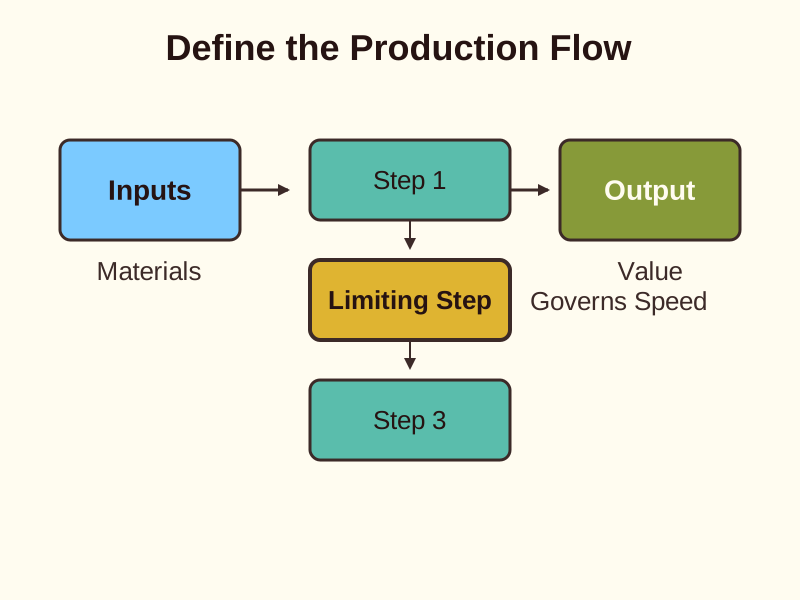
Seeing work as a production flow prevents managers from improving isolated activity while the real output still stalls.
The Manager as a Factory Owner
Every manager runs a production flow. Whether you lead a kitchen or a software team, your job is to transform inputs into valuable outputs.
Think of a breakfast order. You take raw eggs, bread, and coffee beans. You apply labor and equipment to turn them into a meal.
This logic applies to all work. A legal team transforms evidence into a verdict. A software team transforms requirements into a stable release.
Defining Your Production Flow
To manage effectively, you must map your process. Start by identifying your output and the customer standard.
What does the customer actually value? For a breakfast diner, it is a hot meal delivered on time. For a developer, it is code that works and meets security standards.
If you do not define the output, you might optimize activities that do not matter to the final result.
- Activity Focus
- Output Focus
Finding the Limiting Step
Every system has a limiting step. This is the specific constraint that determines your total speed or capacity.
Imagine your toaster is slow. Buying a faster coffee machine will not get breakfast to the table any sooner. The toaster governs the whole flow.

In a software team, the limiting step might be code reviews or security approvals. Identifying this bottleneck tells you exactly where to focus your energy.
Avoiding Common Pitfalls
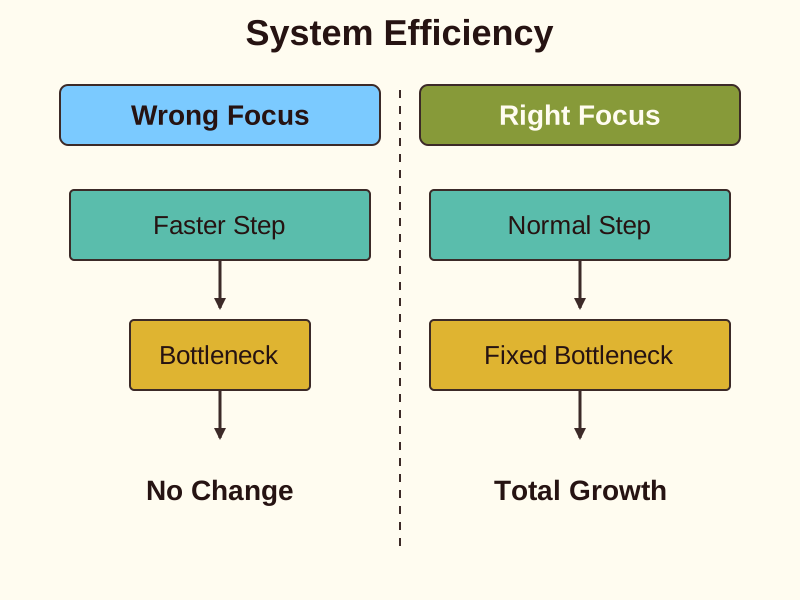
Managers often make the mistake of improving the easiest task instead of the most important one.
Improving a non-limiting step is a waste of resources. It increases local speed but leaves the final output unchanged.
Focus on the system, not just individual effort. Your goal is to deliver the required result at the lowest sensible cost without sacrificing quality.
How to Apply It in Real Life
- Define Output: Identify the final deliverable and the quality standard the customer expects.
- Map the Flow: List the sequence of steps from initial request to final delivery.
- Find the Limit: Identify which step takes the longest or has the biggest backlog.
- Intervene: Focus resources on the limiting step rather than making easy steps faster.
Check yourself
Production thinking applies _____ to service-based work like legal or software teams.
- equally
- only
Answer: equally
Production flow is a universal logic: any work that transforms inputs into outputs for a customer follows these principles, not just factories.
In a production flow, the _____ determines the total speed of the system, while the _____ defines the required quality of the final output.
Answer: In a production flow, the limiting step determines the total speed of the system, while the customer standard defines the required quality of the final output.
The limiting step is the bottleneck that governs throughput; the customer standard ensures you don't optimize for the wrong result.
A manager notices that the 'Security Review' takes 5 days, while 'Coding' takes 2 days. What happens if they make the 'Coding' step twice as fast?
- The final output reaches the customer faster
- The final output speed remains unchanged
- The cost of production automatically decreases
- The quality of the output will improve
Answer: The final output speed remains unchanged
Improving a non-limiting step (Coding) does not change the final delivery time because the system is still constrained by the slower step (Security Review).
Keep going
This is lesson 1 of 16 in High Output Management Deep Dive. Next up:
- Manage Indicators and Inventory
- Multiply Managerial Output
- Make Meetings Do Work
- Decide Where Knowledge Lives
- Plan From Tomorrow
Wondering turns any topic into short lessons you can read, watch, or listen to, with practice questions and an AI tutor.