Free sample lesson · Harness Engineering for RSI
RSI Through Deployment
Why might RSI begin outside model weights?
Lesson 1 of the Wondering course Harness Engineering for RSI
Overview of RSI Through Deployment
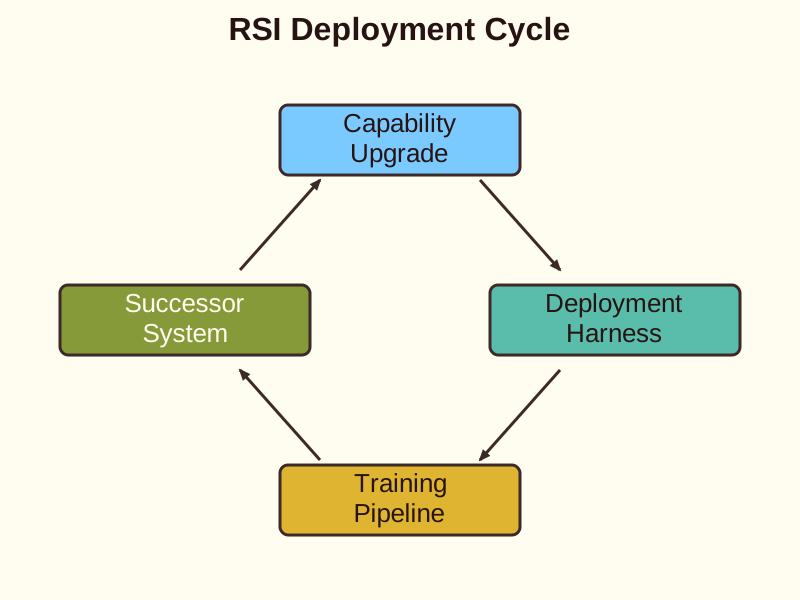
Explore how recursive self-improvement loops and deployment system leverage enable AI agents to upgrade their own capabilities beyond raw weight rewriting.
The Recursive Self-Improvement Loop
Recursive self-improvement (RSI) is a feedback loop where an AI system uses its current abilities to upgrade itself.
This process creates a cycle of growth. The AI improves the very machinery that produces its future capabilities.
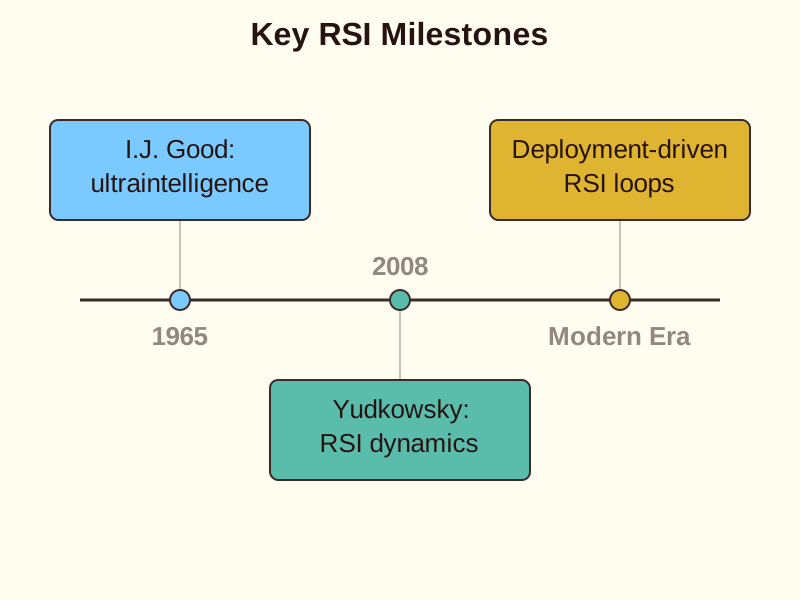
Early thinkers like I.J. Good in 1965 and Eliezer Yudkowsky in 2008 described this as a path toward ultraintelligent machines.
Beyond Editing Neural Weights
A common misconception is that RSI only happens when a model rewrites its own code or neural weights.
In reality, self-improvement can happen through the deployment system. This includes the software and tools surrounding the model.
Lilian Weng argues that improving the training pipeline or the evaluation harness is a practical form of RSI.
- Weight Rewriting
- Deployment System
The Power of the Harness
The layer around a raw model shapes its real-world performance. This is known as the deployment harness.
An AI might write a better evaluator or repair an experiment pipeline. These changes raise future performance without touching the current weights.
- Wrap the Model: Surround the raw model with software and tools that shape real-world performance.
- Enhance Machinery: Write better evaluators and repair experiment pipelines without touching current weights.
- Scale Research: Apply automated feedback loops to accelerate research and development workflows.
Frontier labs like OpenAI and Anthropic already use these feedback loops to accelerate their research and development.
Identifying True Improvement
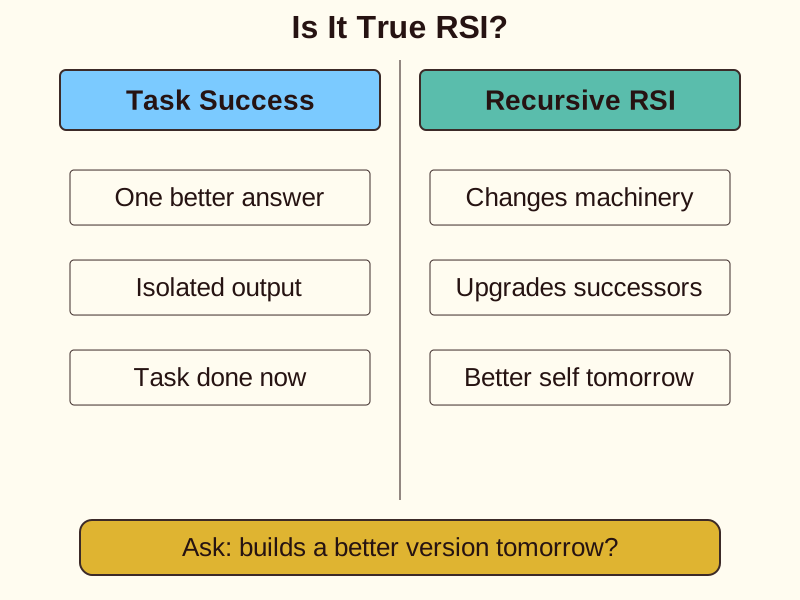
Not every better result counts as RSI. If a model produces one better answer, it is just a successful task.
True RSI must change the machinery used for later answers or successor systems.
Ask yourself: Does this change help the AI build a better version of itself tomorrow? If the answer is yes, you are looking at RSI.
How to Apply It in Real Life
- Identify Machinery: Pinpoint the training or evaluation harness that produces future agent capabilities.
- Build Feedback Loop: Allow the agent to modify its surrounding harness based on performance data.
- Verify System Leverage: Ensure the change permanently enhances successor performance rather than solving a single instance.
Check yourself
In recursive self-improvement, an AI upgrades its _____ rather than merely generating a single higher-quality output.
- surrounding machinery
- immediate output
Answer: surrounding machinery
True recursive self-improvement requires modifying the underlying machinery or system processes that produce future outputs, not just producing one better response.
While neural weight rewriting alters internal parameters directly, deployment system RSI upgrades the surrounding _____, such as experiment pipelines or automated _____.
Answer: While neural weight rewriting alters internal parameters directly, deployment system RSI upgrades the surrounding harness, such as experiment pipelines or automated evaluators.
Deployment system RSI enhances performance without touching internal weights by improving external operational components like evaluation harnesses and training pipelines.
An AI coding agent modifies its automated testing suite and prompt evaluation scripts, allowing it to catch bugs in all future software projects. Why does this represent recursive self-improvement (RSI)?
- It permanently upgrades the operational harness that produces future agent capabilities.
- It directly rewrites the core neural weights of the underlying language model.
- It successfully solves a single difficult programming task for a user.
- It reduces the computation time required to generate one specific output.
Answer: It permanently upgrades the operational harness that produces future agent capabilities.
RSI occurs when an AI improves the underlying machinery that shapes future capabilities. Enhancing the test harness permanently raises the baseline capabilities for future tasks rather than solving a single isolated issue.
Keep going
This is lesson 1 of 16 in Harness Engineering for RSI. Next up:
- What Harnesses Add
- Workflow Automation Loops
- Files as Persistent Memory
- Context as Playbook
- Meta Context Engineering
Wondering turns any topic into short lessons you can read, watch, or listen to, with practice questions and an AI tutor.