Free sample lesson · Great Thinkers
Question Assumptions
What if everything you believe about success and happiness is just a shadow on a wall?
Lesson 1 of the Wondering course Great Thinkers
Living on Autopilot
What if everything you believe about success and happiness is just a shadow on a wall?
The Greek philosopher Plato (428-348 BCE) argued that our lives go wrong for a simple reason. We do not give ourselves time to think carefully and logically about our plans, values, and beliefs.
- Rarely examined
- Our plans
- Our values
- Our beliefs
- Where it misleads
- Careers
- Relationships
- Goals
Beliefs absorbed from society, never questioned
Instead, we absorb them from society and never ask why.
This is the unexamined life. It can lead us to the wrong careers, relationships, and goals for decades.
The Allegory of the Cave
Plato told a famous story to show the problem.
Picture prisoners chained inside a cave, facing a wall. Light behind them casts shadows that move across it.
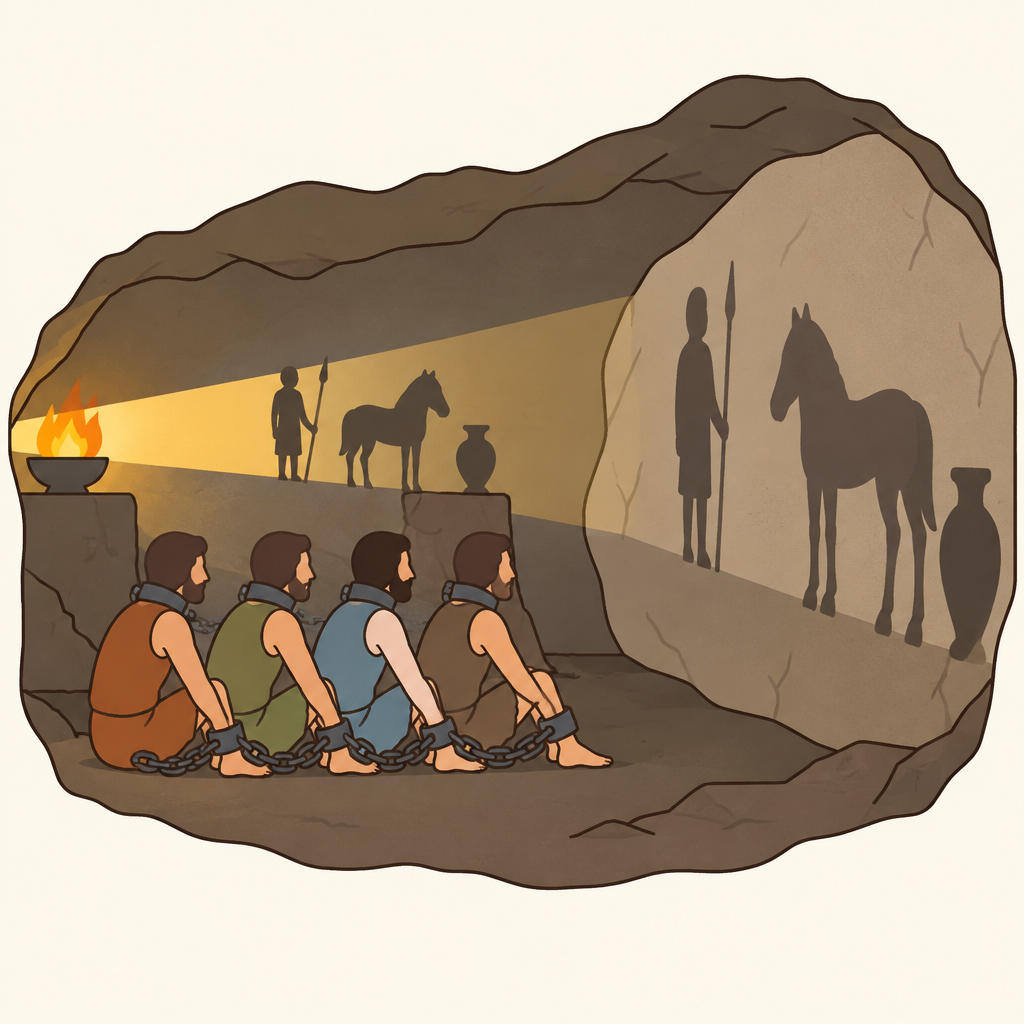
Notice that the prisoners face only the wall, so the shadows are all they can see, while the light and the real world stay behind them.
Since shadows are all they know, the prisoners believe the shadows are reality. They never think to turn around.
Plato said most people live like these prisoners. His allegory shows how difficult, and how necessary, it is to question our assumptions.
Shadows in Modern Life
Today, the shadows are not literal. They are social expectations and conventional wisdom: ideas about success we accept because everyone around us does.
Think of parental expectations or the pull of social prestige.
These shadows feel real because they are familiar. But familiar is not the same as true.
- Shadows
- Reality
Reality, in Plato's sense, is what you find when you examine a belief yourself: what would genuinely fulfill you.
A Twenty-Year Shadow
Imagine someone who becomes a lawyer because their parents were lawyers.
They never stop to ask whether law fits their own values and talents. The choice simply feels expected.
For 20 years, they feel vaguely unfulfilled. Nothing is obviously wrong, yet something is missing.
Finally they realize they chose based on shadows, parental expectations and social prestige, rather than examining what would genuinely fulfill them.
- Inherit the path: They become a lawyer because their parents were lawyers.
- Skip the question: They never ask if law fits their values and talents.
- Twenty quiet years: They feel vaguely unfulfilled for 20 years.
- The realization: They see they chose by shadows, not by what would fulfill them.
Ask Why Until It Holds
Plato's solution is philosophy: systematic questioning of your beliefs.
Take any belief, such as "I should become a lawyer." Ask why. Then ask why about that answer.
Keep going until you reach first principles, the basic reasons you cannot break down further.
- Pick a belief: For example, I should become a lawyer.
- Ask why: Question the reason behind your last answer.
- First principle reached?: Can this reason be broken down further?
- Belief examined: You now know what the belief rests on.
- No
- Yes
If your answer is "because my parents expect it," you have found a shadow. Keep questioning.
Fulfillment, Not Mere Happiness
Where does all this questioning lead? Plato said it leads to wisdom.
The Greek word for the goal is eudaimonia. It means fulfillment rather than mere happiness.
A life built on shadows can still contain pleasant moments, like the lawyer's 20 years. Fulfillment comes from a life you have examined and chosen.
This is why questioning assumptions is the foundation of a well-lived life.
Spotting Shadows in Your Life
You can start examining your assumptions today.
Look at a career plan, a relationship, or a goal. Ask where the belief came from: your own reasoning, or society, parents, and prestige?
Then ask why, repeatedly, until you reach first principles.
To explain it to a colleague: most people chase shadows they never questioned. Questioning them is how you find what truly fulfills you.
Check yourself
In Plato's Allegory of the Cave, the shadows on the wall represent _____
- unquestioned social expectations
- carefully examined beliefs
Answer: unquestioned social expectations
The shadows stand for social expectations and conventional wisdom. The prisoners never question them, so they mistake these secondhand images for reality itself.
Plato said prisoners in the cave mistake _____ on the wall for the real world. Philosophy frees us and leads to _____, which means deep fulfillment rather than mere happiness.
Answer: Plato said prisoners in the cave mistake shadows on the wall for the real world. Philosophy frees us and leads to eudaimonia, which means deep fulfillment rather than mere happiness.
Shadows are the unquestioned images (social expectations, conventional wisdom) people take as real. Eudaimonia is the wisdom-based fulfillment that systematic questioning makes possible, which goes deeper than momentary happiness.
Maya became a lawyer because her parents were lawyers and the job is prestigious. After 20 years, she feels vaguely unfulfilled. What best explains her situation?
- She followed absorbed expectations without examining them
- She did not work hard enough to succeed in law
- She picked a career that pays too little to satisfy
- She had too many career options to choose from
Answer: She followed absorbed expectations without examining them
Maya chose based on shadows: parental expectations and social prestige. She never examined whether law fit her own values and talents. The problem is an unquestioned assumption, not effort, pay, or a lack of choices.
Keep going
This is lesson 1 of 46 in Great Thinkers. Next up:
- Examine Values
- Find Balance
- Practice Virtues
- Control What's Yours
- Rehearse Adversity
Wondering turns any topic into short lessons you can read, watch, or listen to, with practice questions and an AI tutor.