Free sample lesson · Google-Scale Systems Lessons
Read Growth Vectors
Which search metric improved 50,000x while the page looked the same?
Lesson 1 of the Wondering course Google-Scale Systems Lessons
What You Will Learn
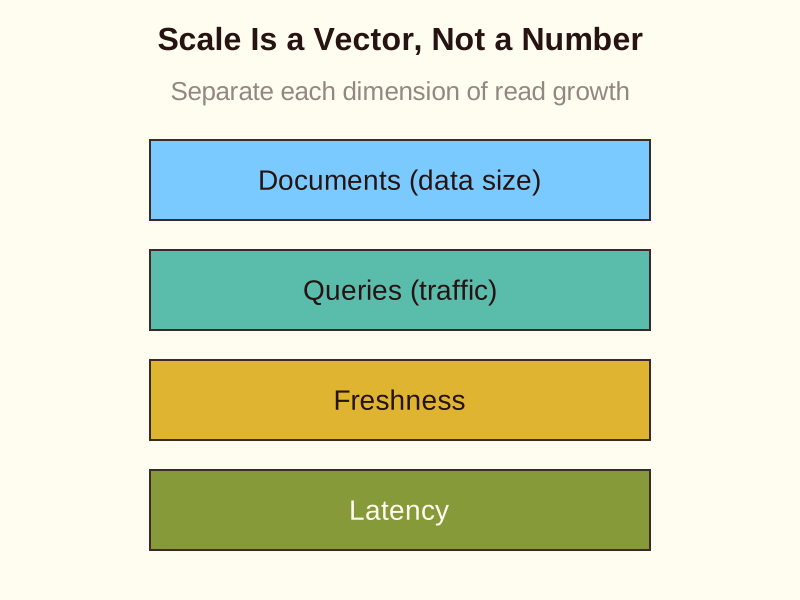
Scale decisions become clearer when you separate data size, traffic, per-document richness, freshness, and response latency instead of treating scale as one number.
Scale is a Vector
Engineers often treat scale as a single number, like total traffic. In reality, scale is a vector with multiple independent dimensions.
Google search grew along several paths between 1999 and 2010. Documents indexed grew 1,000x, while daily queries also grew 1,000x.
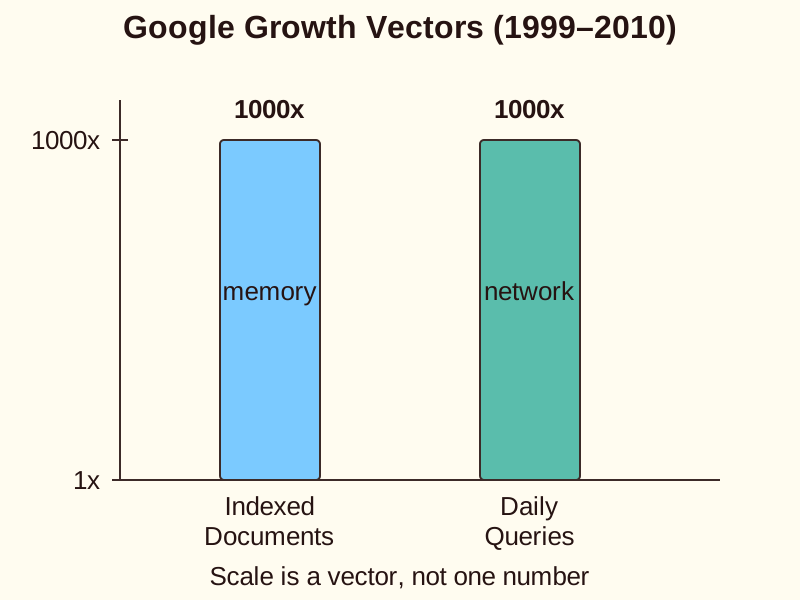
Each dimension creates unique pressure. A larger corpus exhausts memory, while higher traffic stresses your network and query processing.
The 50,000x Improvement
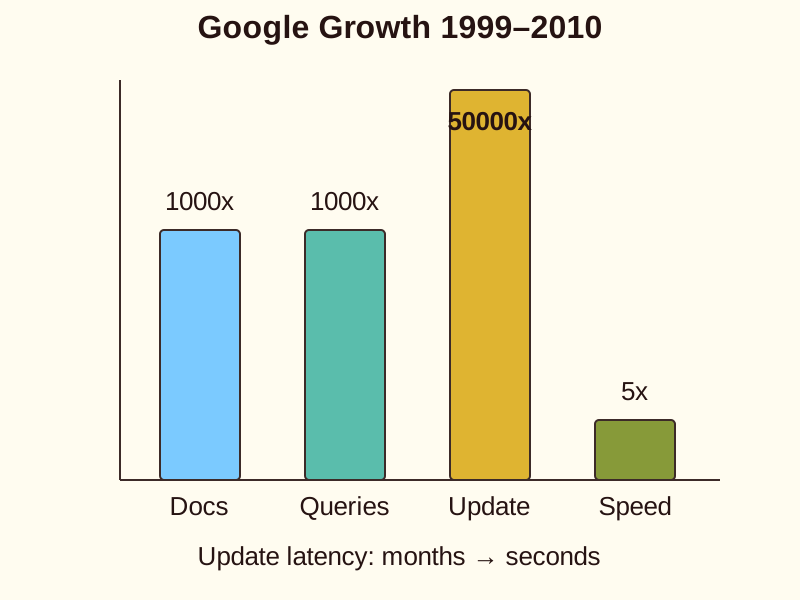
While document count grew steadily, other metrics moved at different speeds. Update latency dropped from months to tens of seconds.
This represents a 50,000x improvement in freshness. At the same time, query latency fell from 1 second to 0.2 seconds.
Growth metrics for Google (1999 to 2010): documents 1,000x, queries 1,000x, update speed 50,000x, query speed 5x.
Hidden Architecture Shifts
Users rarely notice when a backend is replaced if the interface stays the same. Google revised its search system seven times in eleven years.
Major redesigns are necessary when growth exceeds a certain threshold. Designing for 5x to 50x growth is usually sustainable.
However, once a metric grows beyond 100x, the existing mechanism typically breaks. This requires a complete rethink of the architecture.
- Stable Growth: Designing for 5x to 50x growth is usually sustainable with existing mechanisms.
- The 100x Limit: Once a metric grows beyond 100x, the existing mechanism typically breaks.
- System Rethink: Major redesigns become necessary to handle massive scale thresholds.
Solving for Specific Pressures
Naming the specific growth dimension tells you which mechanism to change. You do not always need to scale everything at once.
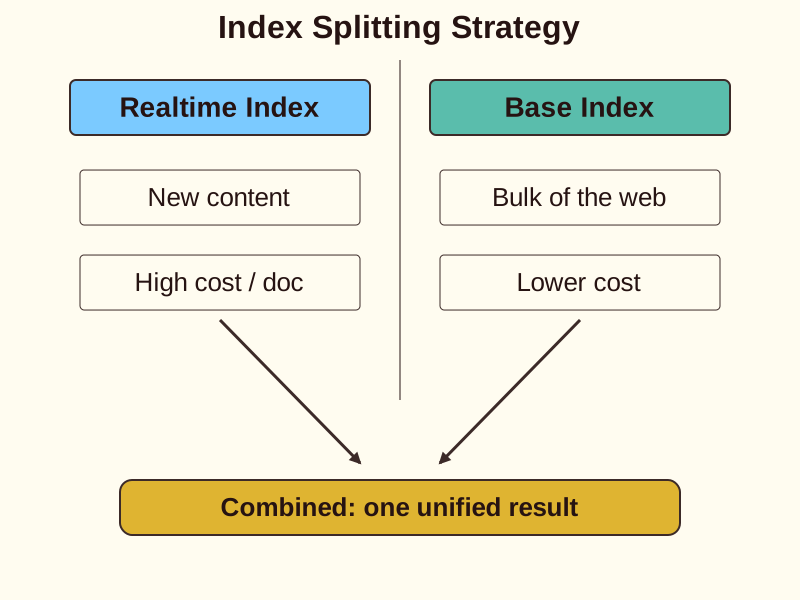
Google managed freshness by splitting the index. A realtime index handled new content at a high cost per document.
A larger base index served the bulk of the web at a lower cost. These two systems combined to provide one result.
Putting It All Together
- Isolate Dimensions: Identify which specific vector is growing (e.g., query volume vs. corpus size).
- Check Thresholds: Determine if the growth metric exceeds the 100x limit where current mechanisms fail.
- Targeted Solutions: Apply specialized architectures rather than scaling every component at once.
Check yourself
Engineers should treat scale as a _____ with multiple independent dimensions rather than a single headline number.
- vector
- constant
Answer: vector
Scale is a vector because different dimensions (like traffic vs. data size) grow at different rates and require different technical solutions.
In a retrieval system, a larger _____ exhausts memory and storage, while higher _____ stresses the network and query processing.
Answer: In a retrieval system, a larger corpus exhausts memory and storage, while higher traffic stresses the network and query processing.
Isolating these dimensions allows engineers to solve for specific pressures; for example, adding memory for more documents versus optimizing networking for more queries.
Why might a backend architecture require a complete redesign even if the user interface remains unchanged?
- A growth metric has exceeded the 100x threshold where old mechanisms fail.
- Users usually demand a new backend every few years for freshness.
- The system must be redesigned every time the document count grows by 5x.
- Architectural changes are only necessary when the UI is updated.
Answer: A growth metric has exceeded the 100x threshold where old mechanisms fail.
Existing mechanisms typically break once a growth metric (like volume or latency) exceeds a 100x threshold, necessitating a 'hidden' architecture shift.
Keep going
This is lesson 1 of 9 in Google-Scale Systems Lessons. Next up:
- Partition Query Work
- Move Hot Paths to Memory
- Make Failure Routine
- Hide Distributed Mess
- Shape Sparse State
Wondering turns any topic into short lessons you can read, watch, or listen to, with practice questions and an AI tutor.