Free sample lesson · Foundations of Introductory Anthropology
Defining Culture
What invisible rules shape every decision you make daily?
Lesson 1 of the Wondering course Foundations of Introductory Anthropology
The Invisible Rules
Why do you shake hands, bow, or wave when you meet someone? You probably never decided. You just know.
That knowing comes from culture.
Anthropologists define culture as the learned and shared system of beliefs, values, practices, symbols, and expectations that shapes how people understand and act.
Your social science classes may have covered related ideas like norms. Anthropology gathers them into this one central concept.
Five Parts of One System
The definition names five parts. Together they work as a system, so each part connects to the others.
Beliefs are ideas people hold to be true. Values are what a group treats as important or good.
Practices are things people regularly do. Symbols carry shared meaning, like words. Expectations are ideas about what is appropriate.
With these parts, groups make sense of the world, organize everyday life, and communicate what matters to them.
Seen and Unseen Culture
Some parts of culture are easy to spot. Food, clothing, language, art, and celebrations are visible elements.
Other parts are less visible: values, assumptions, social rules, and ideas about what is normal or appropriate.
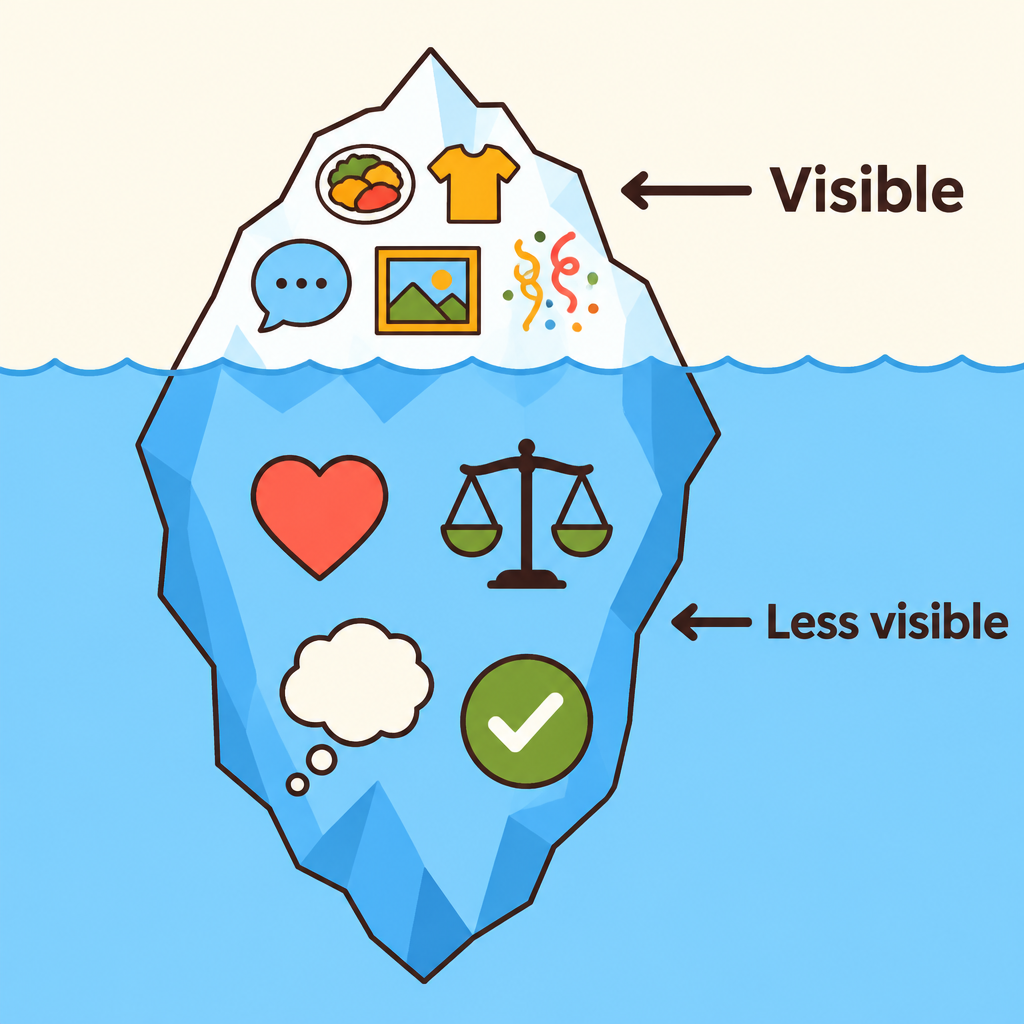
Notice how food, clothing, and celebrations sit above the waterline while values and social rules fill the larger part below.
Both levels count as culture.
Beginners often notice only the visible layer. The less visible layer is easy to miss because it feels like plain common sense.
Nobody Is Born Knowing It
Culture is learned. People are not born knowing a culture; they pick it up over time.
Some lessons come from people close to us, such as family and peers.
Others come from institutions like schools and media.
Much is learned simply through participation in social life, by watching, joining in, and being corrected.
- Learning culture
- Close people
- Family
- Peers
- Institutions
- Schools
- Media
- Social life: Learning by taking part
Is It Culture? A Quick Check
Use the definition as a test. Two features matter most: culture is learned, and it is shared by a group.
- A behavior or idea
- Is it learned?
- Not culture: Inborn, like blinking.
- Shared by a group?
- Personal habit: Only one person does it.
- Part of culture: Like a group's greeting custom.
- No
- Yes
- No
- Yes
A reflex like blinking fails the first test. Nobody teaches it.
One person's private habit fails the second test. If a group does not share it, it stays personal.
Something that passes both tests, such as a group's greeting custom, is part of culture.
Different, Not Better
Anthropologists study culture to understand human diversity.
They avoid assuming that one group's practices are naturally better or more correct than another's.
- Ranking view
- Anthropological view
Your own culture can feel like the normal way. Yet its rules were learned, and other groups learned different ones.
So the goal is to understand a practice within its own system first.
Putting Culture to Work
You can now spot culture in your own life and work.
When something feels obviously right, pause. Ask whether it is learned and shared, and where you learned it.
Look past visible elements to the values and assumptions underneath.
Then compare groups to understand diversity, without ranking them.
- Notice: Spot a rule that feels obviously right.
- Test it: Ask if it is learned and shared by a group.
- Look deeper: Find the values and assumptions beneath it.
- Compare fairly: Compare with other groups to understand, not rank.
Check yourself
In anthropology, culture is something people are _____.
- taught and learn over time
- born already knowing
Answer: taught and learn over time
People are not born knowing a culture. They acquire it through family, peers, schools, media, and participation in social life. A child raised in a different community would learn that community's culture instead.
Culture has two kinds of elements. Holiday foods and traditional clothing are _____ elements. Ideas about what is normal or polite are less _____ elements, and they include _____, which define what matters most to a group.
Answer: Culture has two kinds of elements. Holiday foods and traditional clothing are visible elements. Ideas about what is normal or polite are less visible elements, and they include values, which define what matters most to a group.
Culture includes visible elements such as food, clothing, language, art, and celebrations. It also includes less visible elements such as values, assumptions, and social rules. The less visible elements are often taken for granted.
Which of these is the best example of a less visible element of culture?
- A shared assumption about how close to stand when talking
- A dish commonly served at family gatherings
- A style of clothing worn at weddings
- A parade held on a national holiday
Answer: A shared assumption about how close to stand when talking
Assumptions about how much personal space is appropriate in conversation are unspoken social expectations. Food, clothing, and celebrations are visible cultural elements you can directly see or touch.
Keep going
This is lesson 1 of 9 in Foundations of Introductory Anthropology. Next up:
- Cultural Relativism
- Sociocultural Anthropology
- Linguistic Anthropology
- Archaeology
- Biological Anthropology
Wondering turns any topic into short lessons you can read, watch, or listen to, with practice questions and an AI tutor.