Free sample lesson · Foundation Bicycle Maintenance Preparation
Chain Care
How can a simple chain check save a family member hundreds in replacement parts?
Lesson 1 of the Wondering course Foundation Bicycle Maintenance Preparation
Know the Drivetrain Parts
When friends hand you their bike, the parts doing the work sit on the right side.
The chain wraps around the chainrings at the pedals and the cassette at the rear wheel. Together these three make up the drivetrain.
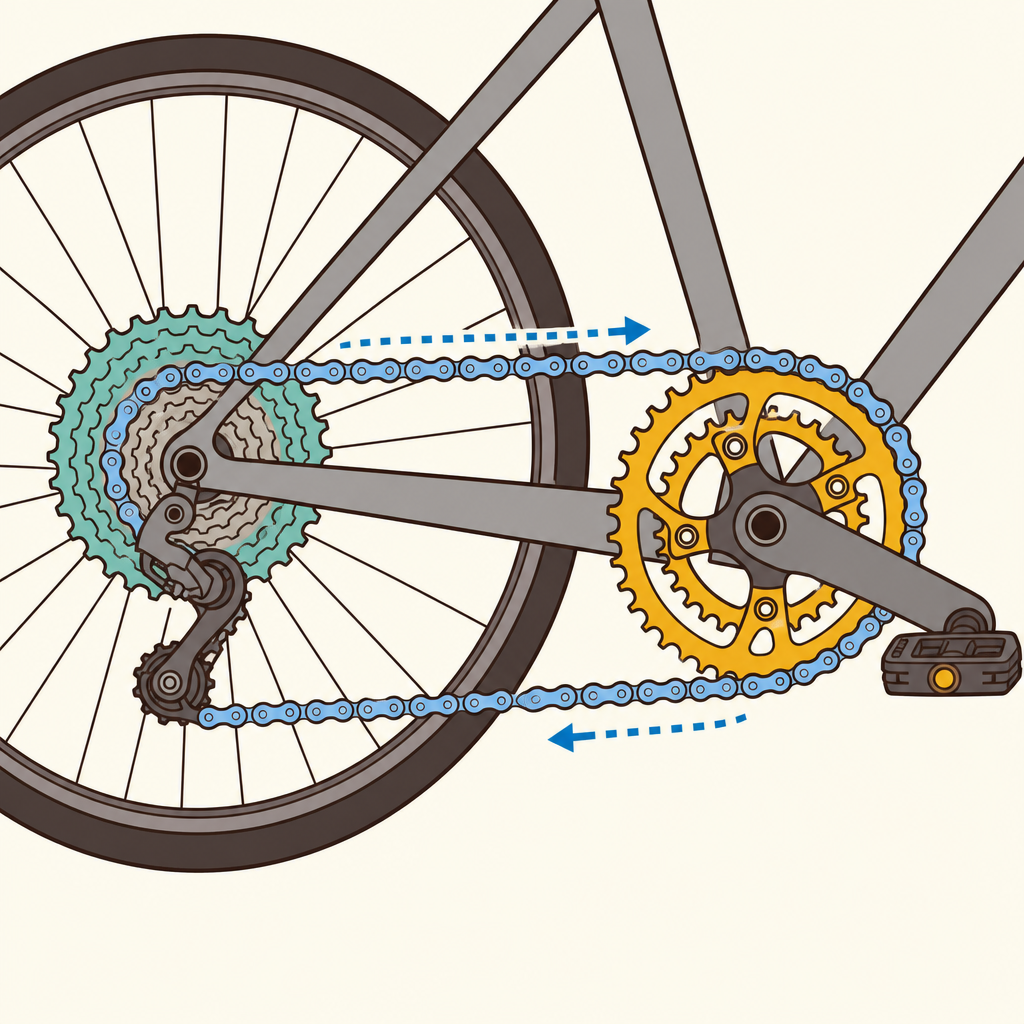
The three drivetrain parts you will inspect on every bike
The chain is a consumable part. It is designed to wear out and be replaced.
How Chains Stretch
A chain is never dry inside. Every pedal stroke grinds its internal bushings against the pins.
As those surfaces wear away, each link gains a little slack. Multiply that across a hundred links and the chain grows longer.
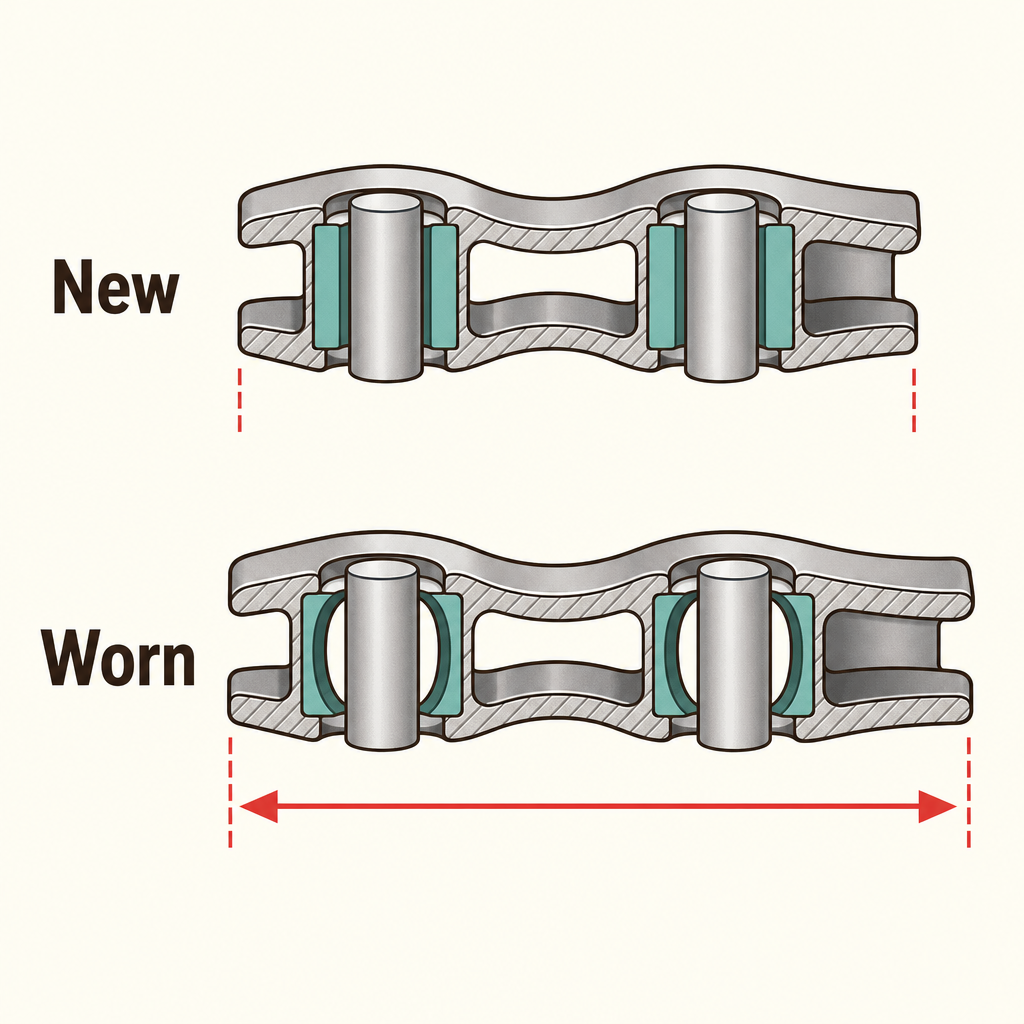
Notice that the extra length comes from material worn away inside the bushing, not from the metal itself stretching.
Mechanics call this elongation, or chain stretch. The metal is not pulling like a rubber band; friction is simply eating material away.
The Damage Spreads
Here is why a cheap part becomes an expensive problem.
A stretched chain no longer matches the tooth spacing of the cassette and chainrings. Under load it grinds those teeth into its own longer pitch.
- Friction: Constant friction wears down the chain's internal bushings.
- Elongation: The chain stretches to a longer pitch than when new.
- Tooth wear: The longer chain deforms cassette and chainring teeth to match it.
- Skipping: The chain starts skipping and the whole drivetrain needs replacement.
By the time the chain starts skipping, the whole drivetrain usually needs replacement.
Measure Before It Costs
A chain checker is a small tool that drops into the links and reads wear as a percentage.
Replace at 0.5% or 0.75% wear and you pay about $25 for a chain. Wait too long and a new drivetrain runs $150 or more.
- New chain: Paid when the chain checker reads 0.5% or 0.75% wear.
- New drivetrain: The floor of the cost, since the page states $150 or more.
That is the whole argument for checking early.
Your Routine for Others
Chain care is three habits: clean, lubricate, and measure.
Cleaning and lubrication slow the internal friction. The chain checker tells you when slowing it is no longer enough.
- Clean: Remove grit that speeds up internal friction.
- Lubricate: Reduce the friction wearing the internal bushings.
- Measure: Use a chain checker to read wear as a percentage.
- Replace or ride: Swap the chain at 0.5% or 0.75% wear, otherwise keep riding.
Run this loop on every bike you look after, and you catch wear while it still costs $25.
Check yourself
Is a bicycle chain designed to be replaced as it wears?
- Yes
- No
Answer: Yes
Yes. A chain is a consumable part, so it is expected to wear out and be replaced.
The chain wraps around the _____ at the pedals and the _____ at the rear wheel; together with the chain, they form the drivetrain.
Answer: The chain wraps around the chainrings at the pedals and the cassette at the rear wheel; together with the chain, they form the drivetrain.
Chainrings are located at the pedals, while the cassette is located at the rear wheel. The chain connects and wraps around both.
A chain checker reads 0.75% wear on a bicycle chain. What is the best action?
- Replace the chain
- Wait until the chain starts skipping
- Replace only the rear wheel
- Add lubricant and ignore the measurement
Answer: Replace the chain
Replace the chain at 0.5% or 0.75% wear. Early replacement helps protect the cassette and chainrings from damage and can avoid a much more expensive drivetrain replacement.
Keep going
This is lesson 1 of 8 in Foundation Bicycle Maintenance Preparation. Next up:
- Gear Indexing
- Pad Alignment
- Cable Adjustment
- Headset Inspection
- Bottom Brackets
Wondering turns any topic into short lessons you can read, watch, or listen to, with practice questions and an AI tutor.