Free sample lesson · Fooled by Randomness
Hidden Randomness
What if most success you see around you is just luck in disguise?
Lesson 1 of the Wondering course Fooled by Randomness
Luck in Disguise
Look at the most successful people around you. Most of us assume they earned every bit of it.
Humans systematically underestimate how much randomness and luck shape outcomes. We prefer stories where results come from skill, intelligence, or hard work.
That is hidden randomness: chance is everywhere, but it rarely gets the credit.
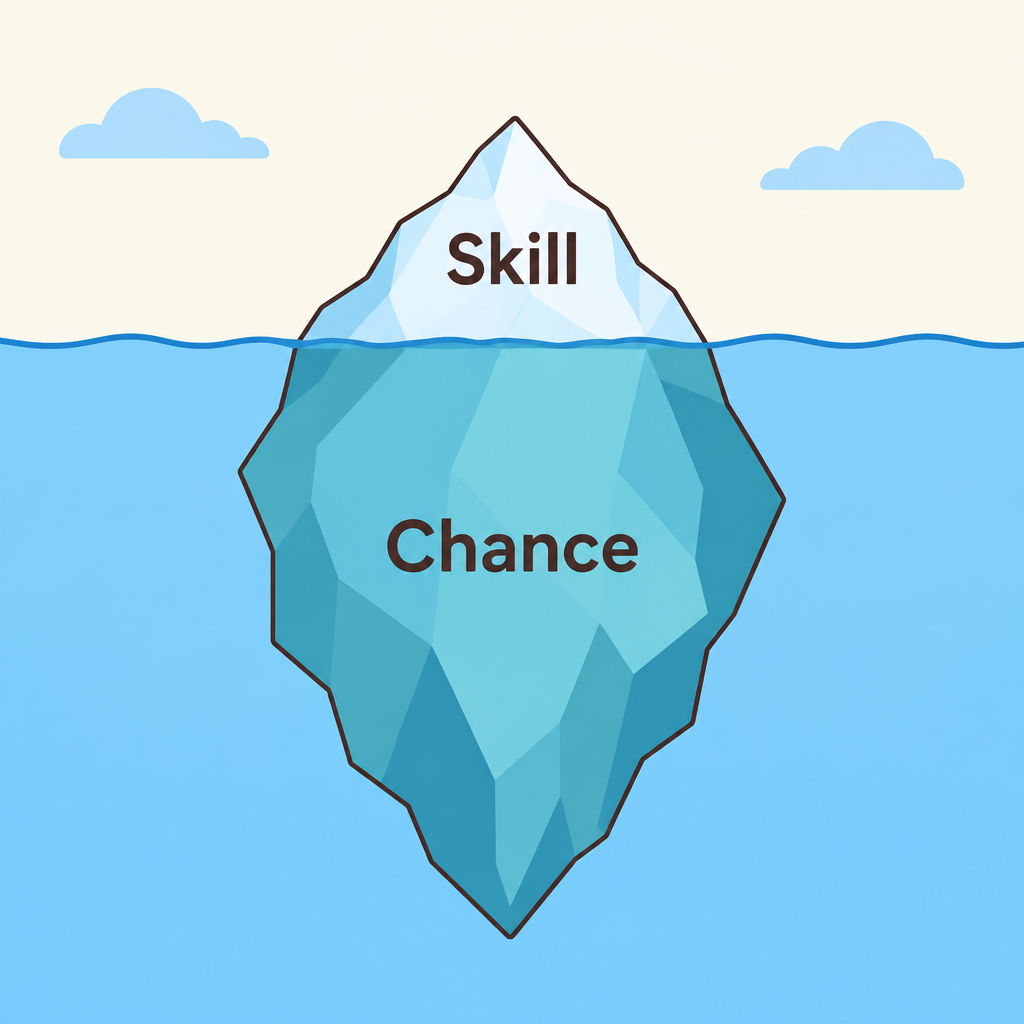
Notice how the visible tip labeled skill is small while the hidden mass labeled chance is far larger, just like luck behind success stories.
The luck is real. It simply does not show up in the stories we tell.
Where Chance Hides Most
Chance matters most where many forces collide at once.
Financial markets: a fund beats the market, and we call the manager a genius. Yet prices move for countless reasons nobody controls.
Business: a startup takes off, and the founder gets all the credit. Timing and circumstances outside anyone's control often played a big part.
Careers: a promotion looks like pure merit. Who you happened to meet, and when, can matter a lot.
- Markets
- Business
- Careers
The more complex the environment, the more room luck has to hide.
The Attribution Error
This bias has a name: the attribution error.
When someone succeeds, we credit their skill, intelligence, or hard work. When someone fails, we blame incompetence or poor character.
- After success
- After failure
Both judgments make the same mistake. They ignore that chance can drive either outcome.
A lucky person looks talented. An unlucky person looks careless, even when both made the same choices.
Judge the Decision, Not the Result
Picture two founders who make equally careful choices. One market booms, the other crashes.
Judge by outcome alone, and one looks brilliant while the other looks foolish. Yet their decisions were the same.
So separate two questions: Was the decision good? Was the outcome good?
- Deserved success: Good choice, good result
- Lucky break: Poor choice rescued by chance
- Bad luck: Good choice, chance went wrong
- Deserved failure: Poor choice, bad result
That gives four cases: deserved success, lucky break, bad luck, and deserved failure. The outcome alone cannot tell you which case you are in.
What the Blind Spot Costs
Ignoring chance is not harmless. It has three real costs.
- Underestimating chance
- Poor predictions: Expecting past winners to keep winning.
- False confidence: Reading a lucky streak as mastery.
- Weak preparation: No plan for surprises.
Poor predictions: if you think past winners won by skill, you expect them to keep winning.
False confidence: a lucky streak feels like proof you have mastered the game.
Weak preparation: if you believe outcomes are under your control, you do not plan for surprises.
Separating Skill From Chance
You cannot remove luck. You can stop mistaking it for skill.
Before crediting or blaming anyone, including yourself, run a quick check.
- Judge the decision: Look at the choice made, not only the result.
- Name the uncontrollable: List what was outside anyone's control.
- Test repeatability: Ask whether the result would repeat with different luck.
- Prepare: Plan for uncertainty, since chance will return.
Look at the decision, not only the result. Name what was outside anyone's control. Ask whether the result would likely repeat with different luck.
Then prepare for uncertainty, because chance will show up again.
Key Takeaways
Hidden randomness: chance shapes outcomes far more than we admit, especially in markets, business, and careers.
Attribution error: we credit success to skill and blame failure on incompetence, ignoring luck in both.
What to do: judge decisions separately from results, stay humble about wins, and prepare for surprises.
Next time you admire a success story, ask what role chance played.
Check yourself
In complex areas like the stock market or starting a business, the role luck plays in who succeeds is usually _____
- bigger than most people think
- smaller than most people think
Answer: bigger than most people think
People tend to underestimate randomness. In complex areas like markets and business, chance shapes results far more than people think. Assuming luck matters less than it does is the very blind spot to watch for.
When things go well, people tend to credit their _____. When things go badly, they tend to blame _____. In both cases they overlook _____.
Answer: When things go well, people tend to credit their skill. When things go badly, they tend to blame incompetence. In both cases they overlook chance.
This is the attribution error. Success gets credited to skill, and failure gets blamed on incompetence. Both judgments ignore chance, which can play a dominant role in either outcome.
Maya's startup became a big success. She writes a book saying her hard work and smart choices alone made it happen. Many other founders worked just as hard, and their startups failed. What mistake might Maya be making?
- She is ignoring how much luck helped her succeed
- She is giving too much credit to luck and too little to herself
- She is right, because success is mostly a fair reward for hard work
- She is blaming other founders' failures on bad luck
Answer: She is ignoring how much luck helped her succeed
Maya credits her success fully to her own effort and skill. Other founders worked just as hard and still failed, so luck likely played a big part too. That is the classic attribution error.
Keep going
This is lesson 1 of 36 in Fooled by Randomness. Next up:
- Luck's Reversibility
- Lucky Fool Detection
- Survivorship Bias
- Silent Evidence
- Hindsight Bias
Wondering turns any topic into short lessons you can read, watch, or listen to, with practice questions and an AI tutor.