Free sample lesson · Fashion Business Executive Essentials
Market Structure
Why do luxury brands and fast fashion players operate on completely opposite operational principles?
Lesson 1 of the Wondering course Fashion Business Executive Essentials
The Pyramid Runs Everything
Luxury brands and fast fashion players are not simply competing at different price points. They run on opposite operational logic.
The fashion industry is organized into a distinct pyramid structure. That structure dictates every operational decision an executive must make.
Where a brand sits on the pyramid determines lead times, price points, and volume requirements.
- Haute Couture, Luxury: Value comes from scarcity, craftsmanship, and high margins rather than volume.
- Bridge, Contemporary: Balances aspirational design with scalable production.
- Mass Market, Fast Fashion: Prioritizes high-volume turnover and supply chain speed.
Each level rests on the one below
Read the pyramid first. Then build the supply chain.
The Apex: Scarcity as Value
At the apex sits Haute Couture and Luxury.
Here, value is derived from scarcity, craftsmanship, and high margins. Volume is not the engine of profit.
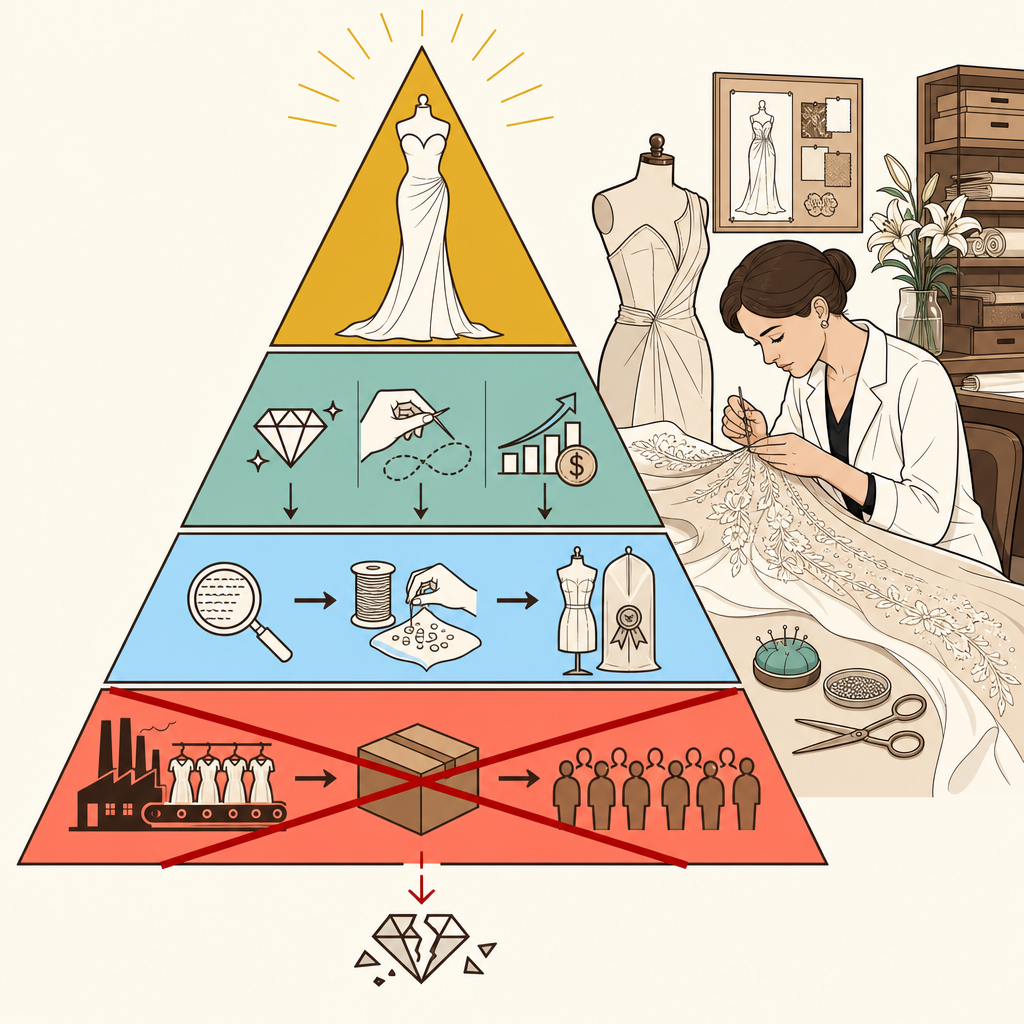
Craftsmanship is the product at the apex of the pyramid
That single fact reshapes the supply chain. A luxury strategy requires a supply chain focused on quality control and exclusivity.
Producing more units does not strengthen this position. It weakens it.
The Middle: Bridge and Contemporary
Moving down, we reach the Bridge and Contemporary segments.
This is where brands like Berhasm often position themselves.
The job here is a balance: aspirational design paired with scalable production.
- Aspirational design
- Scalable production
That balance is the hardest operational position in the pyramid. Lean too far toward exclusivity and margins cannot cover overhead. Lean too far toward volume and the aspirational signal fades.
The Base: Speed Wins
The base of the pyramid consists of Mass Market and Fast Fashion.
These players prioritize high-volume turnover and supply chain speed.
A mass-market strategy demands extreme efficiency and logistical speed. Margin per unit is thin, so throughput carries the business.
- Design fast: Design cycles compress to keep pace with turnover.
- Produce at volume: High-volume production replaces high margin per unit.
- Move logistics: Extreme efficiency and logistical speed carry the strategy.
- Turn inventory: High-volume turnover is the priority of this segment.
The operational question at the base is not how well a garment is made. It is how fast it moves.
Two Supply Chains, Two Goals
The same word, supply chain, means two different things at the top and the bottom of the pyramid.
A luxury supply chain is built for quality control and exclusivity.
A mass-market supply chain is built for extreme efficiency and logistical speed.
- Luxury
- Bridge
- Mass market
Neither is superior. Each is correct only for its own segment.
What Shifts Between Levels
Three variables move as you travel down the pyramid: lead times, price points, and volume requirements.
At the apex, price points are high and volume requirements are low.
At the base, price points fall and volume requirements rise sharply. Speed replaces scarcity as the competitive edge.
- Scarcity and craftsmanship
- High margins, low volume
- High-volume turnover
- Supply chain speed
- Aspirational design
- Scalable production
Understanding these shifts is the core of segment literacy.
The Cost of Misalignment
Misaligning your operational strategy with your market segment carries real consequences.
Two failure modes appear. Brand dilution follows when a premium positioning is run on mass-market logic.
Unsustainable overhead costs follow when a mass-market business is run on luxury logic.
- Operational strategy
- Matches segment?: Does the operating model fit where the brand sits on the pyramid?
- Aligned strategy: Operations match brand positioning and consumer expectations.
- Brand dilution: Premium positioning run on mass-market logic.
- Unsustainable overhead: Mass-market business run on luxury logic.
Both failures start with the same error: reading the segment wrong.
A Question Worth Sitting With
Executives often assume that better operations mean faster and cheaper operations.
The pyramid contradicts that instinct. At the apex, speed and scale can actively destroy value, because scarcity is the product.
So the definition of operational excellence is not fixed. It is set by the segment you occupy.
Steering Berhasm's Position
For an executive transitioning into fashion, recognizing where a brand sits on this spectrum is critical.
Berhasm sits in the Bridge and Contemporary space, balancing aspirational design with scalable production.
That position sets the operating brief: enough quality control to protect the aspirational signal, enough scalability to keep overhead sustainable.
- Berhasm: Positioned in the Bridge and Contemporary space.
- Supply chain: Quality control and scalability are balanced here.
- Brand dilution
- Overhead costs
- Consumer expectations
By mastering these segments, a leader can match strategy to positioning and consumer expectations.
Check yourself
Which segment depends most on scarcity, craftsmanship, and high margins rather than high volume?
- Haute Couture and Luxury
- Mass Market and Fast Fashion
Answer: Haute Couture and Luxury
Haute Couture and Luxury sit at the apex, where scarcity and craftsmanship create value. High volume is the engine of the Mass Market and Fast Fashion base, not the apex.
At the apex, fashion has _____ price points and _____ volume requirements; at the base, price points fall and volume requirements rise.
Answer: At the apex, fashion has high price points and low volume requirements; at the base, price points fall and volume requirements rise.
The pyramid changes in a consistent direction from top to bottom: price points decrease, while volume requirements increase sharply. This shift helps executives match operations to the segment.
A luxury brand is reviewing its supply chain. Which operating priority best fits its market position?
- Quality control and exclusivity
- Extreme efficiency and rapid turnover
- Thin margins and maximum throughput
- Lowest possible price and highest volume
Answer: Quality control and exclusivity
Luxury creates value through scarcity, craftsmanship, quality control, and exclusivity. Extreme speed and high-volume turnover are priorities of mass-market and fast-fashion businesses.
Keep going
This is lesson 1 of 11 in Fashion Business Executive Essentials. Next up:
- Business Models
- Pyramid Revenue Structure in Action
- Season Cycles
- Market Weeks
- Fabric Sourcing
Wondering turns any topic into short lessons you can read, watch, or listen to, with practice questions and an AI tutor.