Free sample lesson · Evaluating LLMs for Product Decisions
Architecture Basics
Why did transformers replace previous AI models almost overnight?
Lesson 1 of the Wondering course Evaluating LLMs for Product Decisions
Why Transformers Changed AI
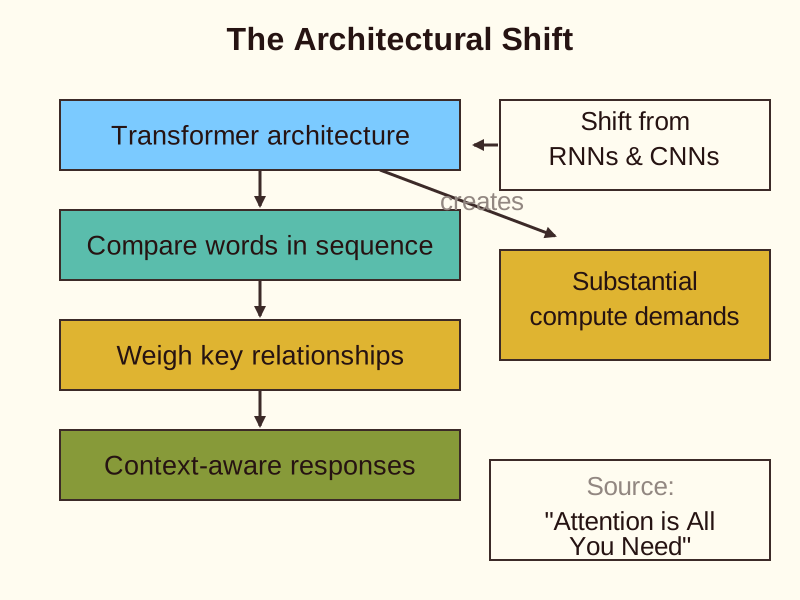
The Transformer architecture changed how models process language and other sequences.
It was introduced in the paper Attention is All You Need, marking a major shift from recurrent and convolutional neural networks.
For someone familiar with machine learning, the key change is how the model weights information.
Instead of relying mainly on processing order, the Transformer compares words across a sequence and identifies which relationships matter.
This shift helps explain why modern large language models produce more context-aware responses and handle complex prompts.
It also explains their cost: the architecture creates substantial computational demands.
The Sequential Limitation
RNNs process a sequence step by step, moving through one word before handling the next.
That sequential flow can make distant context harder to preserve. Earlier information may lose influence as the sequence grows longer.
Consider a sentence where a word near the end depends on an idea introduced near the beginning.
An RNN must carry that earlier signal through every intermediate step.
Transformers approach this relationship differently. They can examine the sequence as a whole when deciding what matters for each word.
- RNNs
- Transformers
This difference is central when evaluating tools that must follow long-form instructions.
How Self-Attention Works
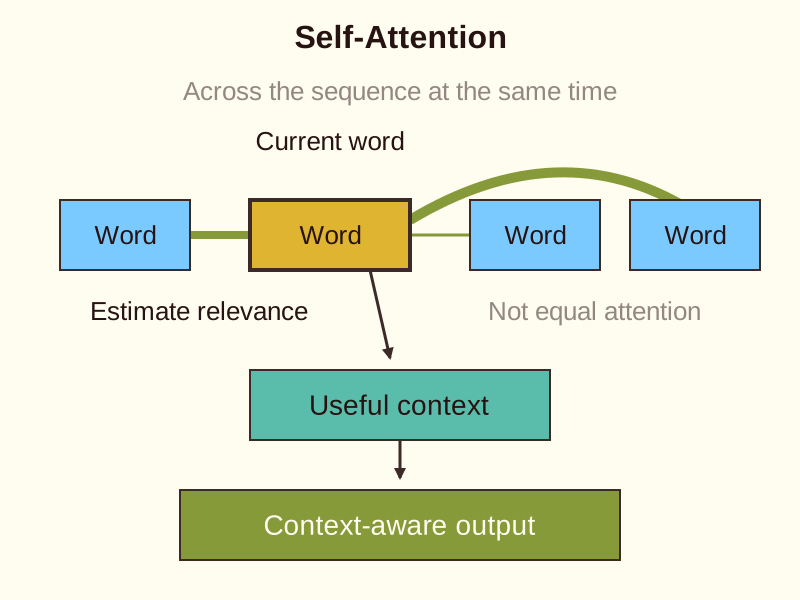
Self-attention lets the model weigh the importance of different words in the same sequence.
For each word, the model considers the other words and estimates which ones are most relevant.
A word can therefore connect directly with useful context, even when that context appears far away.
The process happens across the sequence at the same time, rather than requiring one fixed left-to-right pass.
Self-attention does not mean every word receives equal attention. Relevance changes according to the current word and the surrounding sequence.
This dynamic weighting is the Transformer mechanism most closely tied to context-aware output.
A Contextual Example
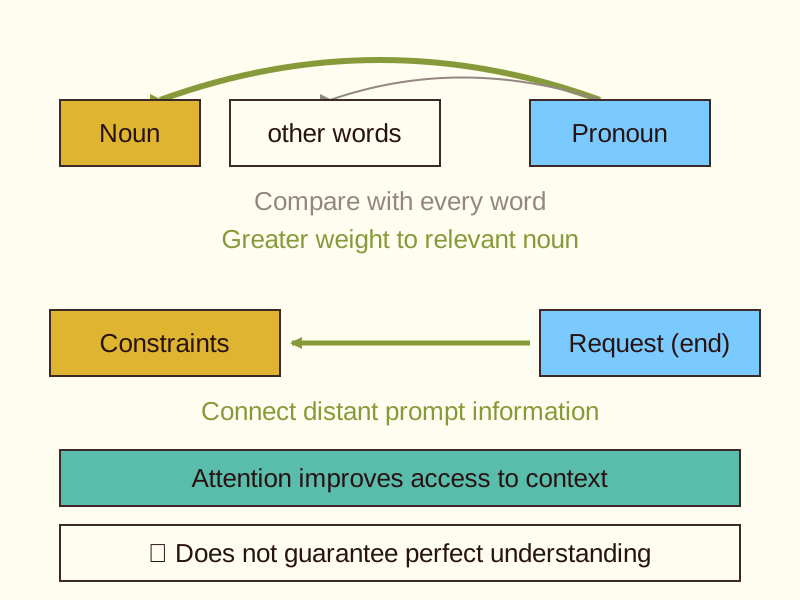
Imagine a sentence containing a pronoun whose meaning depends on an earlier noun.
Self-attention allows the model to compare that pronoun with every other word and assign greater weight to the relevant noun.
The same process can connect a request at the end of a prompt with constraints stated near its beginning.
This helps explain why Transformers can handle complex, long-form prompts more effectively than models that rely mainly on sequential memory.
However, self-attention does not guarantee perfect understanding. The model still depends on the information and relationships present in the sequence.
Attention improves access to context; it does not make every output correct.
Inside the Transformer
A Transformer can use an encoder, a decoder, or an encoder-decoder structure containing both.
The encoder processes input information, while the decoder helps produce an output sequence when the design requires one.
A model does not need both components for every use case. Some systems use only one side of the architecture.
Transformers also include multi-head attention. Multiple attention patterns allow the model to examine different relationships within the same sequence.
Position-wise feed-forward networks then transform information at each position.
Together, these components support the architecture's parallel processing during training.
Parallel Training Benefits
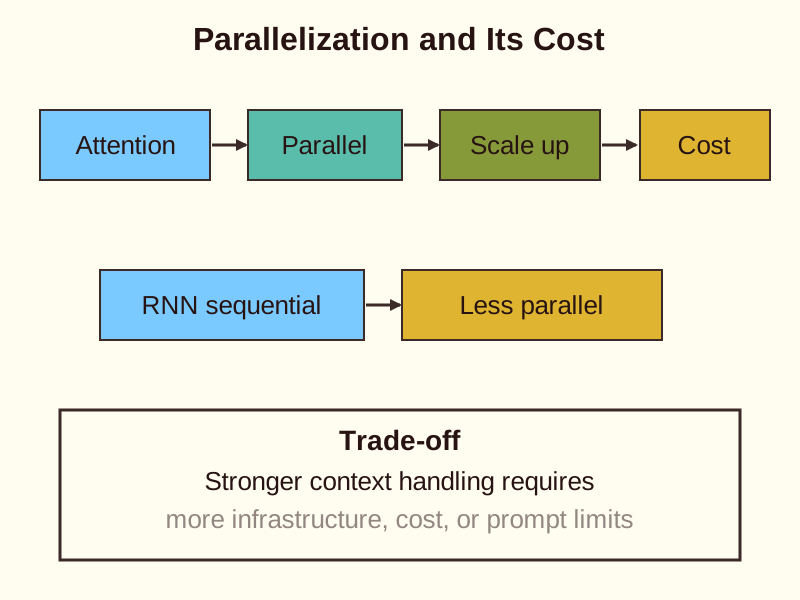
Self-attention examines sequence relationships simultaneously, which supports greater parallelization during training than strictly sequential processing.
This is a major architectural advantage over RNNs, whose step-by-step flow limits how much work can happen at once.
Parallelization can make large-scale training practical, especially when models contain substantial numbers of parameters.
The benefit comes with a cost. Transformers require significant computational resources compared with simpler machine learning models.
For product evaluation, ask what the architecture enables and what it demands.
A tool may offer stronger context handling while requiring more powerful infrastructure, higher costs, or careful limits on prompt size.
Evaluate The Core Engine
When judging an AI product, identify whether its capabilities come from a Transformer-based model and which architectural components it uses.
Look for evidence of strong context handling, especially across complex or long-form prompts.
Then consider the trade-off: the same architecture that supports rich relationships and parallel training also creates significant computational demands.
Remember the central mechanism. Self-attention dynamically weighs words against one another, instead of depending only on sequential processing.
That distinction helps explain the leap from earlier recurrent approaches to modern large language models.
Architecture does not determine product quality alone, but it reveals the tool's technical potential and operating costs.
- Identify: Check whether the product uses a Transformer-based model and which architectural components it uses.
- Inspect context: Look for evidence of strong context handling across complex or long-form prompts.
- Weigh trade-offs: Consider how rich relationships and parallel training relate to computational demands.
- Recall mechanism: Use dynamic self-attention rather than sequential processing as the central architectural distinction.
- Judge potential: Treat architecture as evidence of technical potential and operating costs, not as a complete measure of product quality.
Check yourself
Unlike RNNs, the self-attention mechanism processes words _____ to weigh relationships across the entire sequence.
- simultaneously
- step-by-step
Answer: simultaneously
Self-attention evaluates all sequence relationships simultaneously, whereas RNNs process words sequentially step by step.
Architectural processing styles differ in handling memory: _____ carry context through intermediate steps sequentially, whereas _____ examine the entire sequence directly through self-attention.
Answer: Architectural processing styles differ in handling memory: RNNs carry context through intermediate steps sequentially, whereas Transformers examine the entire sequence directly through self-attention.
RNNs rely on sequential step-by-step memory propagation where distant context can fade, while Transformers directly connect distant words across the entire sequence using self-attention.
When evaluating an AI product based on the Transformer architecture for long-form prompts, what key product trade-off should be expected?
- Enhanced context tracking across complex prompts in exchange for significantly higher computational and infrastructure costs.
- Lower infrastructure demands and operating costs combined with strict step-by-step sequential processing limits.
- Guaranteed 100% output accuracy across long prompts due to non-sequential memory retention.
- Reduced parameter requirements during training with equal attention assigned to every word in a sequence.
Answer: Enhanced context tracking across complex prompts in exchange for significantly higher computational and infrastructure costs.
Transformers support stronger context-handling and parallel training benefits, but they require significantly higher computational resources and infrastructure costs compared to simpler sequential models.
Keep going
This is lesson 1 of 5 in Evaluating LLMs for Product Decisions. Next up:
- Attention Mechanism
- Performance Metrics
- Cost Analysis
- Selection Strategy
Wondering turns any topic into short lessons you can read, watch, or listen to, with practice questions and an AI tutor.