Free sample lesson · Endovascular Surgical Robotics GTM
Drive Systems
How do robotic arms manipulate delicate micro-catheters with sub-millimeter precision?
Lesson 1 of the Wondering course Endovascular Surgical Robotics GTM
The Mechanical Engine
Every robotic endovascular procedure starts with a physician sitting at a console, away from the table.
The drive system is the hardware that turns those console inputs into real movement inside the vessel.
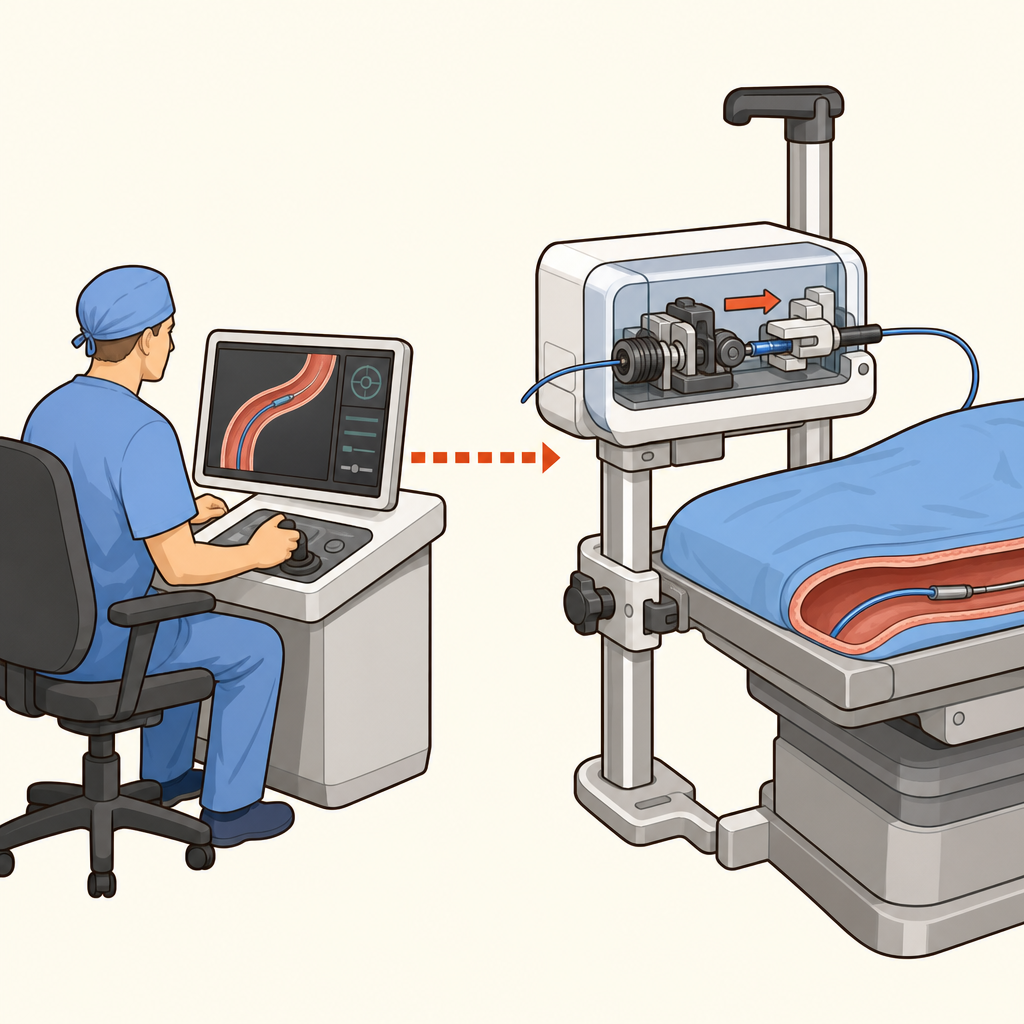
The bedside drive system cardiologists will ask about
Think of it as the mechanical engine of the platform. The physician decides; the drive system executes.
For a sales conversation, this is the part cardiologists will point at and ask about first.
From Input To Movement
The conversion happens in stages, and each stage matters technically.
The physician moves a control at the console. That input becomes a digital signal.
Electromechanical actuators then translate the signal into torque, and the motors grip and move the device inside the vessel.
- Console input: The physician moves a control at the console, away from the table.
- Digital signal: That physical input becomes a digital signal.
- Actuator torque: Electromechanical actuators translate the signal into torque.
- Device motion: Motors grip and move the device inside the vessel.
No step is skipped. That is why the movement is repeatable rather than approximate.
Two Axes Of Control
Drive systems control devices along two distinct axes.
Longitudinal advancement pushes and pulls the device forward and back, with sub-millimeter resolution.
Rotational torque spins the device through a full 360 degrees.
- Longitudinal
- Rotational
Together these two motions reproduce what a physician's hands do manually, but with consistent, measurable output.
Solving Stick-Slip
In manual procedures, a guidewire often binds against the vessel wall, then releases suddenly.
This is the stick-slip phenomenon. Tension builds, then the device jumps forward further than intended.
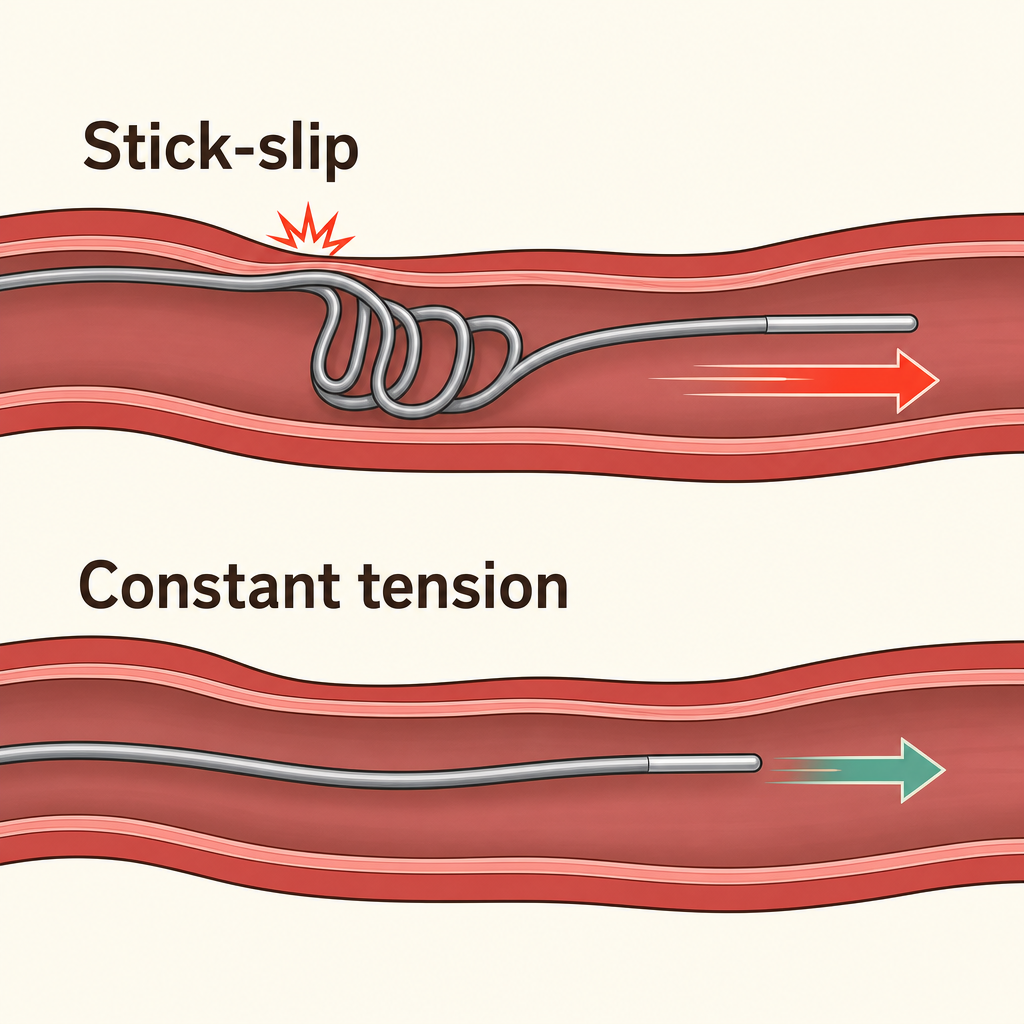
Notice how the manually advanced wire binds against the vessel wall and then overshoots, while the robotically driven wire moves the same distance evenly.
Robotic drive systems significantly reduce stick-slip because the motors maintain constant tension instead of pulsing pressure by hand.
This is one of the cleanest technical stories you can tell a cardiologist.
Works With Standard Devices
A frequent misconception is that robotic systems demand proprietary consumables.
They do not. These drive systems manipulate standard off-the-shelf catheters, guidewires, and stents.
- Off-the-shelf devices: No proprietary consumables are required.
- Catheters: Standard catheters are loaded into the drive system.
- Guidewires: Standard guidewires are advanced and rotated.
- Stents: Standard stents are delivered to the target site.
That matters commercially. The hospital keeps its existing inventory and physician preferences intact.
Correct this misconception early and the conversation shifts from cost risk to clinical value.
Difficult Anatomy
Automation matters most where hands struggle.
The aortic arch demands sharp directional change. Distal coronary arteries are narrow and far from the access point.
In both, manual control degrades as the operator fights friction and distance.
Consistent device delivery in these complex anatomical structures is the argument that lands with interventional cardiologists.
Feedback And Tension
Two specifications deserve special attention in a technical discussion.
Constant tension means the system holds steady force on the device rather than letting it slacken and grab.
Haptic feedback returns a sense of resistance to the physician at the console, so touch is not lost at a distance.
- Constant tension
- Haptic feedback
Both are hardware capabilities, and both translate directly into clinical claims.
Hospital Integration
Technical elegance fails if the system disrupts the lab workflow.
The drive system is typically mounted on a bedside rail, so it fits the existing table rather than replacing it.
It is designed for rapid setup and sterile draping, which protects turnaround time between cases.
- Mounting
- Bedside rail mounted: Fits the existing procedure table rather than replacing it.
- Rapid setup: Protects turnaround time between cases.
- Sterile draping: Designed into the system rather than improvised.
Staff and administrators raise these before torque specifications.
Staff and administrators will ask about this before they ask about torque.
From Specification To Value
Your job is to connect each hardware fact to a benefit someone actually buys.
Sub-millimeter control and reduced stick-slip become enhanced procedural predictability for hospital administration.
Console-based operation becomes reduced radiation exposure for the physician.
Never quote a specification without naming the audience it serves.
Putting It Together
The drive system converts digital inputs into physical movement through high-torque motors.
It delivers sub-millimeter advancement and 360-degree rotation using standard devices, mounted on a bedside rail.
Constant tension reduces stick-slip; haptic feedback keeps the physician connected.
- High-torque motors: They convert digital inputs into physical movement.
- Sub-millimeter precision: Advancement plus 360-degree rotation.
- Constant tension: Held steady force on the device.
- Stick-slip: The binding and jumping seen in manual work.
- Haptic feedback: Keeps the physician connected at the console.
- Bedside rail: Where the system is mounted.
- Standard devices: Off-the-shelf catheters, guidewires, and stents.
Hold these four ideas together and technical questions from cardiologists become opportunities rather than obstacles.
Check yourself
True or false: A drive system converts physician console inputs into physical movement inside the vessel.
- True
- False
Answer: True
True. The drive system is the mechanical hardware that executes console commands by moving the device inside the vessel.
In a drive system, _____ moves a device forward or backward, while _____ spins it through 360 degrees.
Answer: In a drive system, longitudinal advancement moves a device forward or backward, while rotational torque spins it through 360 degrees.
Longitudinal advancement controls forward and backward movement. Rotational torque controls spinning around the device axis.
A cardiologist asks how a robotic drive system can reduce sudden guidewire jumps. Which explanation is most accurate?
- The motors maintain constant tension on the device
- The system replaces the guidewire with a proprietary device
- The console removes the need for rotational control
- The bedside rail eliminates vessel-wall friction
Answer: The motors maintain constant tension on the device
Constant motor tension reduces stick-slip by keeping force steady instead of allowing tension to build and release suddenly.
Keep going
This is lesson 1 of 8 in Endovascular Surgical Robotics GTM. Next up:
- Navigation Sensors
- Radiation Protection
- Patient Outcomes
- Cath Workflow
- Economic Value
Wondering turns any topic into short lessons you can read, watch, or listen to, with practice questions and an AI tutor.