Free sample lesson · Durable Distributed AI Agent Systems
Crash Timelines
What happens when your worker process dies mid-execution right between saving state and triggering an external side effect?
Lesson 1 of the Wondering course Durable Distributed AI Agent Systems
The Crash Timeline Window
Every distributed worker has a dangerous gap: the interval between a local state change and a remote side effect.
In an agent, that means committing a task progress row, then calling an LLM API or a payment gateway.
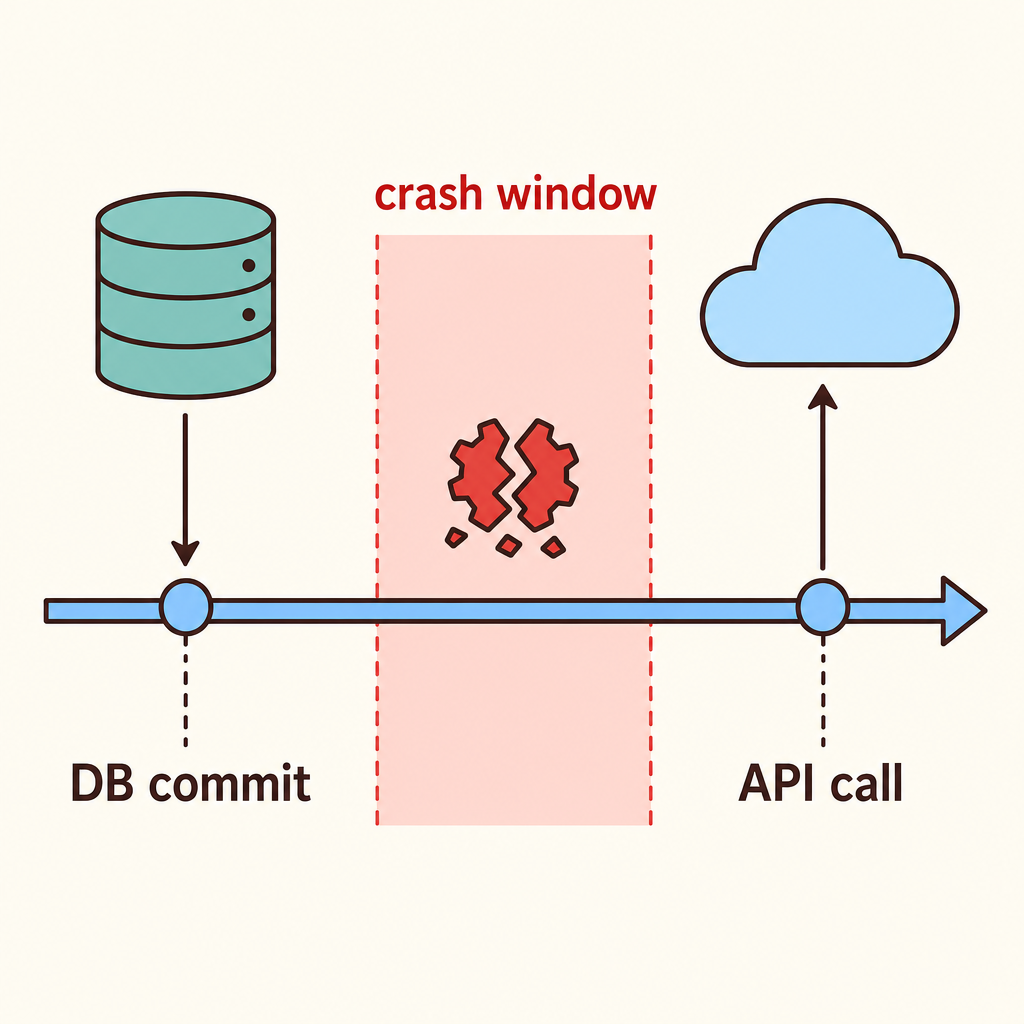
Notice that the vulnerable region is the space between the local commit and the remote call, not either operation itself.
The crash timeline is the ordering of those two operations relative to process death.
Pinpointing where the process died tells you exactly which recovery is safe.
Two Failure Orderings
There are only two orderings, and each fails differently.
Commit first, crash before the network call: local state claims progress that never happened remotely. The system enters a divergent state.
Call first, crash before the commit: the side effect already landed, and the retry replays it. You get a duplicate side effect.
- Commit first
- Call first
Neither ordering is safe on its own.
Why Dual Writes Diverge
The root cause is a dual write: two independent systems, no shared transaction.
Your database commit and the payment gateway call cannot be wrapped in one atomic boundary. There is no rollback for a charge that already cleared.
So the fix is not stronger locking. It is coupling state persistence and side-effect triggering as a single logical unit.
- Database commit: The local state change recording task progress.
- Remote side effect: An LLM API call or a payment gateway charge.
- Divergent state: Local progress recorded while the remote effect never happened.
- Duplicate effect: A retry replays a side effect that already landed.
- Atomic transition: State persistence and side-effect trigger treated as one logical unit.
That coupling is what atomic state transitions mean in an agent workflow.
Locating The Commit Point
Every crash question reduces to one thing: where is the explicit commit point?
Before the effect, after the effect, or captured in a log that survives the process?
- Worker resumes
- Commit recorded?: Check whether the local state change survived the crash.
- Trigger side effect: Call the LLM API or payment gateway.
- Replay step: Retry from the last durable point, risking a duplicate effect.
- Continue chain
- re-check
Making that point explicit turns an unbounded set of failure stories into a small, decidable set.
Event-Sourced History
Durable execution frameworks close the gap with an event-sourced history or a transaction log.
Each completed step is appended before the next one runs. On restart, the runtime replays that log instead of guessing.
Recovery restores the instruction pointer and local variables exactly where they left off.
- Append event: Each completed step is recorded in the transaction log before the next runs.
- Crash: The worker process dies at some point in the timeline.
- Replay history: The runtime reads the event-sourced history instead of guessing what happened.
- Restore frame: The instruction pointer and local variables return to their recorded values.
- Resume: Execution continues from exactly where it left off.
The side effect is no longer a bet against process lifetime.
Runtime Over Retry Loops
For Python and Rust engineers, this is a shift in who owns durability.
Manual try/except retry loops encode recovery in application code, and they only remember what you thought to persist.
Durable execution moves persistence of the call stack into the runtime.
- Manual retry loops
- Durable execution
The difference is not effort. It is whether recovery survives a process that no longer exists.
Idempotent Recovery
Knowing the exact moment of failure is what makes recovery idempotent.
If the log says the payment call completed, the retry skips it instead of charging twice. If the log stops before it, the call runs once.
Retries stay safe because replay is decided by durable history, not by a hopeful guess about what already happened.
The Stakes For Agents
Agents raise the cost of getting this wrong.
A double-spend against a payment gateway is unrecoverable. A lost reasoning chain wastes a long-running sequence of LLM calls that must be rebuilt from nothing.
- Duplicate effects
- Double-spend at the payment gateway: A cleared charge cannot be rolled back.
- Repeated LLM API calls: The same step executes twice after a replay.
- Lost progress
- Divergent task state: The record claims progress the remote system never made.
- Broken reasoning chain: A long-running sequence must be rebuilt from nothing.
Longer runs spend more time inside the crash window.
Long-running work spends more wall-clock time inside the crash window, so infrastructure instability is a matter of when, not if.
Design Checklist
Reduce this to habits you can apply on the next service you write.
Name the commit point for every step that touches an external system. Assume the process dies immediately after it.
Then ask what replay does. If replay cannot decide, the step is not yet durable.
Check yourself
The crash timeline is the interval between a local state change and a remote side effect.
- True
- False
Answer: True
Correct. It covers the dangerous gap in which a process may die between updating local state and triggering an external action.
If a worker commits progress before calling a payment gateway, a crash can leave a _____; if it calls the gateway before committing, a retry can cause a _____.
Answer: If a worker commits progress before calling a payment gateway, a crash can leave a divergent state; if it calls the gateway before committing, a retry can cause a duplicate side effect.
A commit-before-call crash records progress that never occurred remotely, producing divergence. A call-before-commit crash may repeat an already completed external action.
Why can a database commit and a payment gateway call not normally be made one atomic transaction?
- The systems have no shared transaction boundary or common rollback
- Database locks are always released before payment requests finish
- Payment gateways cannot receive requests from worker processes
- Distributed workers cannot store progress in databases
Answer: The systems have no shared transaction boundary or common rollback
They are independent systems without a shared transaction boundary. A database rollback cannot undo a payment that has already cleared, so stronger database locking does not solve the dual-write gap.
Keep going
This is lesson 1 of 14 in Durable Distributed AI Agent Systems. Next up:
- Transactional Outbox
- Idempotency Boundaries
- Event Replay
- Database Coordination
- Distributed Locks
Wondering turns any topic into short lessons you can read, watch, or listen to, with practice questions and an AI tutor.