Free sample lesson · Developmental Psychology From Scratch
What's Development?
How can you be the same person at 5 and at 80 but also completely different?
Lesson 1 of the Wondering course Developmental Psychology From Scratch
Is Mia still the same person?
Imagine a woman named Mia. Picture her at age 5, then again at age 80.
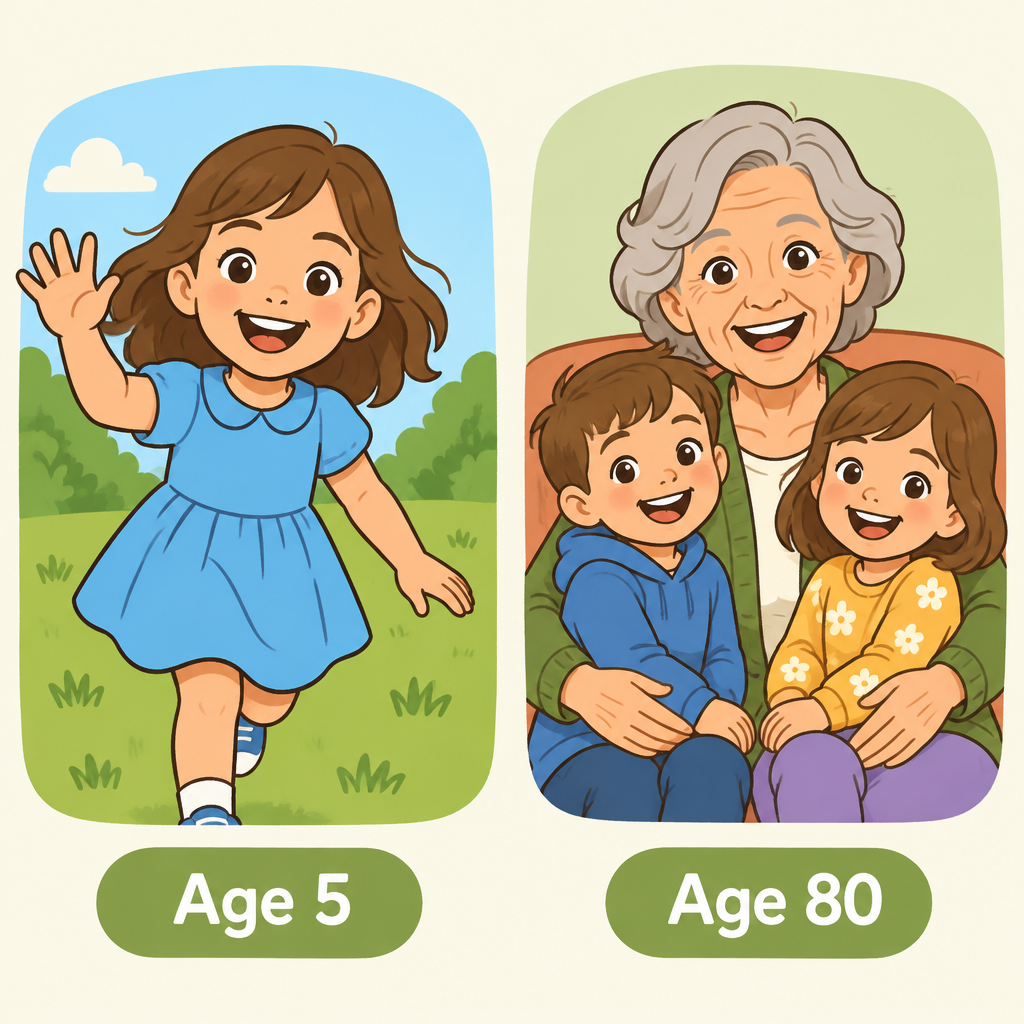
Notice the same cheerful, outgoing expression on both sides, even though her body and her place in the family look very different.
At 5 she is learning words and running everywhere. At 80 she has grandchildren, an aging body and a lifetime of memories.
Her family is split. Some say she is still the same Mia. Others say she is someone completely different.
Who is right depends on what counts as development.
So what do most people think development means?
Does development stop at adulthood?
Many people think development means growing up and getting better. Once you are an adult, it stops, and later life is just decline.
That belief seems right because childhood is the most visible stretch of growth. Kids change fast, so it looks like the whole story.
But Mia breaks it. Between 5 and 80 she gains skills, loses some physical abilities and keeps her outgoing temperament.
- Common belief
- Better model
Development runs from womb to tomb, and it includes losses and stable traits as well as gains.
So how do psychologists actually define development?
Development means orderly, lasting change
Developmental psychology studies systematic changes and continuities in a person from conception to death.
Systematic means orderly, patterned and relatively enduring. A passing bad mood is not development. A lasting shift in how you think is.
- Development: Conception to death
- Gains: New abilities appear.
- Losses: Some abilities decline.
- Neutral changes: Different, neither better nor worse.
- Continuities: Some things stay the same.
The definition covers four kinds of outcome: gains, losses, neutral changes and continuities.
Staying the same counts as development too, because continuities are part of the definition.
But where in a person do these changes and continuities happen?
Every change fits one of three domains
Psychologists sort development into three broad domains.
Physical covers the body: growth of organs, brain development, motor changes and signs of aging.
Cognitive covers mental processes: perception, language, learning, memory and problem solving.
Psychosocial covers personal and interpersonal life: motives, emotions, personality traits, relationships and roles in family and society.
- Physical
- Cognitive
- Psychosocial
Body, mind and relationships: every developmental change you study fits one of these three.
So what happens when we sort Mia's life into them?
Mia changed and stayed the same
Suppose we compare Mia at 5 and at 80, domain by domain.
Physical: her body and organs have aged. Compared with her childhood growth, that is a loss.
Cognitive: she has gained language, memory skills and problem-solving ability she did not have at 5.
Psychosocial: her roles shifted from child to parent to grandparent. But suppose her outgoing temperament stayed stable, which is a continuity.
One person can show gains, losses and continuities at the same time.
So why do psychologists bother studying all this?
Psychologists describe, explain and optimize
Baltes, Reese and Lipsitt (1980) named three goals for studying development.
First, describe typical behavior and inner processes, plus how individuals differ.
Next, explain why humans develop as they do and why people differ.
Then optimize development by applying research in practice, such as evidence-based interventions.
- Describe: Record typical behavior, inner processes and individual differences.
- Explain: Find out why humans develop as they do and why people differ.
- Optimize: Apply research in practice through evidence-based interventions.
Describing comes first, because you cannot explain or improve what you have not observed.
Now we can go back to Mia's family.
Mia is both, and that is development
So, is Mia the same person at 5 and at 80, or completely different?
Both. Her body aged, her mind gained skills and her roles changed. Her outgoing temperament stayed steady through it all.
Development runs from womb to tomb and includes gains, losses, neutral changes and continuities in body, mind and relationships.
When you meet any later topic, ask two things: which domain is this, and is it a gain, a loss, a neutral change or a continuity?
Check yourself
A student says: "A 75-year-old's memory getting slower is just decline, not development." In developmental psychology, this lasting change in memory _____
- counts as development, because development includes losses
- does not count as development, because development means getting better
Answer: counts as development, because development includes losses
Development runs from womb to tomb. It includes losses as well as gains, so a lasting decline in later life still counts. The idea that development is only growing up and getting better is a common misconception.
Complete the diagram showing what developmental patterns include across the lifespan.
Answer: Losses, Continuities
Development is not just growth; it includes orderly gains, losses, neutral changes, and continuities from conception to death.
Development happens across three domains. A toddler taking first steps is a _____ change. The same toddler learning new words is a _____ change. The toddler forming a close bond with a parent is a _____ change.
Answer: Development happens across three domains. A toddler taking first steps is a physical change. The same toddler learning new words is a cognitive change. The toddler forming a close bond with a parent is a psychosocial change.
Walking is a motor change of the body, so it is physical. Language is a mental process, so it is cognitive. Relationships and emotions are personal and social, so they are psychosocial.
Keep going
This is lesson 1 of 15 in Developmental Psychology From Scratch. Next up:
- Big Debates
- Life Contexts
- Study Methods
- Age Designs
- Freud
Wondering turns any topic into short lessons you can read, watch, or listen to, with practice questions and an AI tutor.