Free sample lesson · Designing High-Value SaaS Experiences
Human States
Why does a payroll admin crave certainty rather than delight on Monday morning?
Lesson 1 of the Wondering course Designing High-Value SaaS Experiences
Monday Morning, 9 AM
A payroll administrator opens Payworks with a deadline in hours.
Employee trust, compliance exposure, and personal accountability all sit on her shoulders. What she wants is certainty, not delight.
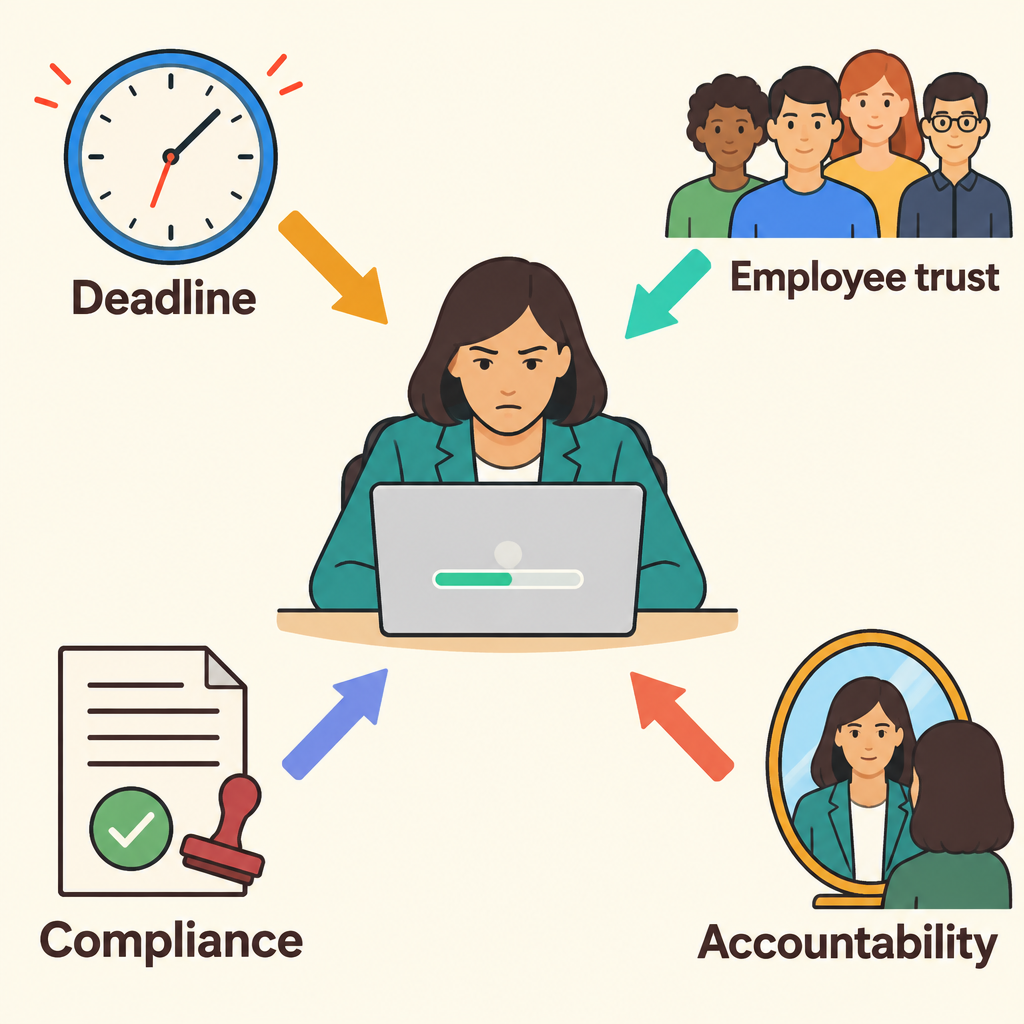
Notice that the pressures pushing on this moment are human conditions, not screen features.
Human states describe the conditions a person brings to an interaction: confidence, stress, urgency, focus, uncertainty, responsibility.
Design for that state, and the experience feels valuable. Ignore it, and even a polished screen feels wrong.
States Are Not Attributes
This is the distinction most teams blur.
System attributes live in the product: speed, reliability, usability. Human states live in the person: urgency, anxiety, accountability, confidence.
A system can be fast and reliable while the administrator still feels exposed.
- System attributes
- Human states
Attributes are what you build. States are what you are building for.
What Support Looks Like
Once you name the state, the design response gets specific.
For an administrator mid payroll run, clarity, confirmation, recoverability, and visible progress matter more than novelty or visual delight.
That is a different brief from "make it satisfying".
Appropriate support beats generic satisfaction, because the state defines what good feels like.
High-Value Journey Moments
States are not evenly distributed across a journey.
They spike at consequential moments: approving a run, handling an exception, verifying a critical outcome.
Those spikes are where experience quality is decided.
- Preparing: Focus and urgency build as the deadline approaches.
- Approving: Ambiguity is most costly, so clarity must reduce it.
- Exception: Confidence is at risk and must be preserved.
- Verifying: Accountability peaks, so the outcome must be easy to check.
So target evaluation effort there rather than spreading it thinly across every screen.
From State To Signal
For an Experience Quality System, a named state is only the starting point.
Turn it into something observable. Uncertainty during approval becomes a measurable pattern: repeated checks, hesitation, support contact.
Preserved confidence after an exception becomes a pattern too: does the person continue, or abandon and escalate?
- Consequential moment: A high-value point such as approval or an exception.
- Name the state: Urgency, uncertainty, accountability, or confidence.
- Observable?: Can this state show up as a pattern in behaviour?
- Define signal: For example repeated checks or abandonment after an exception.
- Business hypothesis: A defensible claim about appropriate support.
- Rename state
The state gives the hypothesis. The signal gives the evidence.
The Delight Trap
Delight is not wrong. It is state-dependent.
The same animation that feels warm during onboarding can feel careless while $2M of payroll is being approved.
So when a stakeholder asks for more delight, ask which state the user is in at that moment.
That question turns a taste argument into a design decision.
Putting It To Work
Three moves you can run this week.
Name the state at your highest-value moments, in the user's own words. Choose the support quality that state demands: clarity, confirmation, recoverability, or visible progress.
Define one signal per state so the claim becomes testable.
- Defensible hypothesis: A claim about appropriate support that evidence can test.
- One signal per state: An observable pattern that makes the state measurable.
- Support quality chosen: Clarity, confirmation, recoverability, or visible progress.
- State named: The condition the person brings to a consequential moment.
Each level rests on the one below
Then experience quality stops being taste and becomes appropriate support you can defend.
Check yourself
A payroll administrator feels accountable for an approval. Is accountability a human state or a system attribute?
- Human state
- System attribute
Answer: Human state
Accountability is a condition the person brings to the interaction. Speed and reliability are attributes of the product.
In experience evaluation, a _____ names what a person is experiencing. A _____ is an observable pattern, such as repeated checks before approval.
Answer: In experience evaluation, a state names what a person is experiencing. A signal is an observable pattern, such as repeated checks before approval.
Naming uncertainty proposes what the user may be experiencing; repeated checks provide observable evidence to investigate.
A Payworks administrator must approve payroll within hours and wants certainty. Which design response best supports her?
- Show clear status, confirm approval, and offer a way to recover
- Add a celebratory animation to make approval feel rewarding
- Refresh the visual style to make the screen feel more polished
- Shorten the approval screen by hiding outcome details
Answer: Show clear status, confirm approval, and offer a way to recover
Clear status, confirmation, and a way to recover directly support urgency and responsibility. Novelty does not resolve uncertainty about a consequential approval.
Keep going
This is lesson 1 of 27 in Designing High-Value SaaS Experiences. Next up:
- Quality Spectrum
- Volume Dials
- Policy Friction
- Design Principles
- Framework Synthesis
Wondering turns any topic into short lessons you can read, watch, or listen to, with practice questions and an AI tutor.