Free sample lesson · Design LeetCode: A System Design Interview Breakdown
Functional and Non-Functional Requirements
Lesson 1 of the Wondering course Design LeetCode: A System Design Interview Breakdown
Two Kinds of Requirements
Before you draw a single box in a system design interview, you pin down what you are building.
Functional requirements describe what the system does. They are features a user can see and use.
Non-functional requirements (NFRs) describe how well it must do those things: speed, safety, uptime, and scale.
- Functional
- Non-functional
Throughout this lesson, we use a coding competition platform as the running example.
The Four Core Features
Our platform has exactly four functional requirements.
Users can view a list of problems, then open a problem and code it in one of several languages.
They can submit their code and get instant feedback on whether it works.
During a competition, they can view a live leaderboard showing who is ahead.
- Browse problems: View the list of problems.
- Write code: Open a problem and code it in one of several languages.
- Submit: Submit the code and get instant feedback.
- Check leaderboard: View the live competition leaderboard.
Notice that each one starts with a user action. That is a quick test for a functional requirement.
Say What You Will Not Build
Stating scope also means naming what is out of scope.
For this platform, we skip authentication, user profiles, payments, analytics, and social features.
- Coding platform
- In scope
- View problem lists
- Code in many languages
- Submit, get feedback
- Live leaderboards
- Out of scope
- Auth and profiles
- Payments
- Analytics
- Social features
These are real features. They are simply not the heart of this problem, and any one of them could eat an entire interview.
Saying this out loud shows focus and lets the interviewer object early if they disagree.
Availability Over Consistency
The first NFR is a trade-off: the platform favors availability over consistency.
Availability means the system keeps responding. Consistency means every user sees the exact same, latest data at the same moment.
During a competition, a leaderboard that lags a few seconds is annoying. A platform that goes down is a disaster.
So when the two conflict, we keep the site up.
Run Untrusted Code Safely
The second NFR is secure, isolated execution.
Every submission is code written by a stranger. It could be buggy, slow, or deliberately harmful.
Isolation means each submission runs in its own sealed environment, often called a sandbox.
If one program crashes or misbehaves, it cannot touch the servers, the database, or other users' code.
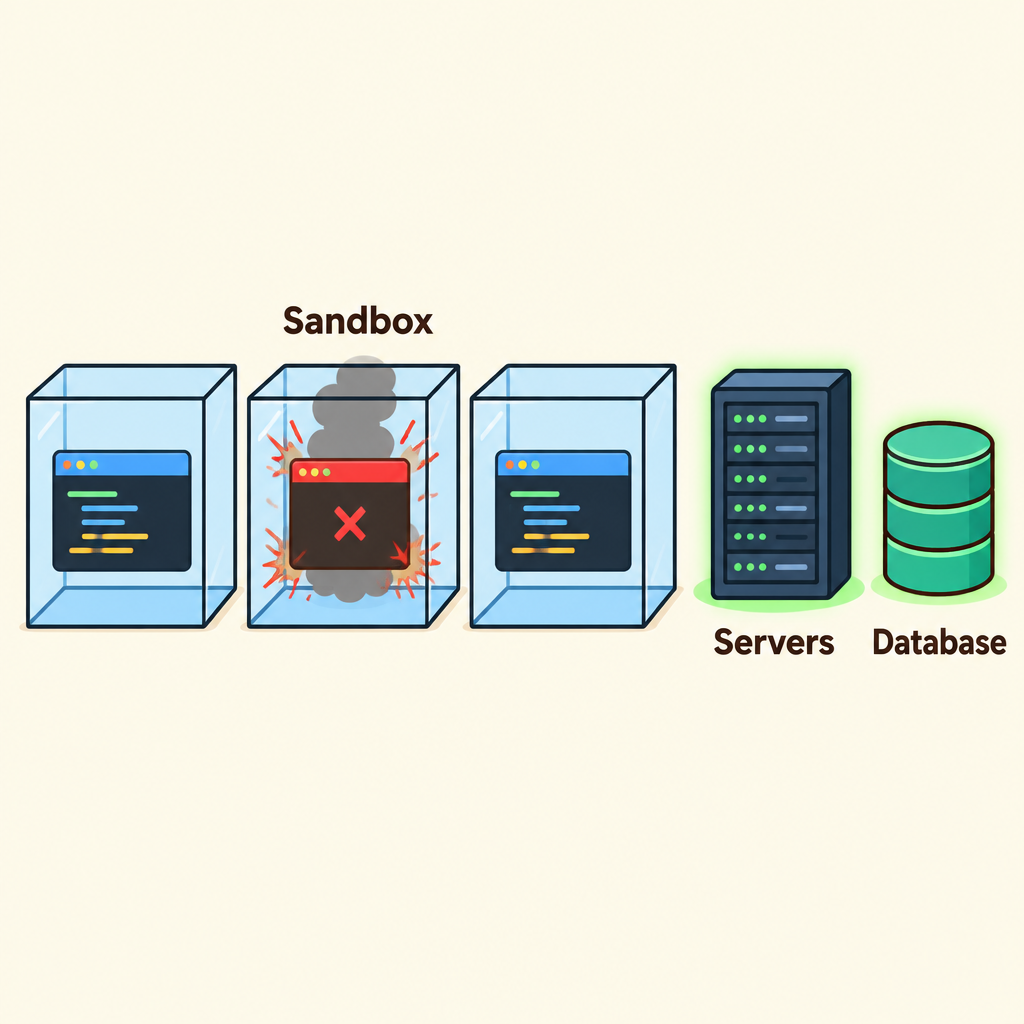
Notice that the misbehaving program stays trapped inside its own box, so the servers, the database, and other submissions are untouched.
Put Numbers on Speed and Scale
Good NFRs are measurable. Our last two have hard numbers.
Submission results within 5 seconds. This is an SLA, a promise about response time, and it is what makes feedback feel instant.
Scale to 100,000 concurrent users in a competition. They all hit the system at the same time, not spread across a day.
- Submission result SLA: What makes feedback feel instant.
- Concurrent competition users: All hitting the system at the same time.
Numbers like these give you something concrete to design against.
Why Scope Comes First
Interviewers expect you to state scope and NFRs before any architecture.
Design choices only make sense against requirements. A 5-second SLA and 100,000 concurrent users shape the design more than any single feature.
- Architecture: Only makes sense against the requirements below.
- Non-functional needs: Availability, isolation, 5-second SLA, 100,000 users.
- Functional scope: Four features in, everything else named as out.
Each level rests on the one below.
Skipping this step risks building the wrong thing or solving problems nobody asked about.
Your move: list the features, name what is out, state NFRs with numbers, then design.
Check yourself
For a coding competition platform, "Users can view a live leaderboard during a competition" is a _____ requirement.
- functional
- non-functional
Answer: functional
It describes a feature the user can see and use, and it starts with a user action. That makes it functional. Non-functional requirements describe how well the system performs, such as speed, safety, uptime, and scale.
In a system design interview, first list the _____, then name what is _____, then state _____ with numbers, and finally _____ the architecture.
Answer: In a system design interview, first list the features, then name what is out of scope, then state NFRs with numbers, and finally design the architecture.
The recommended order is: features → out of scope → measurable NFRs → design. Design choices only make sense when they are measured against requirements. That is why architecture comes last.
Which of the following is a non-functional requirement for a coding competition platform?
- Submission results are returned within 5 seconds
- Users can submit code and get feedback
- Users can open a problem and code it
- Users can view a list of problems
Answer: Submission results are returned within 5 seconds
Returning submission results within 5 seconds describes how well the system performs. It is a measurable response-time promise (an SLA), so it is non-functional. The other three options are user-facing features that begin with a user action, so they are functional.
Keep going
This is lesson 1 of 13 in Design LeetCode: A System Design Interview Breakdown. Next up:
- Core Entities and API Design
- Why Direct Execution, VMs, and Serverless All Fall Short
- Docker Containers as the Isolation Layer
- Universal Test Case Serialization Across Languages
- Why Synchronous Submission Handling Breaks Under Load
Wondering turns any topic into short lessons you can read, watch, or listen to, with practice questions and an AI tutor.