Free sample lesson · Deep Learning Systems at Scale
Data Becomes a Product Primitive
Why did YouTube frames make hand-written vision rules impossible?
Lesson 1 of the Wondering course Deep Learning Systems at Scale
What You Will Learn
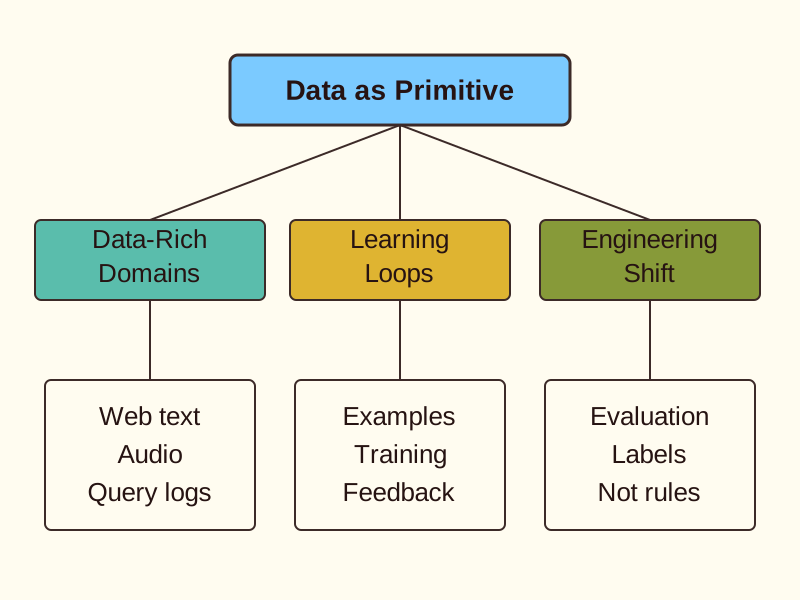
Treating data as a product primitive changes the builder's job from coding every rule to designing learning loops, labels, feedback, and evaluation.
When Rules Fail at Scale
Traditional engineering relies on writing explicit rules. This approach breaks when faced with the massive variation of the real world.
Consider YouTube frames. No human can write enough code to describe every possible visual pattern in millions of videos.
- Traditional Rules
- Learned Behavior
In data-rich domains, we stop coding specific behaviors. Instead, we design systems that learn from examples.
The Power of Data Primitives
Data is not just storage. It is a product primitive that dictates your implementation strategy.
Large-scale sources provide the necessary patterns for deep learning. Examples include web-scale text, audio from speech queries, and user activity logs.
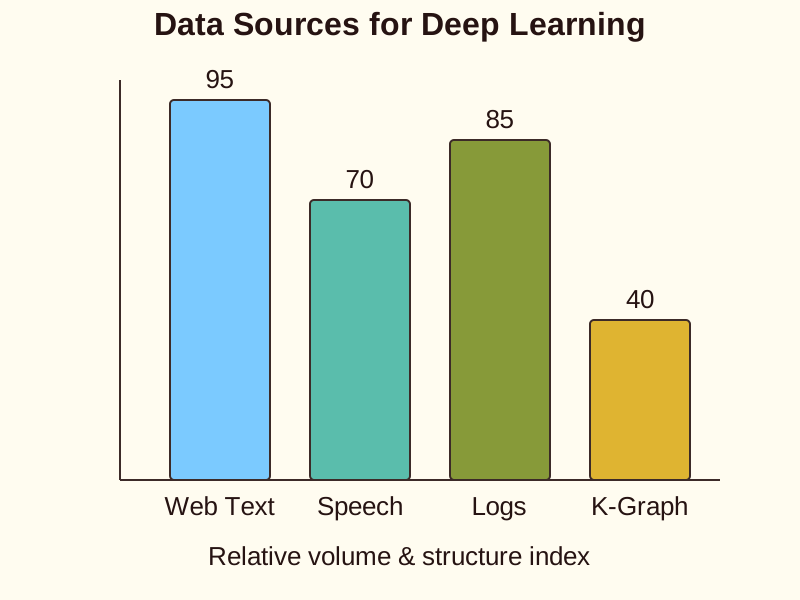
Google Brain systems utilize diverse sources. For instance, the Knowledge Graph contains structured facts like Mozart was born in Austria.
Designing the Learning Loop
A successful ML system is a continuous loop. It connects examples, targets, training, and deployment.
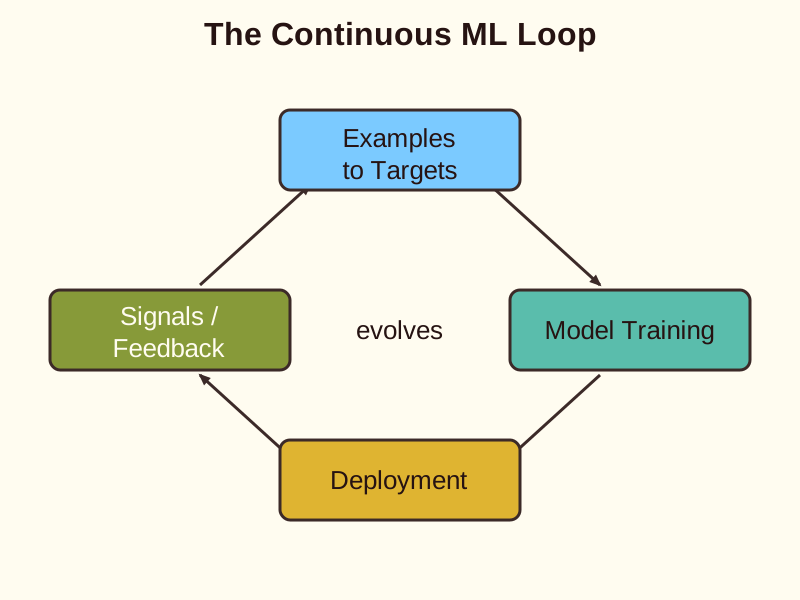
Product signals often serve as feedback. Speech queries help improve recognition systems when the product captures enough signal to evaluate predictions.
Do not view a model as a finished artifact. It is a component that evolves as new data flows through the loop.
The Engineering Shift
Your job changes from writing logic to defining targets and filters. Raw volume does not solve problems alone.
- Define Targets: Shift focus from writing rigid logic to specifying training targets.
- Design Filters: Curate raw volume to ensure high-quality supervision.
- Build Evaluation: Establish rigorous testing to decide if a model is ready to ship.
- Pretraining moved the bottleneck to evaluation
Success requires identifying which product behaviors can be learned from existing feedback.
Quality Over Quantity
Teams often mistake raw data volume for usable supervision. High volume does not guarantee high quality.
Small or high-stakes domains may not benefit from scale immediately. You must solve data quality and evaluation first.
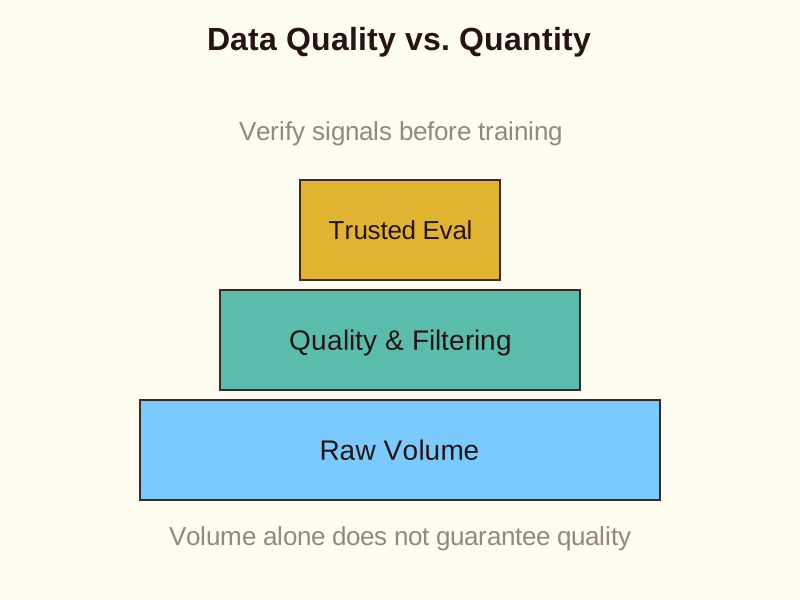
Always verify if a product signal is a reliable training target before trusting it in your learning loop.
Putting It All Together
- Capture Feedbacks: Identify product signals and interaction logs from live usage.
- Filter & Target: Transform raw data into a reliable training target.
- Evaluate & Deploy: Ship the retrained model through a continuous evaluation pipeline.
Check yourself
In data-rich domains, builders shift from writing explicit rules to designing _____.
- learning loops
- hard-coded logic
Answer: learning loops
When variation is too high for manual rules (like YouTube imagery), systems must learn patterns from data examples instead.
A production learning loop follows a specific sequence: first identify _____, then define _____, and finally use product usage as _____.
Answer: A production learning loop follows a specific sequence: first identify examples, then define targets, and finally use product usage as feedback.
The loop connects raw data (examples) to specific goals (targets) and uses real-world results (feedback) to improve the model.
Why is 'raw data volume' often insufficient for building a successful ML product?
- Models require careful filtering and target definition to learn effectively.
- Deep learning models perform worse as the dataset size increases.
- Data-rich domains do not support learned behaviors.
- Storage costs always outweigh the benefits of large datasets.
Answer: Models require careful filtering and target definition to learn effectively.
Large amounts of data are only useful if they are filtered and paired with clear targets that the model can actually learn from.
Keep going
This is lesson 1 of 10 in Deep Learning Systems at Scale. Next up:
- Neural Networks Learn Abstractions
- Frameworks Hide Distributed Messiness
- Parallelism Buys Experiment Time
- Asynchrony Creates New Failure Modes
- Speech Shows Production Leverage
Wondering turns any topic into short lessons you can read, watch, or listen to, with practice questions and an AI tutor.