Free sample lesson · Deconstructing Secret History and Power
Power Rules
Who actually pulls the strings when empires rise and fall?
Lesson 1 of the Wondering course Deconstructing Secret History and Power
Power Is More Than a Throne
When an empire rises or falls, we tend to look at the person at the top.
The Predictive History series Secret History opens with a lesson called "How Power Works." Its framing is wider: power is a pattern, not only a ruler's authority.
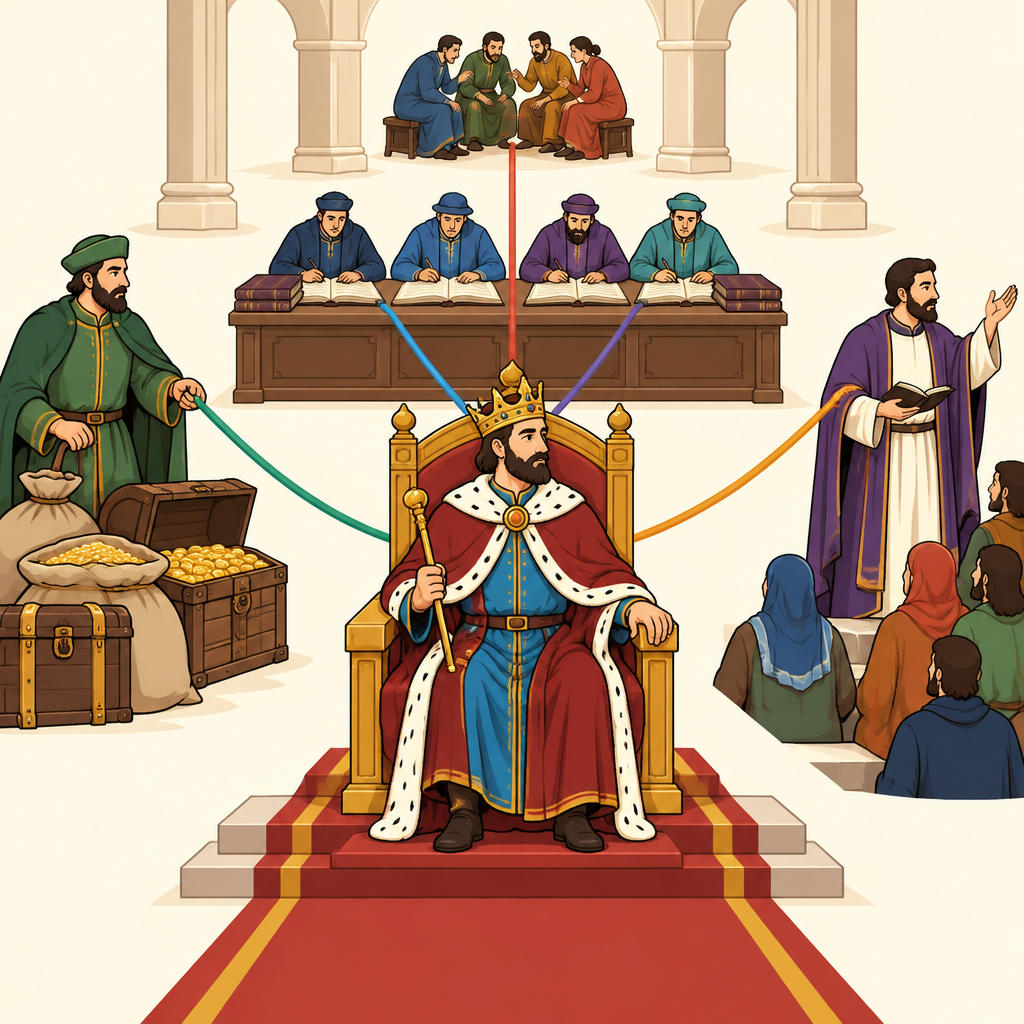
Notice how the ruler sits at the center, but treasurers, officials, a preacher, and an organized group around him each hold something he depends on.
That pattern runs through institutions, social ranks, shared beliefs, and organized systems.
Note: we only have the series description and episode titles here, so treat this lesson as a working framework, not a summary of every episode.
The Four Levers of Power
Power comes from controlling four things.
Resources: money, land, food, and capital. Institutions: lasting organizations with rules, like courts, armies, and offices.
Information: what people know and believe. Organization: the ability to get many people acting together.
- Power
- Resources: Money, land, food, and capital.
- Institutions: Lasting organizations with rules.
- Information: What people know and believe.
- Organization: Getting many people acting together.
A ruler who loses grip on these levers keeps the title but loses the power.
Ask of any situation: who holds each lever?
Resources: Who Pays Whom
Whoever controls wealth can reward people who help them.
Soldiers, officials, and allies all need paying. Control of land, grain, or capital lets someone buy loyalty and protection.
That loyalty then protects the wealth, which buys more loyalty. Power can feed itself in a loop.
- Control resources: Land, grain, or capital.
- Reward supporters: Pay soldiers, officials, and allies.
- Loyalty protects wealth: Supporters defend the source of money.
- Wealth buys more loyalty: If the money stops, the loop breaks.
The loop also runs backward. When the money stops, support can melt away fast.
Institutions Outlast Rulers
Kings die. Institutions keep going.
An institution is an organization with fixed rules, like a bureaucracy, a church, or an army. It decides who rises and who stays below.
The series names three ways these systems pick leaders: gerontocracy (rule by the old), meritocracy (rule by those judged most able), and bureaucracy (rule through offices and paperwork).
- Gerontocracy
- Meritocracy
- Bureaucracy
Each episode title begins with "Death by," hinting that every system can also drag a society down.
Information and Belief
Force is expensive. Belief is cheap and lasting.
The series links power to religion, imagination, and cultural beliefs. Whoever shapes what people think is true can guide them without a single soldier.
Information matters too. Those who control records, news, or knowledge decide what others can even notice.
People often obey because they believe the order is right or normal.
The Power of Organizing
Numbers alone do not win.
A small group that plans, shares information, and acts together can steer a much larger crowd that cannot coordinate.
- Small organized group
- Larger crowd
This is why the series focuses on secret societies. It describes them as groups that came to dominate the world, a claim the series argues rather than proves here.
The general point holds: organization multiplies every other lever.
Using the Power Lens
Next time you hear about a rising or falling power, run four checks.
Who controls the resources? Which institutions set the rules? Who shapes the information? Who can organize people?
- Resources: Ask who controls the money, land, and food.
- Institutions: Ask which organizations set the rules.
- Information: Ask who shapes what people know and believe.
- Organization: Ask who can get people acting together.
The answers often point somewhere other than the person in charge.
The series ties these forces to how societies rise, stay stable, and decline. When these levers slip, watch closely.
Check yourself
Power is best understood as _____
- a pattern working through institutions and systems
- the personal authority held by a single ruler
Answer: a pattern working through institutions and systems
Power is not simply the authority one ruler holds. It is a pattern that works through institutions, social hierarchies, cultural beliefs, and organized systems. A ruler can hold a title while others control the systems that actually shape outcomes.
Owning land, grain, and money is control over _____. Shaping news, records, and what people know is control over _____. Running courts, churches, and bureaucracies is control over _____.
Answer: Owning land, grain, and money is control over resources. Shaping news, records, and what people know is control over information. Running courts, churches, and bureaucracies is control over institutions.
Each example points to a distinct source of power: material wealth (resources), knowledge and narratives (information), and lasting organizations that set rules (institutions).
Which of these is NOT one of the main things whose control shapes power?
- Personal charm
- Information
- Institutions
- Resources
Answer: Personal charm
Power is shaped by who controls resources, institutions, information, and the ability to organize people. Personal charm or popularity may help, but it is not one of these core structural sources.
Keep going
This is lesson 1 of 8 in Deconstructing Secret History and Power. Next up:
- Elite Control
- System Decay
- Bureaucratic Traps
- Divine Authority
- Imperial Faith
Wondering turns any topic into short lessons you can read, watch, or listen to, with practice questions and an AI tutor.