Free sample lesson · Crafting Singable Masri Songs
Vowel Flow
Why do certain Masri words glide effortlessly while others trip up your vocal delivery?
Lesson 1 of the Wondering course Crafting Singable Masri Songs
Why Some Lines Glide
You write in Masri. You already hear when a line feels heavy in the mouth.
Some words slide through a melody. Others stop the breath, break the pulse, or flatten the feeling.
The difference is often the vowel and where the stress falls.
This lesson trains your ear to notice that before you commit to a lyric line.
Open Vowels Carry Sound
An open vowel is a vowel shape sung with the mouth relatively open, like the long aa or aw sounds in Masri.
Open vowels sustain. You can hold them across a long note without squeezing the throat.
Closed or clipped sounds stop the tone quickly.
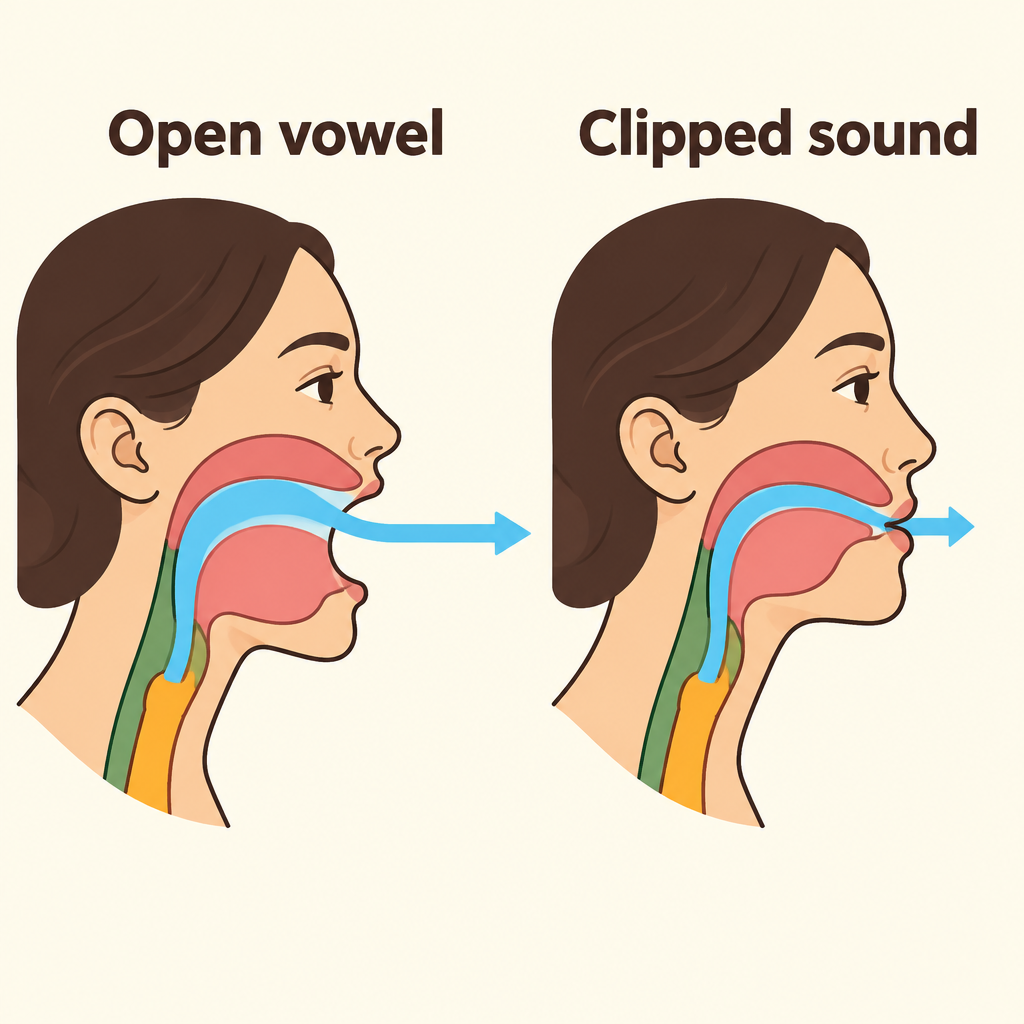
Notice how the open mouth leaves a clear channel for continuous tone, while the closed shape cuts the sound off almost immediately.
That is why singers instinctively land on open vowels at the end of a phrase.
Syllable Length Matters
Masri words carry different syllable weights. Some syllables want length. Others want to pass quickly.
A long syllable placed on a short note feels rushed and smudged.
A short syllable stretched across a long note feels forced and unnatural.
Match the weight of the syllable to the length of the note.
- Long on short
- Short on long
Follow Spoken Stress
Every Masri phrase has a natural spoken stress. Say it out loud and you hear which syllable leans forward.
When the melody puts its strong beat on that same syllable, the line sounds like speech that happens to be sung.
When the melody stresses the wrong syllable, listeners hear the word as odd, even if the pitch is fine.
Speak first. Sing second.
- Sounds like sung speech
- Breath stays supported
- Word sounds strange
- Tone still sustains
- Stress is correct
- Tone stops quickly
- Breath interrupted
- Rhythm broken
Do Not Delete Hard Words
A common misconception: singable writing means avoiding difficult sounds.
It does not. The strongest Masri lyric words are often the consonant-heavy ones that carry the emotion.
The goal is placement. Put the harder sound where the melody can support it, such as on a short note or a rhythmic pickup.
Save the open vowel for the sustained note.
- Delete the word
- Reposition it
Test It With Your Body
You do not need theory to check a line. You need three physical tests.
Read the line aloud at speaking pace. Tap a simple steady pulse with your hand. Then sing the line on a small repeated melody.
Each test reveals something different: mouth comfort, rhythmic fit, then breath and tone.
Where all three feel easy, the phrasing is working.
- Read aloud: Speak the line at normal pace to feel mouth comfort and natural stress.
- Tap pulse: Tap a simple steady beat and say the line against it to check rhythmic fit.
- Sing small melody: Sing the line on a small repeated melody to hear breath and tone.
- Mark rough spots: Note any syllable where breath, rhythm, or feeling breaks.
Revise, Then Test Again
Testing is not a one-time check. It is a loop.
Sing the line, find the spot that trips you, adjust either the word or its placement, then sing it again.
Often the fix is small: move one syllable earlier, or swap the vowel at the phrase ending.
Each pass makes the line easier to deliver.
- Sing the line: Use a small repeated melody so the tune stays constant.
- Find the trip: Locate the syllable where breath, rhythm, or feeling breaks.
- Adjust word or place: Change the vowel or move the syllable within the phrase.
- Sing again: Check whether the rough spot has cleared or moved.
Choosing Between Two Lines
You will often have two Masri lines that mean nearly the same thing.
Do not pick by meaning alone. Run both through the same small melody and listen.
Ask three things: Does the ending vowel sustain? Does the spoken stress land on the strong beat? Does your breath survive the phrase?
The line that answers yes most often is your draft.
Talking To Musicians
This skill pays off outside your notebook.
When you can say this syllable needs a longer note or the phrase ending needs an open vowel, musicians understand you immediately.
You stop describing feelings and start describing sound.
That is how early melody choices get made with confidence.
- Open vowels: Sustained shapes that carry a long note.
- Spoken stress: The syllable that leans forward in natural Masri speech.
- Aloud and pulse tests: Reading, tapping, and singing reveal rough phrasing.
- Clear lyric ideas: Naming the sound problem musicians can act on.
- Early melody choices: Deciding note length and phrase shape with confidence.
Check yourself
An open vowel is usually easier to sustain across a long note than a clipped sound.
- True
- False
Answer: True
Open vowels keep the mouth relatively open and allow the tone to continue. Closed or clipped sounds stop the tone more quickly.
Reading a lyric aloud checks _____, while tapping a steady pulse checks _____.
Answer: Reading a lyric aloud checks mouth comfort, while tapping a steady pulse checks rhythmic fit.
The three physical tests have different jobs: speaking reveals mouth comfort, tapping reveals rhythmic fit, and singing reveals breath and tone.
A Masri syllable feels rushed and smudged when it is placed on which kind of note?
- A short note
- A sustained note
- A note with no melody
- A note after the phrase ends
Answer: A short note
A long or heavy syllable needs enough time. Putting it on a short note makes the singer rush and blur it.
Keep going
This is lesson 1 of 8 in Crafting Singable Masri Songs. Next up:
- Syllable Stress
- Hook Crafting
- Section Contrast
- Vocal Contours
- Scale Flavors
Wondering turns any topic into short lessons you can read, watch, or listen to, with practice questions and an AI tutor.