Free sample lesson · Conversational Serbian for Beginners
Case Logic
How can one word change its ending seven different ways?
Lesson 1 of the Wondering course Conversational Serbian for Beginners
The Magic of Changing Words
In English, word order tells the story. If you swap the subject and object, the meaning changes completely.
- English
- Serbian
Serbian works differently. It uses a system called declension.
This means nouns change their endings to show their role. One word can have seven different endings depending on how you use it.
Meet the Seven Cases
Serbian nouns travel through seven distinct forms called cases.
These include the Nominative, Genitive, Dative, Accusative, Vocative, Instrumental, and Locative.
Each case has a specific job. For example, the Nominative case identifies the subject who performs the action.
Subject versus Object
The Accusative case is a vital tool for beginners. It usually indicates the direct object receiving an action.
Consider the word for coffee: kafa.
When you order it, the ending changes. The word kafa becomes kafu. This small change tells the listener that the coffee is the object of your request.
Flexible Word Order
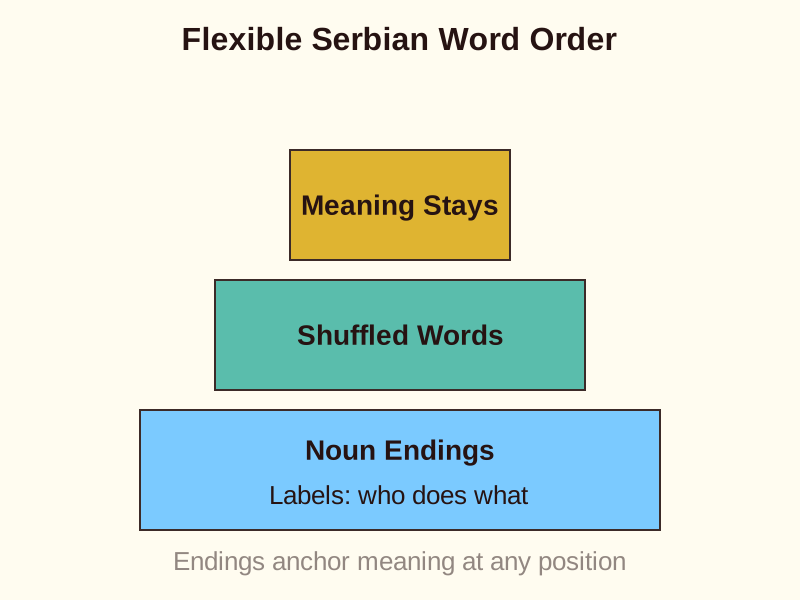
Because endings show the relationship between words, Serbian word order is very flexible.
You can shuffle the words in a sentence and the meaning often remains clear.
The endings act like labels. They tell you who is doing what, regardless of where the word sits in the sentence.
Logic Over Memorization
Do not worry about memorizing every grammar table immediately. Focus on the logic behind the changes.
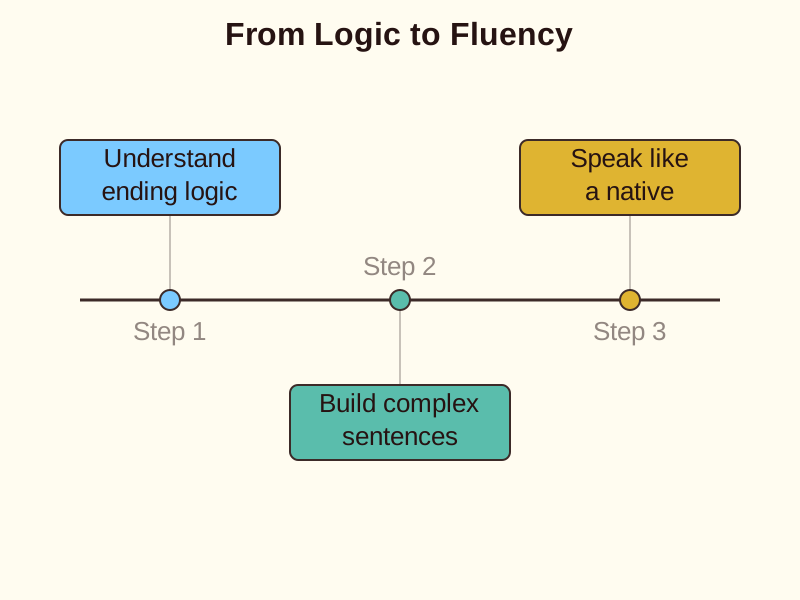
Understanding why an ending shifts is the first step to natural speech.
Mastering these patterns will help you build complex sentences and speak like a native speaker.
Applying Case Logic to Speak Naturally
- Identify the Role: Determine if the noun is the subject or the direct object in your sentence.
- Apply the Ending: Shift the noun ending to match its grammatical role according to the correct case.
- Construct the Sentence: Assemble your words flexibly, trusting the endings to carry the precise meaning.
Check yourself
In Serbian, _____ indicate a noun's grammatical role in a sentence, allowing flexible word order.
- noun endings
- strict sentence positions
Answer: noun endings
Unlike English, which relies heavily on word order, Serbian uses declension—changing noun endings to indicate grammatical roles like subject or object.
In Serbian sentence structure, the _____ case identifies the subject performing the action, while the _____ case indicates the direct object receiving the action.
Answer: In Serbian sentence structure, the Nominative case identifies the subject performing the action, while the Accusative case indicates the direct object receiving the action.
The Nominative case marks who performs the action (subject), whereas the Accusative case marks the target receiving the action (direct object).
Why can words in a Serbian sentence be rearranged without changing who does what to whom?
- The case endings on nouns clearly show their roles regardless of position.
- Serbian sentences require strict subject-verb-object placement.
- Listeners guess the subject based solely on context clues.
- The verbs change completely whenever word order is shuffled.
Answer: The case endings on nouns clearly show their roles regardless of position.
Because Serbian nouns use case endings (declension) to act as grammatical labels, the role of each word is stored in its ending rather than its position in the sentence.
Keep going
This is lesson 1 of 6 in Conversational Serbian for Beginners. Next up:
- Verb Conjugation
- Syntax Mastery
- Perfective Aspect
- Clause Linking
- Advanced Sentence Architecture and Synthesis
Wondering turns any topic into short lessons you can read, watch, or listen to, with practice questions and an AI tutor.