Free sample lesson · Continuous Discovery Habits
Six Core Mindsets
What mental shifts enable teams to discover products customers truly value?
Lesson 1 of the Wondering course Continuous Discovery Habits
Mindsets Come Before Tactics
Continuous discovery is about how product teams think, as much as what they do. Tactics only work when the thinking behind them shifts.
Teresa Torres identifies six interconnected mindsets that successful discovery teams cultivate.
They are outcome-oriented, customer-centric, collaborative, visual, experimental, and continuous. This lesson zooms in on two: outcome-oriented and collaborative.
Together, the six build a culture where teams create measurable value, balance customer and business needs, work across functions, make thinking visible, test ideas scientifically, and keep discovering throughout the product's life.
Outcome-Oriented: Measure Value
An outcome-oriented team measures success by the value it creates for customers and for the business.
Counting features shipped or velocity achieved is an output focus. Those numbers show the team is busy, but they do not prove anyone is better off.
- Output focus
- Outcome focus
So the key question changes from "What did we ship?" to "What changed because we shipped it?"
A Busy Quarter Is Not Enough
Imagine a made-up product team that shipped five new features this quarter and hit every sprint goal.
By an output yardstick, they had a great quarter. Yet customers kept using the product the same way, and the business saw no change.
An outcome-oriented team would call that quarter unfinished. It would ask what value was missing and what to try next.
Both sides count: value for customers and value for the business.
Collaborative: Together From the Start
A collaborative mindset means cross-functional teams work together from the start of discovery.
It rejects the siloed model, where each role works separately and passes work along when its part is done.
In a silo, one person decides, another designs, and another builds. Each sees only a slice of the problem.
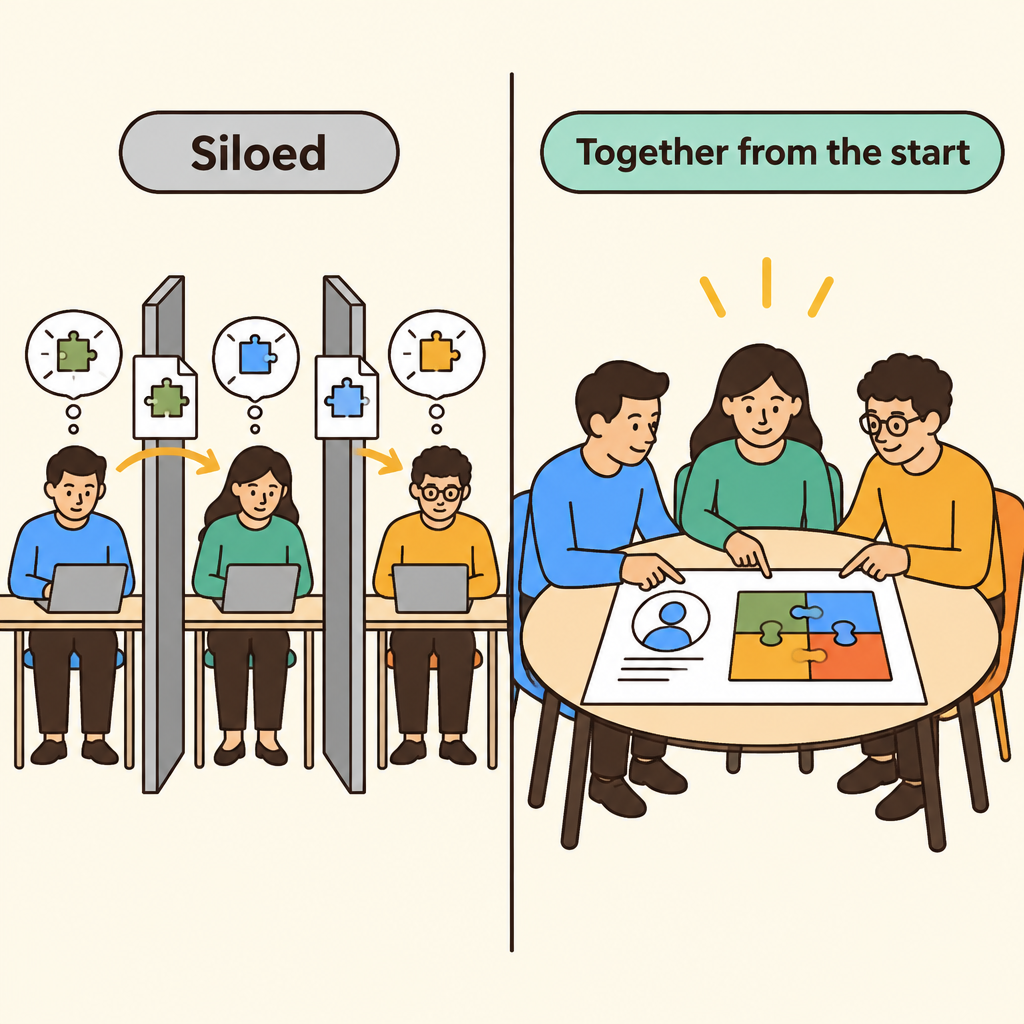
Notice how the silo splits the problem into slices passed along, while the shared table gives every role the same view from the start.
When roles discover together, they share the same understanding of customers and the goal.
Spot the Two Mindsets
Here is a quick way to recognize each mindset in your own work.
Outcome-oriented shows up in what you measure. A warning sign is a status update that only lists features shipped or velocity.
Collaborative shows up in when people join. A warning sign is a role that first hears about a project at handoff.
- Outcome-oriented
- Collaborative
The two connect. A shared outcome gives a cross-functional team a common target to work toward.
Putting the Mindsets to Work
You can start practicing both mindsets this week.
First, rewrite one goal as the value it should create for customers and the business.
Then invite every role into the work at the start, before ideas are locked in.
Finally, review progress by asking what changed for customers and the business.
- Reframe the goal: State the value it should create for customers and the business.
- Invite early: Bring every role in at the start, before ideas are locked in.
- Check the change: Review progress by asking what changed for customers and the business.
Remember: these are two of six connected mindsets that support every discovery practice.
Check yourself
A team with an outcome-oriented mindset measures its success by _____.
- the value it creates for customers and the business
- how many features it ships each quarter
Answer: the value it creates for customers and the business
An outcome-oriented mindset judges success by the value created for customers and the business. Shipping lots of features is output, and output alone does not prove value.
At a team meeting, someone says: "We shipped 12 features this quarter. That's a record!" Which reply best shows an outcome-oriented mindset?
- "Did those features create value for customers and the business?"
- "Great, let's aim for 15 features next quarter."
- "Our speed went up, so this quarter was a success."
- "Let's list every feature so we can share our progress."
Answer: "Did those features create value for customers and the business?"
An outcome-oriented team asks whether the work created value for customers and the business. Counting features or celebrating speed treats output as success, which is the trap this mindset rejects.
A team wants to follow the collaborative mindset. The engineers should join the work _____.
- from the start, alongside the product manager and designer
- after the product manager and designer finish the plan
Answer: from the start, alongside the product manager and designer
A collaborative mindset means the cross-functional team works together from the start. Bringing engineers in only after decisions are made is the siloed model it rejects.
Keep going
This is lesson 1 of 40 in Continuous Discovery Habits. Next up:
- Visual Experimentation
- Outputs vs Outcomes
- Traction Metric Traps
- Product Trio
- Eliminate Handoffs
Wondering turns any topic into short lessons you can read, watch, or listen to, with practice questions and an AI tutor.