Free sample lesson · Commercial Houseplant Tissue Culture Lab
Sterile Workspace
What does it take to keep invisible contaminants from destroying thousands of dollars in rare plant stock?
Lesson 1 of the Wondering course Commercial Houseplant Tissue Culture Lab
From Clean to Sterile
You already know how to keep a propagation bench clean. Wiped surfaces, washed pots, fresh media.
Tissue culture asks for something stricter. A wiped bench still sits in room air full of drifting mold spores.
Sterile means no viable organisms reach the agar at all. That standard cannot be met by wiping alone.
- Clean bench
- Sterile workspace
The Laminar Flow Hood
The Laminar Flow Hood is the heart of a commercial tissue culture lab.
It pulls room air through a HEPA filter, then pushes that air out across the work surface in a steady, even stream.
Nothing settles onto your agar, because clean air is always moving outward past it.
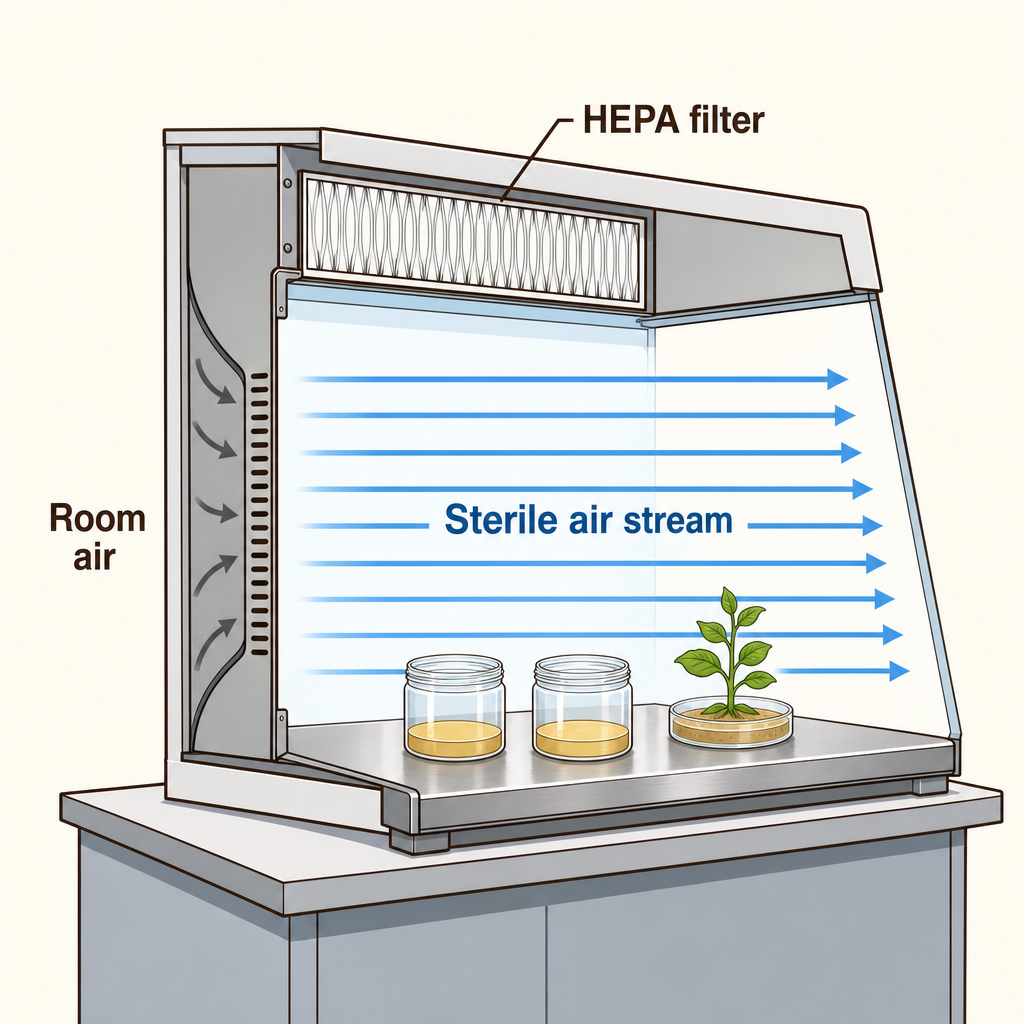
Notice that the filtered air always travels outward past the open jars, so nothing from the room can drift inward and settle.
What HEPA Actually Removes
A HEPA filter removes 99.97% of particles 0.3 microns or larger.
That size range covers the things that ruin cultures: mold spores and airborne bacteria.
This is the whole basis of the sterile curtain. Filter the air, and airborne pathogens never reach the jar.
- Particles removed: The filtration efficiency that defines a HEPA filter.
- Particle size captured: Mold spores and airborne bacteria fall in this range.
- What it stops
- Mold spores: The most common cause of lost jars.
- Airborne bacteria: Carried on dust and skin particles in room air.
Filtered air is what separates sterile work from merely clean work.
Sterilize Between Every Jar
Washing tools once at the start is not enough here.
Scalpels and forceps go into a flame or glass bead sterilizer between every single jar.
One contaminated forceps tip carried into the next jar spreads the infection through a whole batch.
- Sterilize tools: Flame or glass bead sterilizer between uses.
- Cool briefly: Hot instruments would damage the plant tissue.
- Work one jar: Cut or transfer tissue inside the air stream.
- Close the jar: Seal before moving on to the next vessel.
Clean-to-Dirty Flow
Layout matters as much as equipment.
The workspace follows a strict clean-to-dirty flow. Sterile items sit closest to the filter, used and non-sterile items sit downstream.
Non-sterile items must never cross the path of the sterile air stream before it reaches your cultures.
- Fresh agar jars
- Sterilized scalpels and forceps
- Sterile items placed too far out
- Unsterilized tools blocking the air stream
- Used tools
- Waste and trimmings
Why the Stakes Are High
A latent fungal infection does not always show itself on day one.
It can sit quietly in a jar, then decimate a commercial inventory within days.
With rare plant stock, that is thousands of dollars gone from a single lapse in technique.
Setting Up Your Lab
Three things make a workspace sterile rather than clean.
Filtered air from the hood, tool sterilization between every jar, and a clean-to-dirty layout that protects the air stream.
Miss any one of them and the other two cannot save the batch.
Check yourself
A wiped propagation bench is clean, but it is not necessarily sterile.
- True
- False
Answer: True
A clean bench may still be exposed to room air containing mold spores. Sterile means that no viable organisms reach the agar.
For a tissue-culture bench, a wiped surface may be _____, while protection of agar requires the workspace to be _____. A sterile workspace prevents _____ from reaching the agar.
Answer: For a tissue-culture bench, a wiped surface may be clean, while protection of agar requires the workspace to be sterile. A sterile workspace prevents viable organisms from reaching the agar.
Clean describes a surface that has been wiped or otherwise maintained. Sterile is stricter: no viable organisms may reach the agar. Viable organisms are living organisms capable of surviving or reproducing.
What does a HEPA filter remove according to the tissue-culture protocol?
- 99.97% of particles 0.3 microns or larger
- All organisms from every surface
- Only visible dust larger than 3 microns
- Room odors and dissolved contaminants
Answer: 99.97% of particles 0.3 microns or larger
A HEPA filter removes 99.97% of particles 0.3 microns or larger. This includes mold spores and airborne bacteria that can ruin cultures.
Keep going
This is lesson 1 of 8 in Commercial Houseplant Tissue Culture Lab. Next up:
- Media Prep
- Explant Sourcing
- Rapid Multiplication
- Genetic Variation
- Embryo Rescue
Wondering turns any topic into short lessons you can read, watch, or listen to, with practice questions and an AI tutor.