Free sample lesson · Comic Gadget Science Channel
Gadget Breakdown
What would Iron Man's repulsor actually need to work: physics, chemistry, or pure fiction?
Lesson 1 of the Wondering course Comic Gadget Science Channel
Audit the Gadget, Line by Line
What would Iron Man's repulsor actually need to work: physics, chemistry, or pure fiction?
You already know how an analyst reads financial statements. Nobody judges the whole company at once. You split it into line items and check each one.
Do the same with a comic gadget. This is functional decomposition: list the separate jobs the device must do.
For the repulsor, there are four line items: power source, energy conversion, output, and control and safety.
- Iron Man's repulsor
- Power source: Where does the energy come from?
- Energy conversion: How does stored energy become useful?
- Output: What actually leaves the palm?
- Control and safety: How is it aimed and kept safe?
Line Item 1: Power Source
First question: where does the energy come from?
In the comics, the answer is the arc reactor, a compact device in Tony Stark's chest.
That single answer opens two research threads. How much energy can you pack into that small volume? That is energy density.
And how fast can it deliver that energy on demand? That is power generation, a separate question from storage.
Line Item 2: Energy Conversion
Stored energy is not useful yet. Something has to turn it into a form the palm can release.
This is energy conversion, and it is where your research gets specific.
Depending on how you imagine the repulsor, the conversion step points to electromagnetism, plasma physics, or chemistry.
- Candidate fields
- Electromagnetism: If the repulsor works with electric and magnetic fields.
- Plasma physics: If energy becomes a hot ionized gas.
- Chemistry: If energy is released through reactions.
The mechanism you assume decides the field you research.
Pick the mechanism first. The mechanism tells you which textbook to open.
Line Item 3: What Leaves the Palm
Third question: what actually leaves the palm?
The repulsor does two different jobs. It produces thrust for flight, or a beam for combat.
Thrust brings in Newton's third law and momentum. Whatever the palm pushes out, the palm gets pushed back the other way.
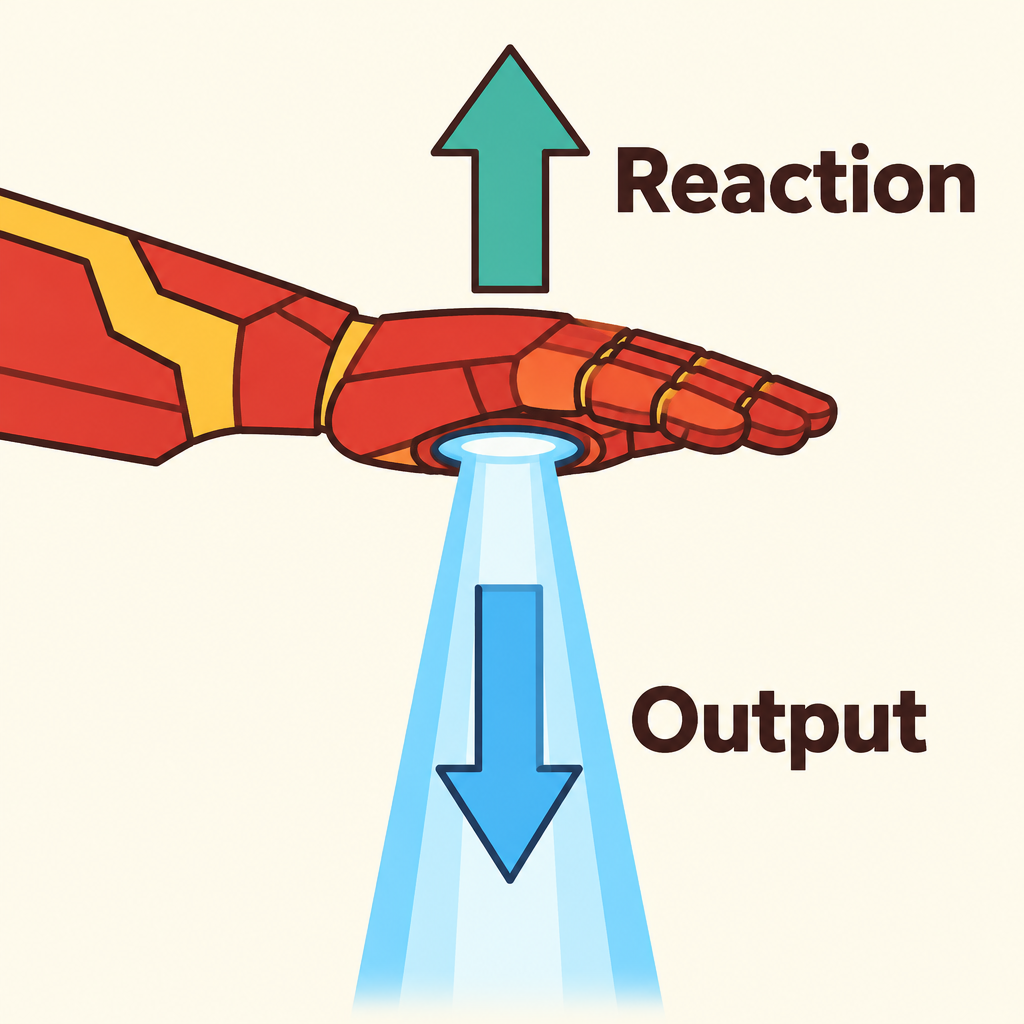
Notice the two arrows point in opposite directions: output leaving the palm always pushes the palm back, which is Newton's third law at work.
Both modes also raise a hard question about heat.
Line Item 4: Control and Safety
Fourth question: how is it aimed, stabilized, and kept from burning the wearer?
This line item is easy to skip, because comics rarely show it. Analysts know hidden costs live in exactly these lines.
Control and safety pulls in materials science, thermal management, and even human biology.
After all, the hand producing the blast is still a human hand.
Give Every Line a Verdict
Now judge each function on its own, like flagging each line on a statement.
Use three verdicts: established science, plausible with future engineering, or pure fiction.
One gadget can mix all three. A repulsor might obey real laws in its output yet rely on fiction in its power source.
The result is a research checklist: one question, one field, one verdict per line.
Turn the Checklist Into a Video
Your breakdown is already a video outline.
Give each function its own segment in your stick-figure explainer. Four functions means four clean segments.
In each one, draw a simple diagram: what goes in, what comes out, and where the real science stops.
- Name function: Pick one line item, such as the power source.
- Show input: Draw what goes into this part.
- Show output: Draw what comes out of it.
- Mark the limit: Show where the real science stops.
- State verdict: Call it established, plausible, or pure fiction.
End by stating the verdict. Viewers see exactly which parts are real and which are comic book magic.
Check yourself
When researching whether Iron Man's repulsor could work, you should _____
- judge each core function separately.
- give the whole gadget one verdict.
Answer: judge each core function separately.
Like an analyst checking line items on a financial statement, you split the gadget into its jobs. One part may be solid physics while another is pure fiction, and a single overall verdict would hide that.
A repulsor breaks into four jobs: the _____ supplies energy, _____ turns stored energy into something useful, the _____ is the thrust or beam leaving the palm, and _____ aims it and protects the wearer.
Answer: A repulsor breaks into four jobs: the power source supplies energy, energy conversion turns stored energy into something useful, the output is the thrust or beam leaving the palm, and control and safety aims it and protects the wearer.
Each function answers one question: Where does energy come from? How is it transformed? What leaves the palm? How is it aimed and kept from burning the wearer? These four line items become your research checklist.
Your stick-figure explainer has a segment on the repulsor's output: the thrust that lifts Iron Man off the ground. Which science should that segment research?
- Newton's third law, momentum, and heat
- Energy density and power generation
- Materials science and human biology
- Electromagnetism and plasma generation
Answer: Newton's third law, momentum, and heat
Output is what leaves the palm. Thrust for flight depends on Newton's third law: pushing mass or energy one way pushes the suit the other way. It also raises questions about momentum and heat. Energy density belongs to the power source. Thermal protection for the wearer belongs to control and safety. Plasma generation belongs to energy conversion.
Keep going
This is lesson 1 of 13 in Comic Gadget Science Channel. Next up:
- Science Sources
- AI Research
- Feasibility Scoring
- Explainer Anatomy
- Powerful Hooks
Wondering turns any topic into short lessons you can read, watch, or listen to, with practice questions and an AI tutor.