Free sample lesson · Chess Strategy
Pawn Structures
Can a single weak pawn determine the outcome of a master-level game?
Lesson 1 of the Wondering course Chess Strategy
The Skeleton of the Position
At master level, games are rarely decided by a single one-move blunder.
They are won by the slow accumulation of small advantages.
The pawn structure is the skeleton of the position. It is the frame every strategic plan hangs on.
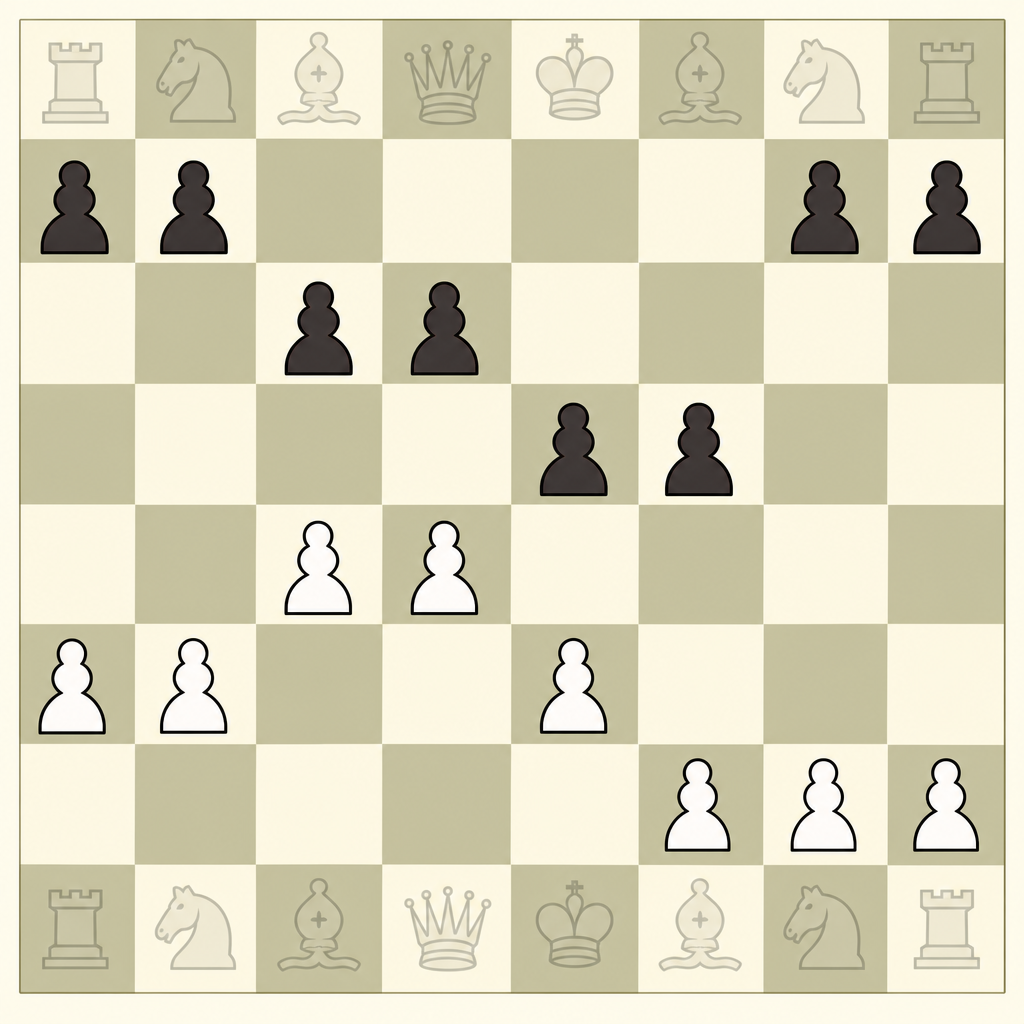
Notice how the pawn chains, not the pieces, mark out which squares stay open and which stay closed.
Once you read the skeleton, you know where the game wants to go.
Structure Dictates Piece Placement
Pawns cannot move backwards. That permanence is what makes them powerful guides.
Where pawns stand decides which squares your minor pieces can safely occupy.
A knight needs a square no enemy pawn can attack. A bishop needs open diagonals the pawns have not blocked.
- Pawn permanence: Pawns cannot move backwards, so their decisions last.
- Safe squares: Squares no enemy pawn can attack.
- Knight: A knight needs a square no enemy pawn can attack.
- Bishop: A bishop needs open diagonals the pawns have not blocked.
- Middlegame flow: The structure sets the flow before a single piece is placed.
So the structure sets the flow of the whole middlegame before you place a single piece.
Three Structures Worth Knowing
Master play leans on recognisable pawn skeletons.
The Carlsbad, the Isolani and the Hedgehog each come with their own weak squares and their own trading logic.
- Carlsbad
- Isolani
- Hedgehog
Learning them is pattern work. When you recognise the skeleton, you inherit the plan that belongs to it.
That is the shortcut from guessing to knowing.
Which Pieces Should Be Traded
Structure analysis answers a question intermediate players often skip: which trade helps me?
If the skeleton gives you a permanent safe square, keep the piece that occupies it.
If the skeleton leaves your opponent a defender of a weak point, trade the rest and leave that weakness exposed.
- Read the skeleton: Begin from the pawn structure, not the material count.
- Permanent safe square?: Does the structure give you a square no enemy pawn can attack?
- Keep that piece: Keep the piece that occupies the safe square.
- Defender of weak point?: Is an enemy piece guarding a weak point in the structure?
- Trade the rest: Leave the weakness exposed.
- Structural decision
- re-read
Trades are structural decisions, not material ones.
Backward Pawns and Holes
Two defects deserve constant attention.
A backward pawn cannot be defended by another pawn and cannot advance safely.
A hole is a square in your structure that no pawn will ever cover again.
- Backward pawn
- Hole
Either one can become a permanent target. Permanent means it does not disappear with a clever move.
From Weakness to Win
A permanent target does quiet work.
The opponent must assign pieces to guard it, and those pieces stop doing anything useful.
Their defence shrinks while your freedom grows.
- Defect appears: A backward pawn or a hole becomes a permanent target.
- Pieces tied down: The opponent assigns pieces to guard the target.
- Freedom shifts: Their defence shrinks while your freedom grows.
- Breakthrough: Pressure elsewhere becomes too much and the position breaks.
Eventually the pressure elsewhere becomes too much and the position breaks. That is how one weak pawn decides a master game.
Proactive, Not Reactive
Most intermediate players answer threats. Masters set the terms.
Reading the structure tells you where the game will be decided long before any threat appears.
You choose the target, the trades and the timing.
- Reactive play: Answering threats with no long-term plan
- Blind aggression: Setting terms without reading weak squares
- Quiet reading: Sees the skeleton but still waits
- Proactive play: Chooses target, trades and timing
The shift is small in effort and large in results.
Pawn Breaks Change Everything
Structures are stable, not frozen.
A pawn break is the move that transforms the skeleton and creates a new position with new rules.
Break at the right moment and you open lines for an attack, or steer into an endgame that favours you.
- Lines opened for an attack
- Transition into an endgame that favours you
- Opponent gets the better structure
- New rules favour the opponent
Break too early and you hand the opponent the better structure.
A Question to Sit With
Everything above rests on one uncomfortable idea.
A pawn is the least valuable unit on the board, yet the skeleton it forms outlives every piece exchange.
The weakness you create on move twelve may still be there on move sixty.
Putting It to Work
Start every middlegame by reading the skeleton before counting material.
Ask three things: which squares are weak, which pieces should be traded, and which break is available.
Those answers hand you a plan that lasts twenty moves instead of two.
Check yourself
Because pawns cannot move backward, a pawn structure can guide strategic plans for many moves.
- True
- False
Answer: True
Correct. Pawn placement is relatively permanent, so weaknesses and useful squares may remain important throughout the middlegame.
A _____ cannot be defended by another pawn or advanced safely. A _____ is a square that no pawn will cover again.
Answer: A backward pawn cannot be defended by another pawn or advanced safely. A hole is a square that no pawn will cover again.
A backward pawn is a pawn defect, while a hole is a permanently weak square. Both can become long-term targets.
Which pairing best matches how pawn structure guides minor-piece placement?
- Knight on a safe square; bishop on an open diagonal
- Knight behind a blocked diagonal; bishop on an attacked square
- Knight on a square attacked by pawns; bishop behind its own pawns
- Knight and bishop placed without considering pawn locations
Answer: Knight on a safe square; bishop on an open diagonal
A knight wants a square that enemy pawns cannot attack. A bishop wants a diagonal that the pawn formation has not blocked.
Keep going
This is lesson 1 of 11 in Chess Strategy. Next up:
- Outpost Control
- Open Files
- Decoy Sacrifices
- Intermezzo Moves
- Clearance Tactics
Wondering turns any topic into short lessons you can read, watch, or listen to, with practice questions and an AI tutor.