Free sample lesson · Central Italy WSET Wine Guide
Tuscan Climate
How can hillside altitude in a hot region still give wines with high acidity?
Lesson 1 of the Wondering course Central Italy WSET Wine Guide
Tuscany's Hot-Climate Puzzle
Tuscany has a warm Mediterranean climate with hot, dry summers.
Without other influences, that heat would give wines with high alcohol and low acidity. Grapes would race to ripeness and lose acid fast.
Yet the best Tuscan Sangiovese is known for high acidity and fresh red-cherry fruit.
So something must be cooling these vineyards. The answer is height above sea level, and it starts with where the vines are planted.
Vines on the Apennine Foothills
Most of the best Tuscan vineyards sit on hillsides in the foothills of the Apennines.
They are typically between about 150 and 500 metres. Some Chianti Classico sites are higher still.
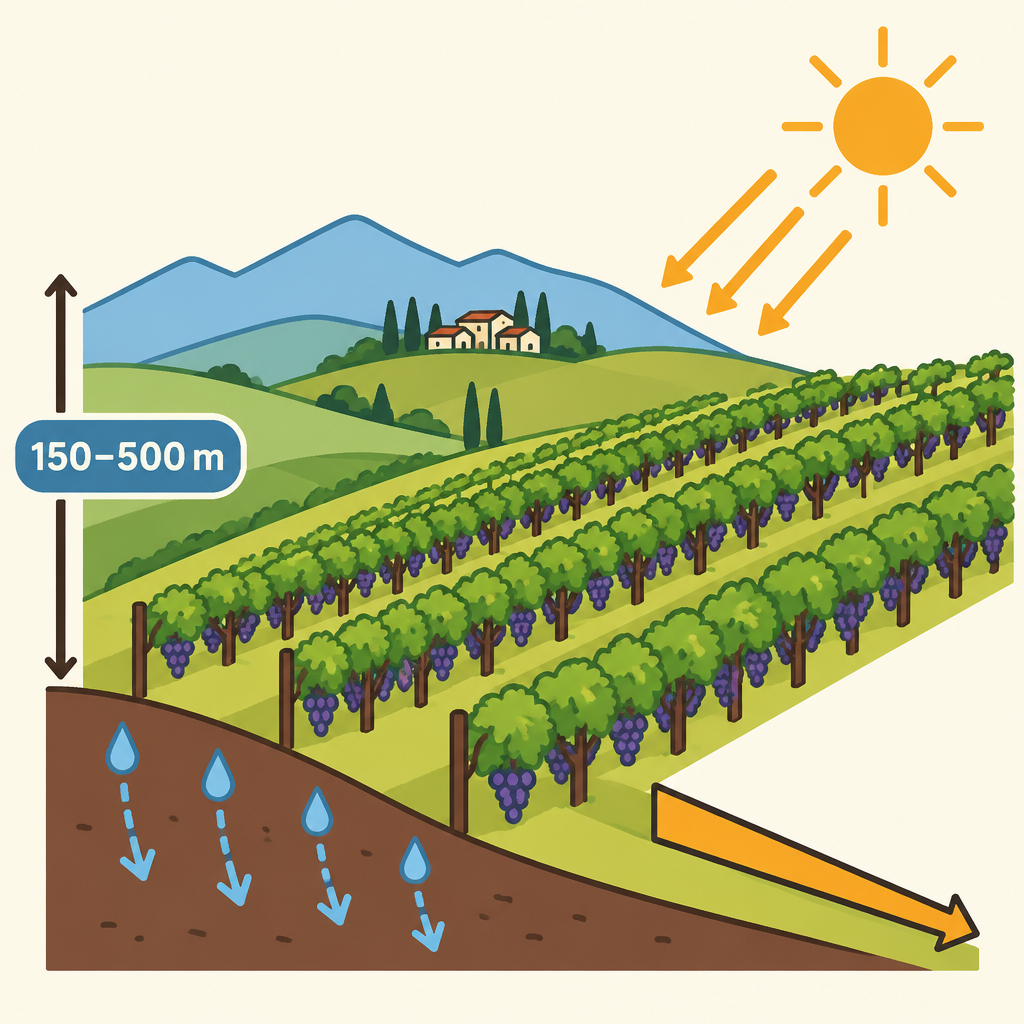
Hillside vineyards in Chianti Classico: height and slope cool and warm the vines
Slopes bring two bonuses. They drain well, and they can face the sun to gain extra warmth.
So a hillside site is cooled by height but can still ripen grapes properly.
Altitude, Cool Nights and Acid
Altitude lowers average temperatures. It also makes the gap between hot days and cool nights larger.
That night-time cooling matters most. Cool nights slow the loss of acid in the grapes, so the wine keeps its freshness.
Meanwhile, the long, sunny growing season still lets tannins and fruit flavours ripen fully.
For the exam, write it as a chain: altitude, then cooler nights, then acid retained, then a fresh, high-acid Sangiovese.
- Altitude: Hillside height lowers average temperatures.
- Cooler nights: The gap between hot days and cool nights grows larger.
- Acid retained: Cool nights slow the loss of acid in the grapes.
- Fresh style: The result is a fresh, high-acid Sangiovese.
Valley Floor or Hillside?
Imagine two Sangiovese plots in central Tuscany. One is on a valley floor at 100 m, the other on a hillside at 500 m. Which makes the fresher wine?
Temperature falls about 0.6°C for every 100 m of height. So the hillside plot is roughly 2.4°C cooler.
Its cooler nights slow acid loss, while summer heat still ripens sugars and tannins.
Result: the hillside wine has high acidity and red-cherry fruit. The valley-floor wine is riper and softer.
- Valley floor
- Hillside
Sangiovese and Autumn Rain
Sangiovese is Tuscany's main grape. It buds early, ripens late, and naturally has high acidity and high tannin.
It also has thin skins. Rain near harvest can cause dilution and rot.
This is why autumn rainfall is a key reason Tuscan vintages vary.
- Sangiovese
- Buds early
- Ripens late
- Exposed to autumn rain: A key reason vintages vary.
- Thin skins
- Dilution and rot: Caused by rain near harvest.
- High acid and tannin
Back to our plots: the cooler 500 m hillside ripens more slowly, so its grapes hang longer and face more autumn rain risk.
Coastal Warmth and Drought
Not all Tuscany is hilly. Coastal sites such as Bolgheri and the Maremma are warmer and lower-lying, moderated by sea breezes.
Inland hillsides at about 150 to 500 metres rely on altitude and cool nights to keep fresh, high acidity. Coastal wines tend to be riper and fuller-bodied.
- Inland hillsides
- Bolgheri, Maremma
Heat can also go too far. In hot years, drought and heat stress can slow or even stop ripening, especially on poorer, stony soils.
Building Exam Answers
In exam answers, link each factor to its effect on the grape, then to the style in the glass.
Altitude gives cooler nights, so acid is retained and Sangiovese tastes fresh. Autumn rain on thin skins brings dilution and rot, so vintages vary.
Sea breezes on warm, low coastal sites give riper, fuller-bodied wines. Drought on stony soils can slow or stop ripening.
Use this chain and every Tuscan style makes sense.
Check yourself
In Tuscan hillside vineyards, cool nights _____ the loss of acid in ripening Sangiovese grapes.
- slow
- speed up
Answer: slow
Cool nights slow the breakdown of acid in the grapes. That is why high-altitude Tuscan sites keep Sangiovese fresh even though summer days are hot. Warm nights would speed acid loss, giving flatter, softer wines.
Sangiovese buds _____ in spring but ripens _____ in autumn. Its _____ skins make it vulnerable to rot if rain falls near harvest.
Answer: Sangiovese buds early in spring but ripens late in autumn. Its thin skins make it vulnerable to rot if rain falls near harvest.
Sangiovese buds early and ripens late, so its season is long and its harvest falls into autumn. Its thin skins mean rain near harvest can cause dilution and rot. These traits sit alongside its naturally high acidity and high tannin.
Compared with hillside Chianti Classico, what style of Sangiovese-based wine is typical of warmer, lower-lying coastal Tuscan areas such as Bolgheri and the Maremma?
- Riper and fuller-bodied
- Lighter with higher acidity
- Leaner with less ripe tannins
- Lower in alcohol and tart
Answer: Riper and fuller-bodied
Coastal sites are warmer and lower-lying. Sea breezes moderate them, but they still lack the cooling effect of altitude. The result is riper, fuller-bodied wines. Higher acidity and red-cherry freshness are hallmarks of the cooler hillside sites instead.
Keep going
This is lesson 1 of 15 in Central Italy WSET Wine Guide. Next up:
- Sangiovese
- Toscana IGT
- Chianti DOCG
- Chianti Classico
- Chianti Compared
Wondering turns any topic into short lessons you can read, watch, or listen to, with practice questions and an AI tutor.