Free sample lesson · CDN for Engineers: Beyond Static Caching
Edge Caching and Points of Presence
Lesson 1 of the Wondering course CDN for Engineers: Beyond Static Caching
Why Distance Slows the Web
Every request travels a physical path. When a page lives in one origin datacenter, a visitor on the other side of the world pays for that distance in waiting time.
Latency is the delay between asking for content and receiving it.
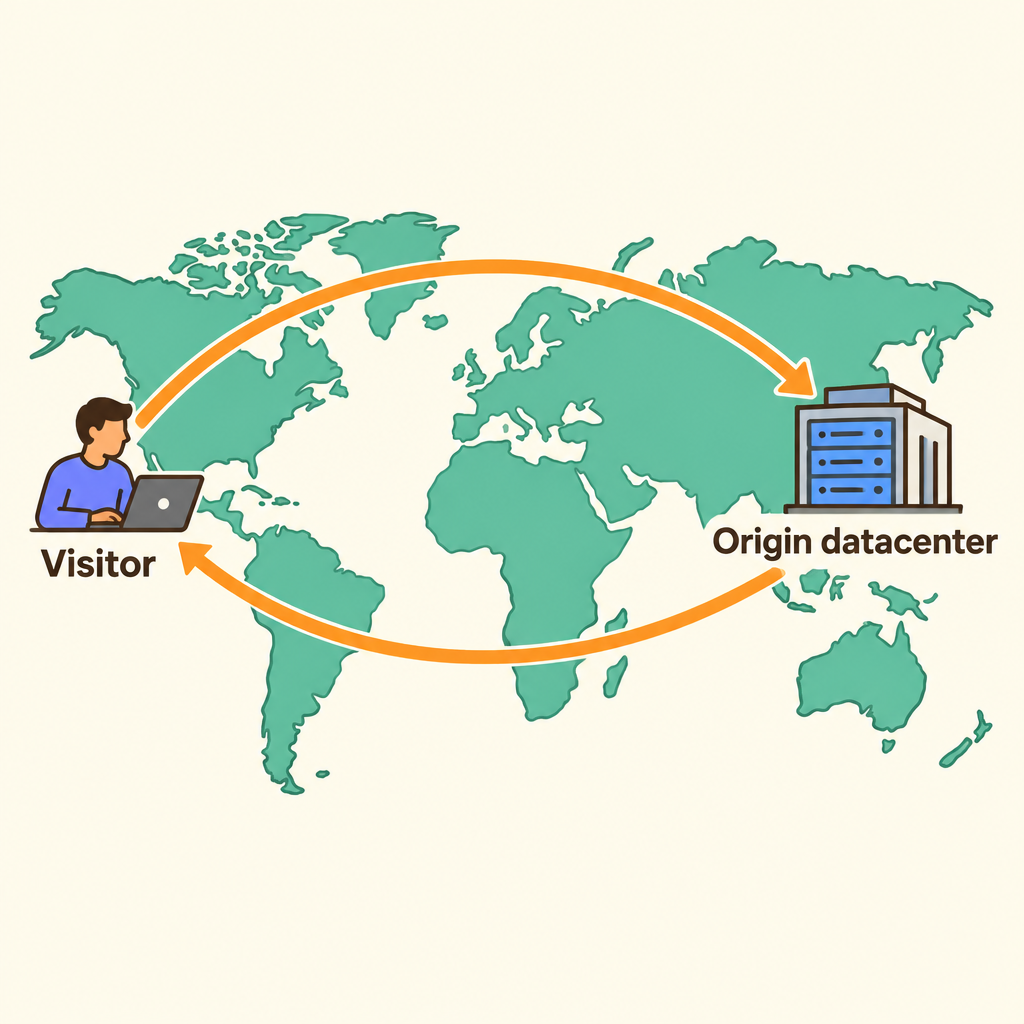
Notice how a single origin forces every request to cross the full distance twice, once out and once back.
A content delivery network attacks that delay by moving copies of the content closer to people.
What a Point of Presence Is
A CDN runs many small sites around the world. Each one is called a point of presence, or PoP.
A PoP holds servers that store copies of content near local users.
- CDN network: The full set of geographically distributed sites.
- Point of presence: One site placed near a group of local users.
- Edge node: Servers inside the PoP that store content.
- Cached content: The copy handed directly to the nearby visitor.
Each layer sits inside the one above it.
Instead of one location serving everyone, dozens or hundreds of geographically distributed edge nodes share the work.
Edge Caching in Action
Edge caching means keeping copies of content on those edge nodes rather than only at the origin.
The first visitor in a region may still trigger a trip to the origin. The edge stores the response.
- User request: A visitor asks for content.
- Nearest PoP: The request reaches a nearby edge node.
- Copy cached here?
- Fetch from origin: The edge node travels to the origin datacenter.
- Store at edge: The response is kept for later visitors.
- Serve locally: Content is delivered from nearby.
- next visitor
Every later visitor nearby gets served locally, without the long journey.
One Origin Versus Many Edges
The contrast is simple once you see both shapes side by side.
- Single origin
- Edge PoPs
A single origin datacenter answers every request itself, so distance grows with how far the visitor lives.
Distributed edge nodes answer most requests locally, and the origin only handles what the edge does not already hold.
What Geography Buys You
Placing content near users cuts the round trip, and shorter round trips mean faster pages.
It also protects the origin. Requests answered at the edge never reach the datacenter at all.
- For users
- Shorter round trip: The request travels a smaller physical distance.
- Faster pages: Less waiting between asking and receiving.
- For the origin
- Fewer requests arrive: Edge-answered traffic never reaches the datacenter.
- Spikes spread out: Load is shared across many points of presence.
Geography is the mechanism behind both sets of gains.
That makes traffic spikes far easier to absorb, because the load spreads across many points of presence.
A Copy Is Not the Origin
An easy misreading is that a CDN replaces the origin datacenter.
It does not. The origin remains the source of truth, and edge nodes hold copies of what it produces.
When the edge lacks a copy, it still goes back to the origin to get one.
Putting It Together
A CDN works by geography. Content sits at many points of presence so requests stop traveling across the world.
Edge caching turns the first local request into a stored copy that serves everyone else nearby.
- Distribute: Place points of presence near where users actually are.
- Cache: Store copies of origin content on the edge nodes.
- Serve locally: Answer nearby requests without crossing to the origin.
The origin still matters, but it stops being the only door.
Check yourself
Latency is the delay between requesting content and receiving it.
- True
- False
Answer: True
This statement is correct. Latency measures the waiting time between a request and the arrival of its content.
In a CDN, the _____ remains the source of truth, a _____ serves nearby users, and _____ keeps content copies there.
Answer: In a CDN, the origin remains the source of truth, a PoP serves nearby users, and edge caching keeps content copies there.
The origin produces and owns the authoritative content. A PoP is the nearby serving location, while edge caching is the practice of storing copies on edge nodes.
A visitor requests an item that is already stored at a nearby edge node. What normally happens?
- The nearby edge node serves the stored copy
- The origin must serve the request directly
- The request is discarded because copies cannot be reused
- Every PoP must retrieve a new copy first
Answer: The nearby edge node serves the stored copy
The nearby edge node serves the stored copy, avoiding a long trip to the origin. This reduces round-trip distance and usually lowers latency.
Keep going
This is lesson 1 of 7 in CDN for Engineers: Beyond Static Caching. Next up:
- Origin Offload and Cache Hit Ratio
- TTL and Cache Invalidation
- Edge Security and DDoS Mitigation
- Dynamic Content Acceleration
- Cache Key Misconfiguration
Wondering turns any topic into short lessons you can read, watch, or listen to, with practice questions and an AI tutor.