Free sample lesson · California Coastal Marine Biology
California's Coastal Mosaic
Why can one coastline hold cliffs, mudflats, and kelp forests?
Lesson 1 of the Wondering course California Coastal Marine Biology
One Coast, Many Homes
Stand on California's shore and you may see cliffs, mudflats, and kelp within a short walk.
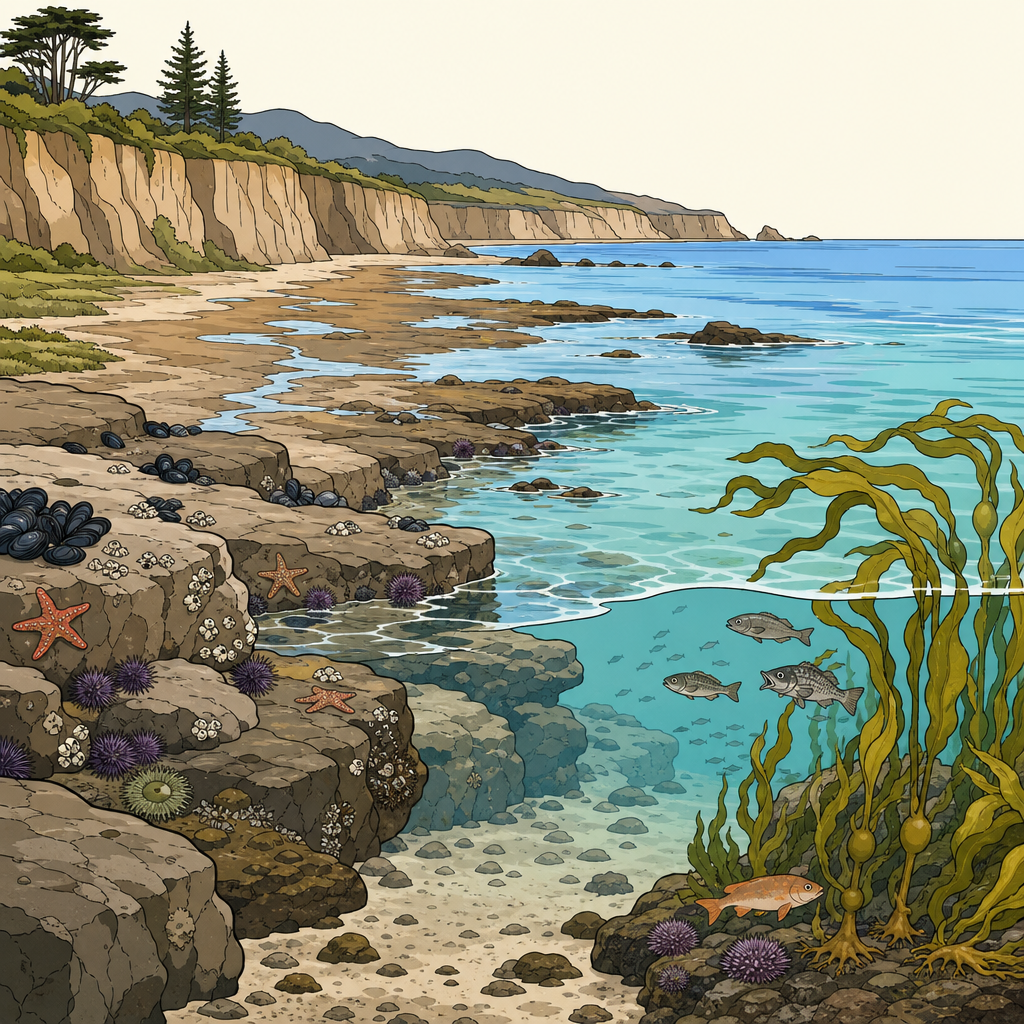
Rocky shore and shallow water meeting along the California coast
That is not one ecosystem. It is a mosaic of habitats stitched together.
Each habitat offers different depth, water movement, saltiness, and shelter. Animals settle where conditions suit them.
Five Habitats To Know
Coastal California life sorts into a few recognizable habitat types.
Rocky intertidal shore alternates between air and seawater. Sandy beach shifts under waves. Estuary mixes fresh and salt water.
Eelgrass beds grow in sheltered soft bottoms. Kelp forests build structure just below the low-tide edge.
Tidepool Versus Kelp Forest
Two photos make the difference obvious.
- Rocky tidepool
- Kelp forest
A Monterey tidepool shows wet rock crowded with green anemone tentacles and purple urchin spines. Animals sit exposed at low tide.
A Monterey Bay kelp forest shows a leather star among giant kelp, always underwater, sheltered by tall plant structure.
Gradients Sort The Species
Habitats are not arbitrary. Physical gradients do the sorting.
Depth, tides, wave exposure, substrate, temperature, and nutrient delivery all change across short distances.
- Barnacles
- Eelgrass
- Giant kelp
Barnacles dominate high splash zones. Eelgrass grows in sheltered soft-bottom water. Giant kelp needs shallow rocky bottom with enough light.
Boundaries Are Not Walls
A common mistake is treating habitat edges as barriers.
Tides, currents, and mobile animals connect them constantly.
- Sea otters: They forage in kelp forests and estuaries.
- Shorebirds: They feed on flats exposed at low tide.
- Juvenile fish: They shelter in vegetation before moving offshore.
- Tides and currents: Water movement links neighbouring habitats.
Sea otters forage in kelp forests and estuaries. Shorebirds feed on exposed flats at low tide. Juvenile fish shelter in protected vegetation before moving offshore.
Read A Scene In Three Steps
You can now analyse almost any California coast photo.
- Name habitat: Decide if the scene is rocky intertidal, sandy beach, estuary, eelgrass bed, or kelp forest.
- Find stressor: Pick one physical condition such as wave force, exposure to air, or changing salinity.
- Predict trait: Name one animal feature that would survive that stressor.
Name the habitat first. Then name one physical stressor acting there. Then predict one animal trait that fits.
Example: rocky intertidal, drying air at low tide, a hard shell or clamped body that holds water.
Why The Mosaic Matters
Memorizing animal names without asking about habitat conditions leaves the story unfinished.
The better question is what makes this animal successful right here.
Treating the coast as one uniform place hides the gradients that actually decide who lives where.
Check yourself
California’s coastline is best described as a mosaic of several habitats, not one uniform ecosystem.
- True
- False
Answer: True
This is correct. Rocky shores, sandy beaches, estuaries, eelgrass beds, and kelp forests provide different conditions for marine life.
A shallow coastal area has a rocky bottom, strong sunlight, and enough water depth to stay below the low-tide edge. Which habitat is most likely there?
- Kelp forest
- Eelgrass bed
- Sandy beach
- High splash zone
Answer: Kelp forest
A kelp forest needs a shallow rocky bottom and enough light. It grows below the low-tide edge, unlike a rocky tidepool that can be exposed to air.
Why would barnacles be more likely than giant kelp in a high, wave-exposed splash zone?
- Barnacles tolerate air exposure and wave stress better there.
- Barnacles require sheltered soft sediment for their roots.
- Giant kelp grows best where it is regularly exposed to air.
- Giant kelp can grow without light on any substrate.
Answer: Barnacles tolerate air exposure and wave stress better there.
Barnacles tolerate repeated exposure to air and strong wave conditions. Giant kelp needs a shallow rocky bottom with enough light and remains underwater below the low-tide edge.
Keep going
This is lesson 1 of 10 in California Coastal Marine Biology. Next up:
- Upwelling Feeds the Coast
- Tide Pools Trap Worlds
- Surviving Air and Waves
- Reading Vertical Zones
- Kelp Builds Habitat
Wondering turns any topic into short lessons you can read, watch, or listen to, with practice questions and an AI tutor.