Free sample lesson · Building Your Second Brain
Mental Limits
Why does your biological mind constantly struggle to remember every great insight?
Lesson 1 of the Wondering course Building Your Second Brain
Your Mind Has Limits
Your brain is excellent at processing information, making connections, and generating ideas. It is much less reliable as a storage device.
The conscious mind can hold only a few thoughts at once. When you try to remember every fact, date, and insight, mental energy quickly becomes crowded.
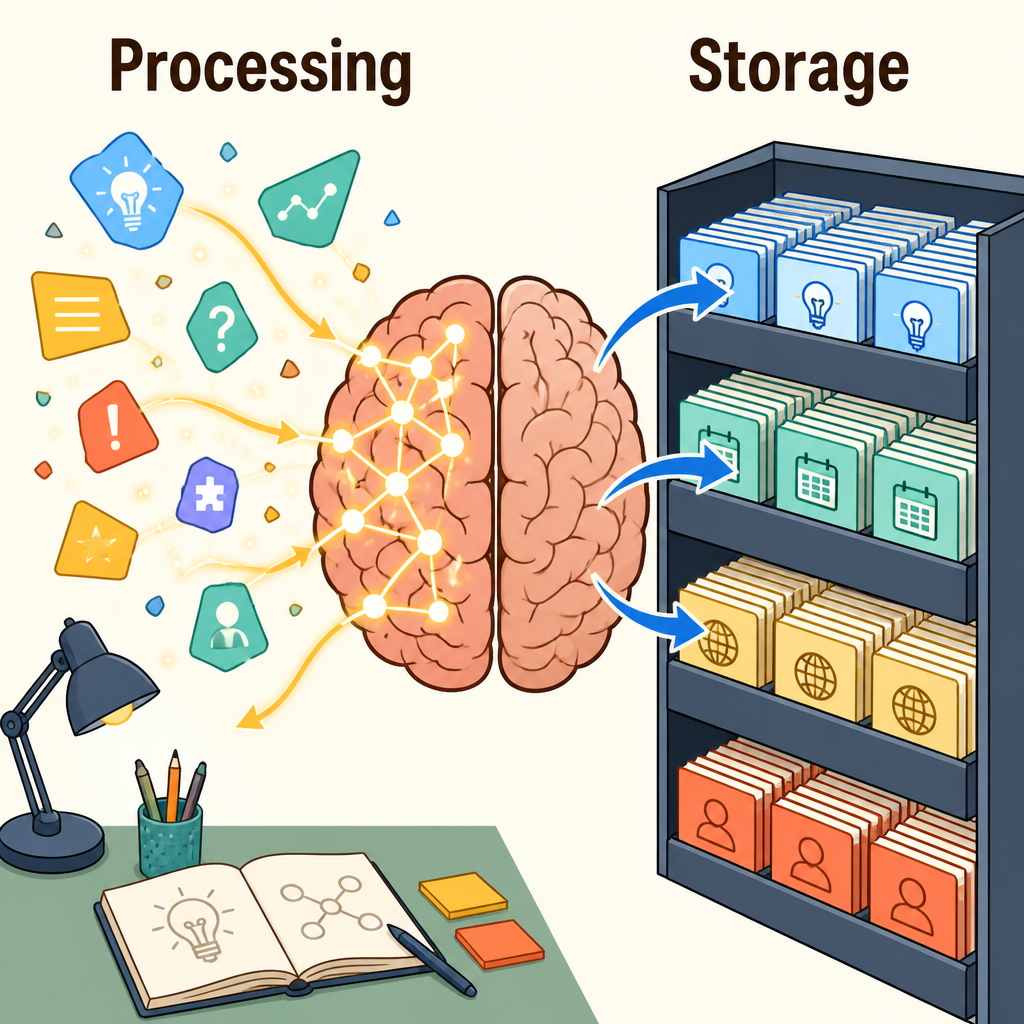
Notice how the mind can actively connect ideas while an external archive holds the growing collection of facts and insights.
Your brain is for having ideas, not holding everything.
Unfinished Thoughts Consume Attention
Unrecorded ideas and unfinished tasks can keep returning to your attention. This creates background anxiety and distraction.
The Zeigarnik Effect describes this pull toward incomplete tasks. For example, a brilliant idea may interrupt your current work because your mind is trying to preserve it.
- Idea appears: A brilliant idea or unfinished task enters your attention.
- Task remains open: Because it is unrecorded and incomplete, your mind keeps trying to preserve it.
- Attention returns: The thought interrupts current work and creates background anxiety or distraction.
- Write it down: Recording the idea gives your attention somewhere reliable to rest.
Writing it down gives your attention somewhere reliable to rest.
Delegate Storage Digitally
Cognitive load management means recognizing what your mind cannot comfortably retain, then moving that information into a trusted digital system.
Since you already use Notion or Obsidian, the next step is building a consistent PKM system. Store raw notes, dates, facts, and ideas there instead of relying on memory.
- Recognize limits: Identify information your mind cannot comfortably retain.
- Choose a system: Use a trusted digital system such as Notion or Obsidian.
- Store information: Move raw notes, dates, facts, and ideas into the PKM system.
- Reduce clutter: Let the stored information take pressure off your mental workspace.
This reduces mental clutter.
Build Your Second Brain
A Second Brain extends your biological mind through an organized digital environment. It preserves useful information so you can retrieve and connect it later.
When an insight appears, capture it in Notion or Obsidian. Your mind can then focus on synthesis, creative problem-solving, and deciding what the idea means.
- Biological mind: The mind that generates and interprets ideas.
- Digital environment: An organized place that extends the mind.
- Capture insight: Record an insight when it appears.
- Preserve information: Keep useful information for later retrieval.
- Retrieve later: Find preserved information when needed.
- Connect ideas: Relate information across time.
- Synthesis: Combine ideas into understanding.
- Creative problem-solving: Use freed attention to work through problems.
The goal is less remembering and more thinking.
From Mental Limits to a Second Brain
Check yourself
Is the brain generally more reliable for generating ideas than for storing every fact and date?
- Yes
- No
Answer: Yes
Yes. The brain is strong at processing information, making connections, and generating ideas, but it is less reliable as a storage device.
The _____ explains why incomplete tasks return to attention, while _____ moves information into a trusted digital system.
Answer: The Zeigarnik Effect explains why incomplete tasks return to attention, while cognitive load management moves information into a trusted digital system.
The Zeigarnik Effect describes the pull of unfinished tasks. Cognitive load management reduces that pressure by delegating storage to a digital system.
You have an insight during focused work but worry that you will forget it. What best applies cognitive load management?
- Keep repeating the insight silently while working
- Record the insight in Notion or Obsidian
- Stop working until the insight feels completely memorized
- Ignore the insight so it cannot distract you
Answer: Record the insight in Notion or Obsidian
Recording the insight in Notion or Obsidian delegates storage to a trusted digital system. Your mind can then return to focused thinking instead of repeatedly holding the idea in attention.
Keep going
This is lesson 1 of 8 in Building Your Second Brain. Next up:
- Digital Extension
- Quick Capture
- Smart Curation
- Project Structuring
- Linking Notes
Wondering turns any topic into short lessons you can read, watch, or listen to, with practice questions and an AI tutor.