Free sample lesson · Building Scalable Payment Systems
Ecosystem Players
Who actually moves the money when a customer swipes a credit card?
Lesson 1 of the Wondering course Building Scalable Payment Systems
Four Nodes, One Transaction
A card swipe looks like one action. Under the hood it is a distributed request crossing four independent parties.
Visa processing runs on a four-party model built to create trust and liquidity between strangers.
The four roles are the Cardholder, the Issuer, the Merchant, and the Acquirer. A Card Scheme sits in the middle and routes between them.
- Card Scheme: The central router connecting both banks.
- Issuer: Bank providing credit to the consumer.
- Cardholder: The consumer paying with the card.
- Acquirer: Bank processing payments for the merchant.
- Merchant: The business accepting the card.
Issuer Versus Acquirer
These two names cause the most confusion for developers new to payments. Both are banks, but they serve opposite ends of the transaction.
The Issuer is the bank that provides the credit to the consumer. It holds the funds and makes the approval decision.
The Acquirer is the bank that processes payments for the merchant. It initiates the request on the merchant side.
- Issuer
- Acquirer
The Scheme As Router
The merchant bank and the customer bank usually have no direct connection. Something must sit between them.
That connector is the Scheme, also called the Network. VisaNet is the example here.
It acts as the central router for authorization and clearing messages. Every request and response passes through it.
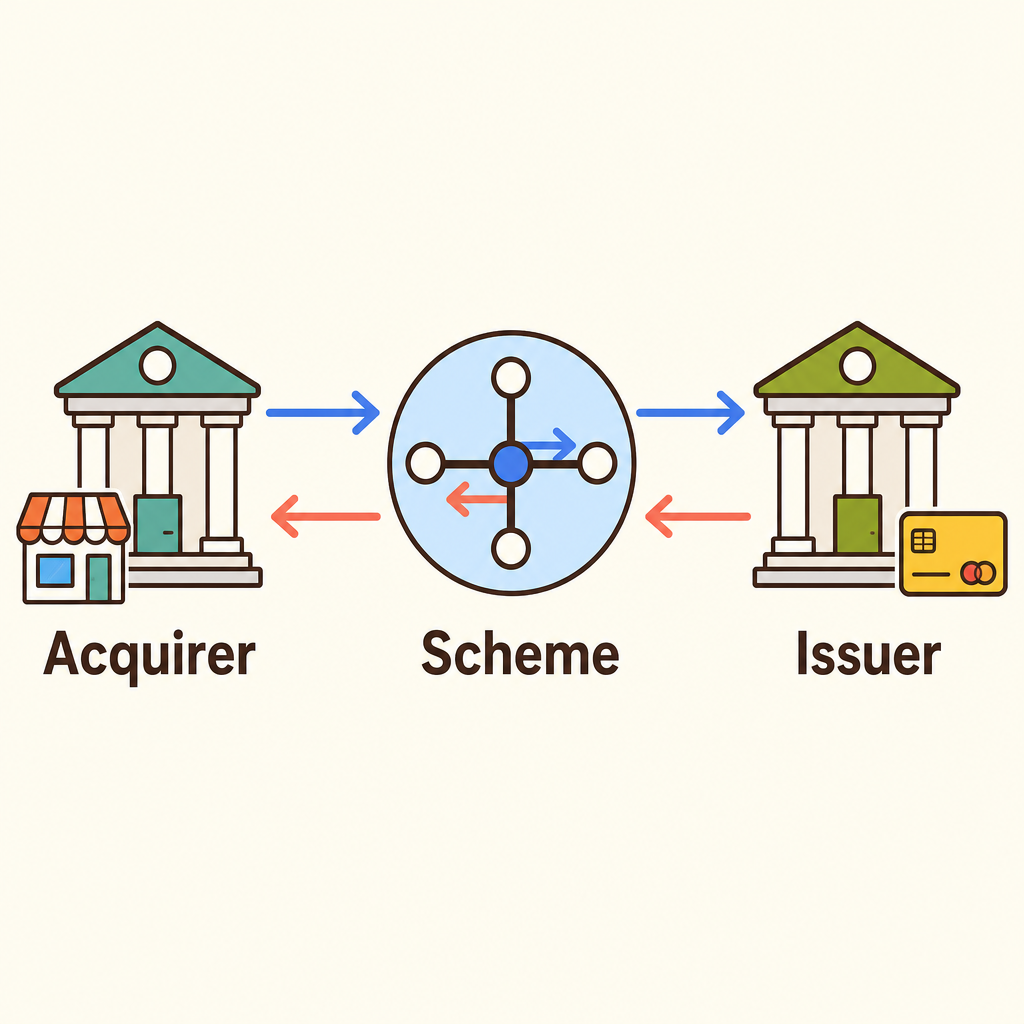
Notice that no line connects the two banks directly; every message must pass through the network in the middle.
Tracing The Authorization Flow
Now follow the message path in order.
The transaction initiates, and the Acquirer sends an authorization request through the Network to the Issuer.
The Issuer verifies funds and returns a response back along the same path.
This whole orchestration completes in milliseconds, even though merchant and customer use different banks.
- Initiate: The transaction initiates at the merchant.
- Acquirer sends: The Acquirer sends an authorization request through the Network.
- Issuer verifies: The Issuer verifies that funds are available.
- Response returns: The Issuer returns a response back through the Network.
Who Does What
Each party owns a distinct responsibility in the flow. Mixing them up is the fastest way to design a broken integration.
Keep the ownership boundaries clear before you write a single line of gateway code.
Why Settlement Needs This
Authorization is only the first half. Money still has to move afterwards.
Ledger systems must reconcile these distinct roles during the settlement phase. Your records have to know which side owed what.
That is why role clarity is not academic detail. It is the foundation for building scalable payment gateways and ledgers.
Check yourself
In a card transaction, does the Card Scheme route authorization messages between the Acquirer and Issuer?
- Yes
- No
Answer: Yes
Yes. The Card Scheme, or Network, acts as the central router because the merchant's bank and customer's bank usually have no direct connection.
In card payments, the bank providing credit to the consumer is the _____, while the bank processing payments for the merchant is the _____.
Answer: In card payments, the bank providing credit to the consumer is the Issuer, while the bank processing payments for the merchant is the Acquirer.
The Issuer serves the consumer side: it provides credit, holds the funds, and decides whether to approve. The Acquirer serves the merchant side by processing the payment and initiating the request.
Which party makes the approval decision after receiving an authorization request through the Network?
- The Cardholder
- The Issuer
- The Merchant
- The Acquirer
Answer: The Issuer
The Issuer verifies available funds and returns the approval or decline response. The Acquirer initiates the merchant-side request, while the Network routes messages between the parties.
Keep going
This is lesson 1 of 9 in Building Scalable Payment Systems. Next up:
- Card Rails
- Dual Messaging
- ISO Protocols
- Idempotency Keys
- Ledger Design
Wondering turns any topic into short lessons you can read, watch, or listen to, with practice questions and an AI tutor.