Free sample lesson · Building Efficient LLM Applications
Inference Engines
Why does specialized runtime software process requests dramatically faster than raw frameworks?
Lesson 1 of the Wondering course Building Efficient LLM Applications
Why runtimes beat raw frameworks
Raw frameworks are excellent for building and testing models. Production serving adds a different problem: coordinating many requests efficiently.
A specialized inference engine is runtime software designed for that serving problem.
- Raw framework
- Inference engine
It improves speed without requiring a new model. The gains come from request batching, memory-efficient attention caching, and optimized GPU execution.
Together, these techniques keep hardware busier and remove avoidable compute overhead.
The serving control layer
Think of the engine as a control layer between incoming requests and GPU work. It decides how serving work is organized at runtime.
The scheduler forms batches. The cache manager preserves reusable attention state. The execution path sends optimized work to the GPU.
- Inference engine: Organizes serving work at runtime.
- Scheduler: Forms batches from incoming requests.
- Cache manager: Preserves reusable attention state.
- Execution path: Sends optimized work to the GPU.
Each role targets a different source of waste, yet all three serve one goal: more useful work from the same hardware.
That coordination is the engine’s core advantage.
Batch requests, use capacity
Without batching, requests may reach the GPU as small, separate pieces of work. That can leave hardware capacity unused.
Request batching groups ready requests so the GPU can process more serving work together.
A serving scheduler repeatedly gathers eligible requests, forms a batch, executes it, and returns each result to the correct request.
- Gather: The scheduler gathers eligible requests.
- Form batch: Ready requests become one batch.
- Execute: The GPU processes the serving work together.
- Return results: Each result returns to the correct request.
The point is utilization: combine compatible work instead of paying similar coordination overhead for every request in isolation.
Reuse earlier attention state
Autoregressive generation repeatedly uses attention information from earlier tokens. Rebuilding all reusable state for every new token would add avoidable work.
A memory-efficient attention cache keeps that reusable state available during generation.
On the next step, the engine reads the stored state, adds information for the new token, and continues.
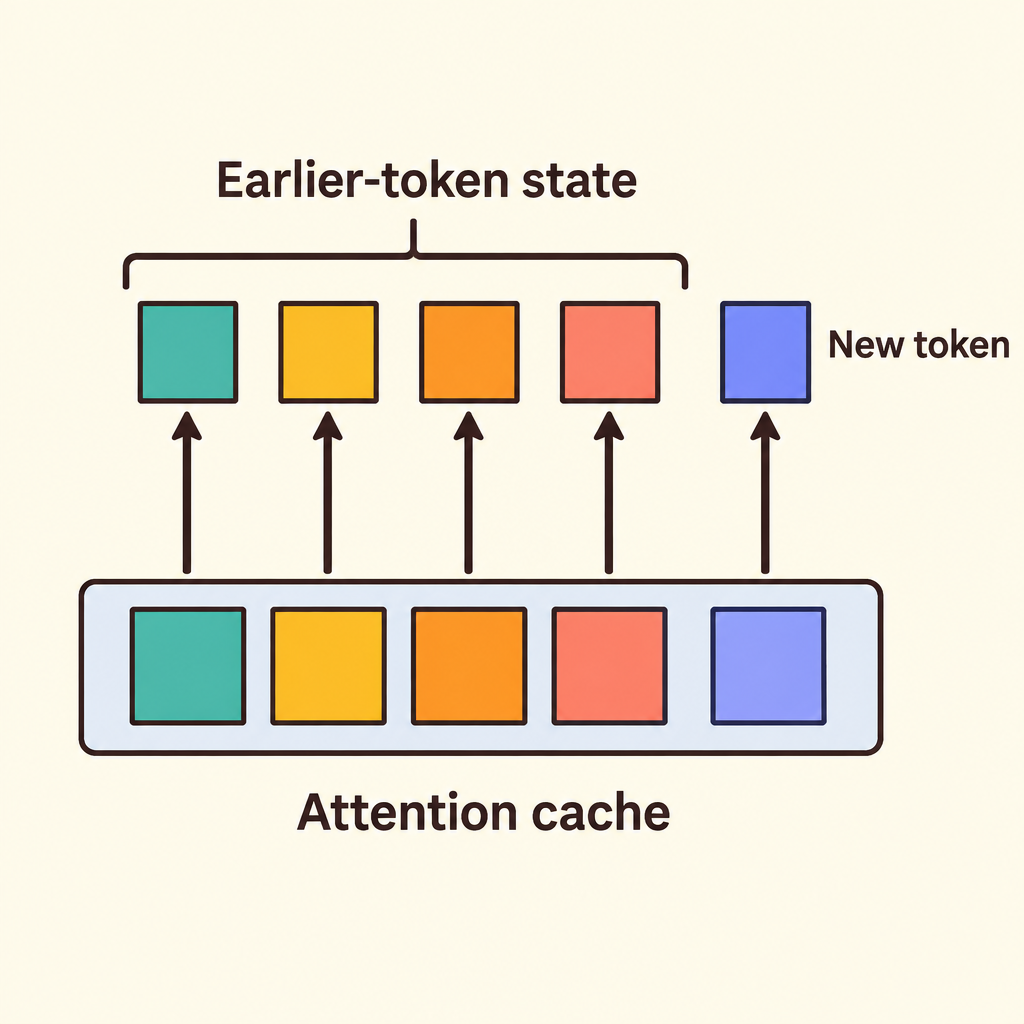
Stored earlier-token state feeds the next step and grows with the new token, avoiding repeated reconstruction.
The cache therefore trades GPU memory for less repeated computation. Its layout matters because serving many requests requires storing many sequences efficiently.
Cache design shapes batching
Batching and caching are tightly linked. A batch can include only requests whose attention state fits in available GPU memory.
If cache storage wastes space, fewer sequences can remain active together. The scheduler then has less work to combine.
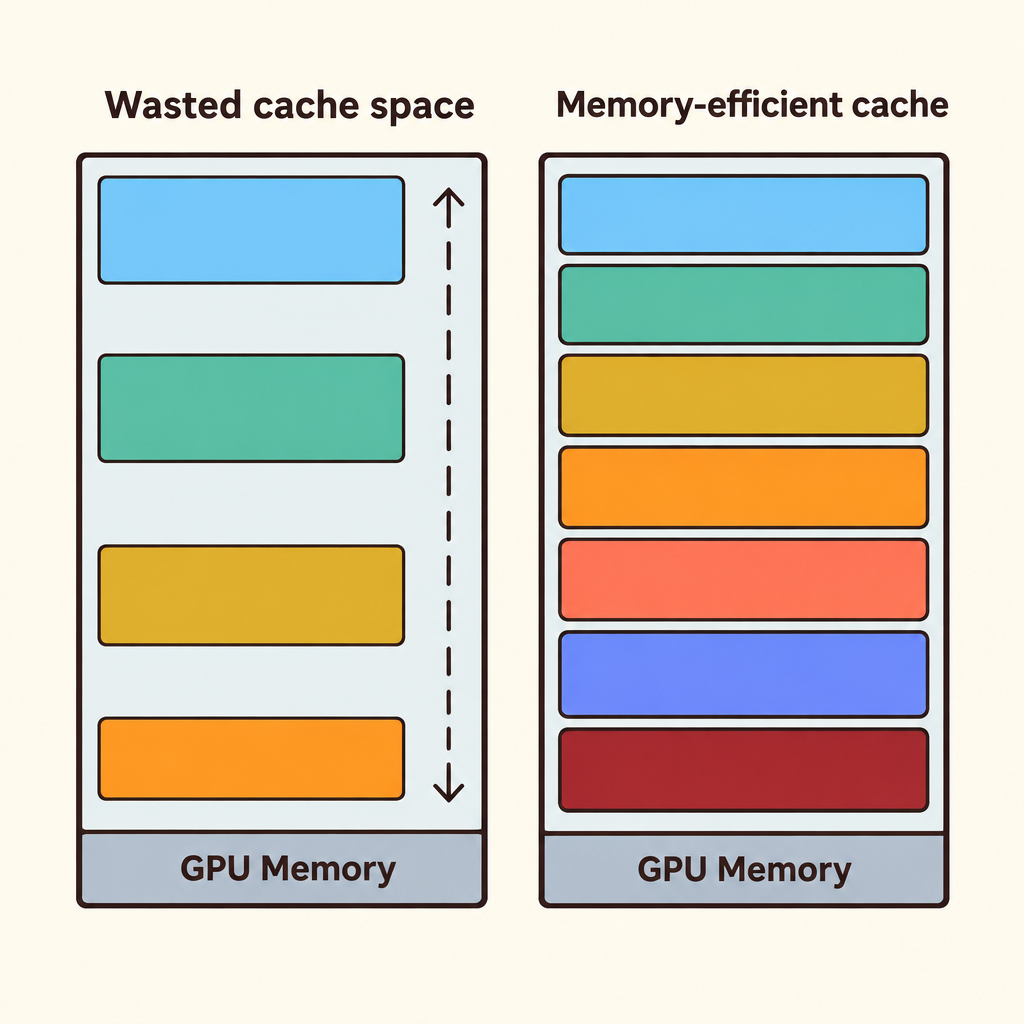
The carefully packed cache fits more active request state into the same GPU memory area.
Memory-efficient caching packs reusable state more carefully, supporting larger or steadier batches within the same memory limit.
So cache design affects both memory use and hardware utilization, not only attention computation.
Streamline GPU execution
Even with good batches and caches, the engine can lose time in how it launches and coordinates GPU work.
Optimized GPU execution reduces that runtime overhead. The engine uses serving-specific execution paths instead of treating every operation like a general framework task.
The model still performs its required computation, but less surrounding software work sits between requests and GPU execution.
This is where specialized runtime software turns serving intent into efficient hardware use.
The techniques reinforce each other
An inference runtime can combine request batching, efficient caching, and optimized execution. These techniques reinforce one another.
Batching can raise hardware utilization by giving the GPU more useful work at once.
Efficient caching can support larger batches because more request state fits in memory. Optimized execution can reduce software overhead around that organized work.
- Request batching: Gives the GPU more useful work at once.
- Efficient caching: Fits more request state in memory.
- Optimized execution: Reduces software overhead.
- Hardware utilization
- Larger batches
- Software overhead
Together, they improve hardware utilization and cut compute overhead. A weakness in one layer can limit the benefit of the others.
Diagnose the runtime bottleneck
In production, start with the observed bottleneck rather than choosing an optimization by habit.
If the GPU lacks enough simultaneous work, inspect request batching. If active request state fills memory, inspect the attention cache.
If work is organized but runtime coordination remains costly, inspect the optimized GPU execution path.
- Observe bottleneck
- Enough GPU work?
- Inspect batching
- State fills memory?
- Inspect cache
- Coordination costly?
- Inspect execution
- Retest concurrently
- No
- Yes
- Yes
- No
- Yes
- No
Then test the change under realistic concurrency. The goal is a measured increase in hardware utilization or a measured reduction in compute overhead.
Check yourself
A specialized inference engine is designed to _____ LLM serving.
- speed up
- replace
Answer: speed up
Specialized inference engines optimize how LLM requests run, improving serving speed rather than changing the model's training goal.
An LLM server receives several requests at once. Which runtime technique can process them together to use hardware more effectively?
- Request batching
- Attention caching
- Model retraining
- Request logging
Answer: Request batching
Request batching groups requests for execution, helping the server make better use of its hardware.
Which inference-engine technique specifically targets memory use associated with attention during LLM serving?
- Memory-efficient attention caching
- Request batching
- Optimized GPU execution
- Request logging
Answer: Memory-efficient attention caching
Memory-efficient attention caching targets the memory cost of attention information used during serving.
Keep going
This is lesson 1 of 12 in Building Efficient LLM Applications. Next up:
- Continuous Batching
- Model Quantization
- Semantic Caching
- Token Streaming
- Speculative Decoding
Wondering turns any topic into short lessons you can read, watch, or listen to, with practice questions and an AI tutor.