Free sample lesson · Building Agentic Workflows and Gbrain
Harness Comparison
Why does Claude Code feel different from OpenClaw or Hermes?
Lesson 1 of the Wondering course Building Agentic Workflows and Gbrain
Three Agent Architectures
Claude Code, OpenClaw, and Hermes can all perform agentic work, yet they place the agent in different environments.
Claude Code runs inside your terminal and local project. OpenClaw connects messaging channels to workflows. Hermes runs as a persistent runtime with learning and memory.
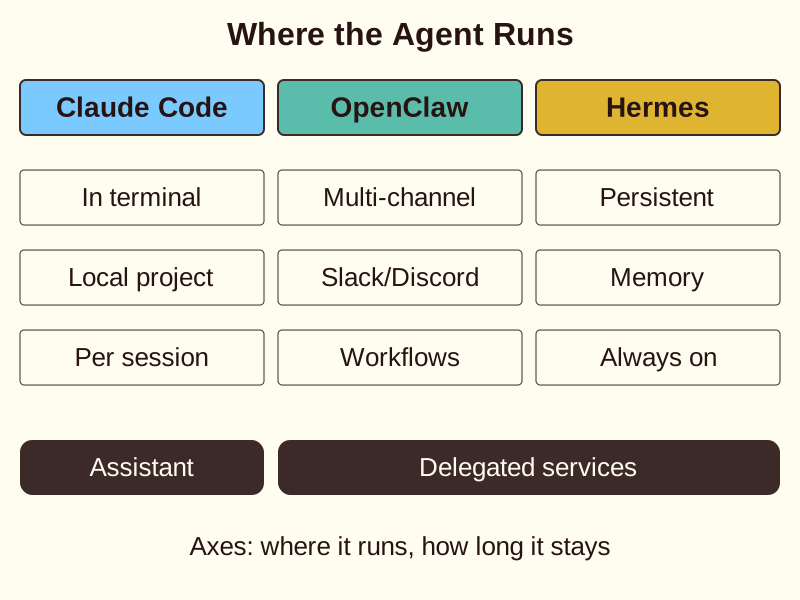
The key question is architectural: where does execution happen, and how long does the agent remain active? This explains why Claude Code feels like a coding assistant, while the others feel closer to delegated services.
Claude Code: Local Feedback
Claude Code is terminal-native. It works directly with your shell, files, and local development environment.
Its workflow resembles an engineering loop: inspect the repository, choose a tool action, observe the result, then continue. A simple while-loop manages this repeated interaction.
Claude Code also uses a compaction pipeline to manage context during longer tasks. This design favors deep project context and per-action safety, especially when you are actively reviewing changes.
- Start task: Begin work in the local project.
- Inspect repository: Inspect the repository before acting.
- Choose tool: Select the next shell, file, or other tool action.
- Observe result: Check what the action produced.
- Continue?: Decide whether the engineering loop should repeat.
- Longer task?: Check whether context management is needed during a longer task.
- Compact context: Use the compaction pipeline to manage context.
- End: Finish the current interaction loop.
- continue
- stop
- longer task
- otherwise
OpenClaw: Persistent Gateway
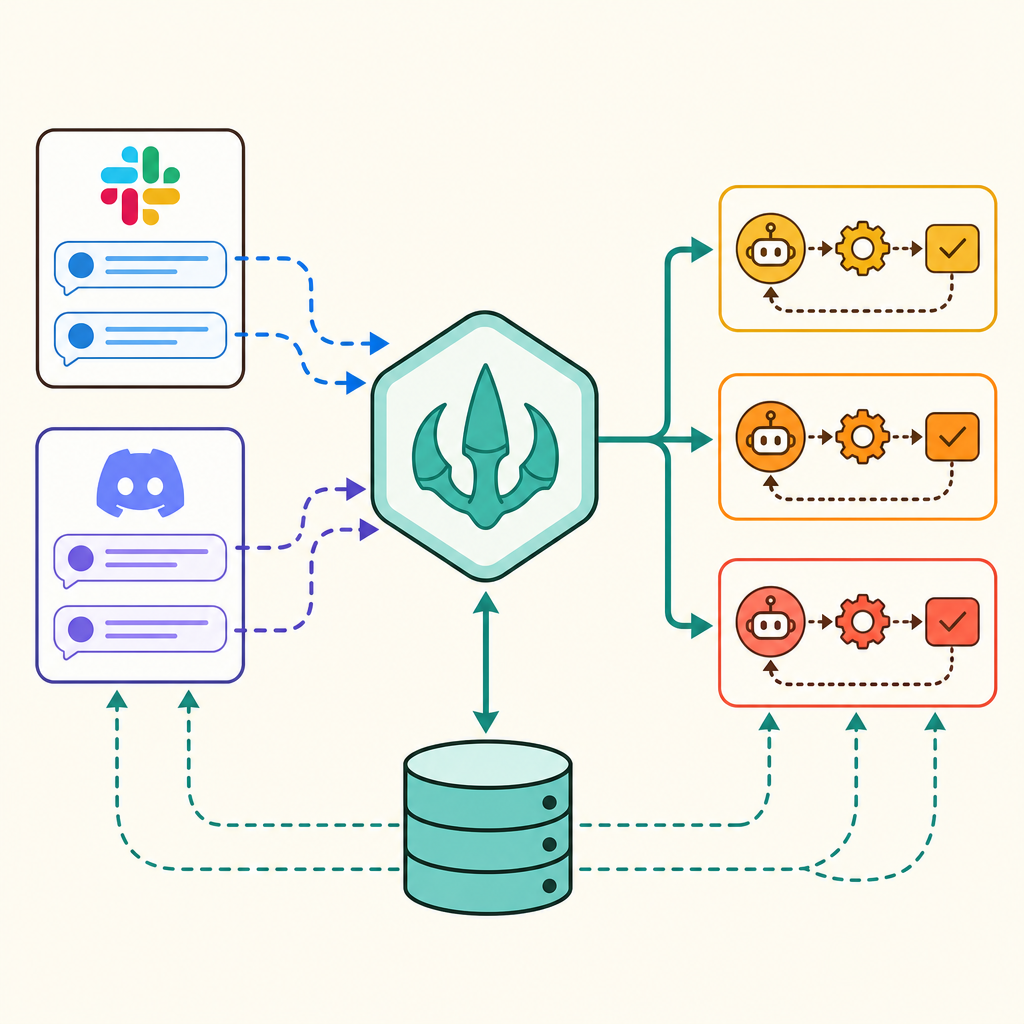
OpenClaw acts as a persistent multi-channel gateway. It connects surfaces such as Slack or Discord with agentic workflows.
Instead of keeping the agent inside one terminal session, OpenClaw coordinates requests across communication channels. Long-term state helps workflows continue across those surfaces.
This makes OpenClaw useful when someone delegates work asynchronously through messaging. The trade-off is architectural: orchestration and continuity matter more than tight, local repository feedback.
Hermes: Learning Runtime
Hermes Agent focuses on a self-improving runtime that stays active beyond one coding session.
Its learning loop generates skill documentation and maintains persistent cross-session memory. Previous work can therefore shape later interactions.
Choose Claude Code when you need hands-on control inside a local project. Consider OpenClaw or Hermes when asynchronous delegation, persistent operation, or broader orchestration matters more. The best choice depends on whether local context or lasting agent coordination drives the task.
Check yourself
Claude Code operates as a _____ execution agent.
- terminal-native
- multi-channel gateway
Answer: terminal-native
Claude Code is terminal-native and works directly inside your local development environment and shell, rather than functioning as a persistent multi-channel messaging gateway like OpenClaw.
In agent architectures, _____ coordinates messaging channels to route requests, while _____ operates as a persistent runtime with cross-session learning.
Answer: In agent architectures, OpenClaw coordinates messaging channels to route requests, while Hermes operates as a persistent runtime with cross-session learning.
OpenClaw functions as a multi-channel gateway across platforms like Slack or Discord, whereas Hermes is designed as a persistent, self-improving runtime with memory across sessions.
A developer needs an automated agent that can receive tasks asynchronously from team Slack messages and track workflows over time. Which agent architecture is best suited for this task?
- Claude Code
- OpenClaw
- A standard terminal REPL
- A local git hook runtime
Answer: OpenClaw
OpenClaw is designed as a persistent multi-channel gateway specifically tailored for receiving requests across communication channels like Slack and handling asynchronous delegation.
Keep going
This is lesson 1 of 5 in Building Agentic Workflows and Gbrain. Next up:
- Tool Use
- Knowledge Synthesis
- Automated Workflows
- Custom Hermes
Wondering turns any topic into short lessons you can read, watch, or listen to, with practice questions and an AI tutor.