Free sample lesson · Berkshire Hathaway Letters to Shareholders: 1965-2024
Business Ownership Mindset
What if buying stocks was actually buying real businesses?
Lesson 1 of the Wondering course Berkshire Hathaway Letters to Shareholders: 1965-2024
A Stock Is a Real Business
What if buying stocks was actually buying real businesses? It is.
Every share you buy makes you a part-owner of a company. You own a small fraction of the whole thing.
That company has tangible assets like buildings and equipment. It has employees doing real work. It produces earnings, or profit.
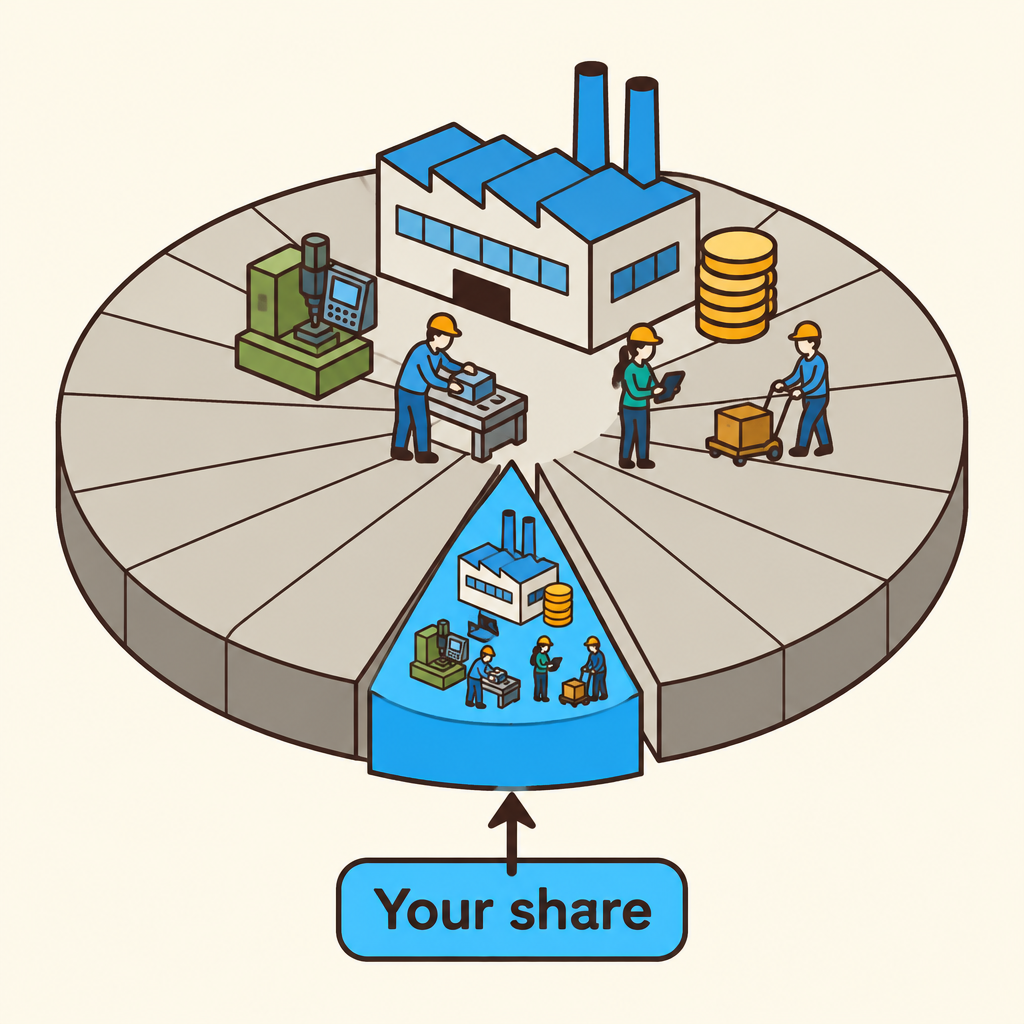
Your share is one small slice of the whole business, including its buildings, equipment, workers, and profits.
Your slice is tiny, but it is real ownership.
Ticket or Ownership Stake?
There are two ways to see a stock purchase.
Some people treat stocks as speculative tickets. They watch the price jump around, follow the market mood, and hope to sell to someone for more.
Value investors treat each purchase as an ownership stake in a real business, with a claim on its assets and earnings.
- Speculative ticket
- Ownership stake
The same share can be either. The difference lives in your head, and it shapes every decision you make.
Buffett's Private Business Test
Warren Buffett described his approach plainly.
Whenever Charlie and I buy common stocks for Berkshire's insurance companies, we approach the transaction as if we were buying into a private business.
He looks at the economic prospects of the business, the people in charge of running it, and the price he must pay. Turn those into questions: Will it earn well ahead? Who runs it? What must I pay?
Notice what is missing. There is no mention of charts or headlines.
Price Versus Intrinsic Worth
Value investing means buying securities at prices below their intrinsic worth.
Intrinsic worth is what the business itself is truly worth, based on its assets, earnings, and prospects.
The stock price is just what the market asks today. It can sit above or below that worth.
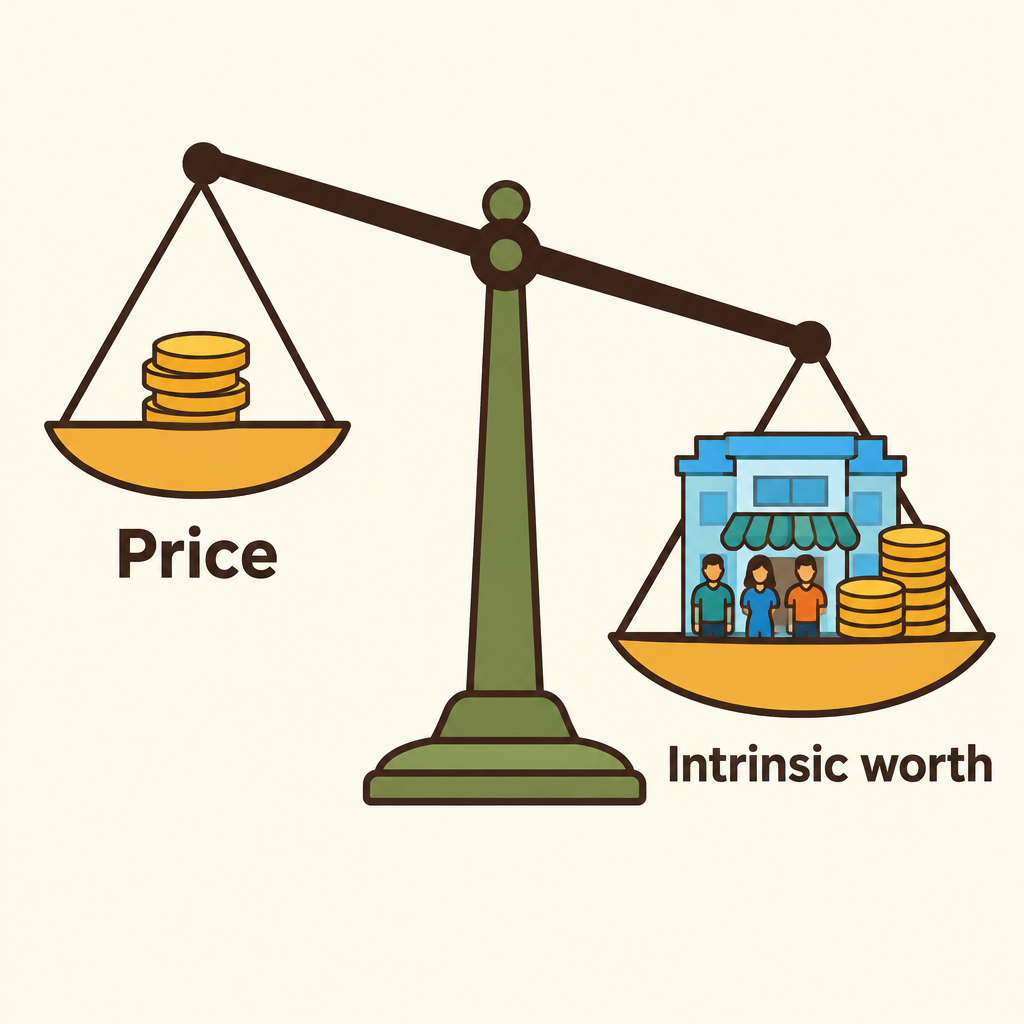
When the business side outweighs the price you pay, you are buying below intrinsic worth.
An owner asks one thing: am I paying less than this business is worth?
The Business Behind the Ticker
A ticker is the short symbol a stock trades under. Behind every ticker sits a real company.
Prices move every day. Market sentiment, the crowd's mood, swings from fear to excitement.
When a price jumps or drops, an owner asks: did the business itself change?
If yes, re-check its prospects, people, and price. If no, the move is mood, and the fundamentals still guide you.
- Price jumps or drops
- Business itself changed?
- Re-check fundamentals: Look again at prospects, people, and price.
- Treat it as mood: The crowd's sentiment moved, the business did not.
- Decide as an owner
- Yes
- No
No Exit Date in Mind
Buffett's quote ends with a striking line: We do not have in mind any time or price for sale.
A speculator plans the exit before buying. An owner of a private business rarely thinks that way.
Owners focus on how the business performs over time. The selling price is not the point of buying.
Thinking Like an Owner
Here is the whole mindset in one routine.
Before you buy, remember you are buying part of a real business. Study its economic prospects and the people in charge.
Then compare the price to its intrinsic worth. Ignore daily mood unless the business itself changes.
- Own a business: Remember each share is part of a real company.
- Study prospects: Ask whether the business will earn well ahead.
- Judge the people: Look at who is in charge of running it.
- Weigh price: Pay less than the business is worth.
- Ignore mood: React only when the business itself changes.
Explain it to a friend this way: a stock is a slice of a company, so judge the company.
Check yourself
When you buy a share of stock, you are buying _____
- a small piece of a real business
- a ticket to bet on price changes
Answer: a small piece of a real business
A share is a fractional ownership stake in a real business. It is not just a ticket whose only value comes from price changes; you own a small piece of the company's assets and earnings.
Value investing means buying securities at prices _____ their _____, treating each purchase as an _____ stake rather than a speculative ticket.
Answer: Value investing means buying securities at prices below their intrinsic worth, treating each purchase as an ownership stake rather than a speculative ticket.
Value investors aim to pay less than what a business is truly worth (its intrinsic worth). This only makes sense if a stock is viewed as ownership in a real business, not as a speculative bet.
Which of these is part of what a shareholder actually owns a fraction of?
- The company's assets and earnings
- The stock's ticker symbol
- The stock's recent price chart
- The market's current excitement
Answer: The company's assets and earnings
A shareholder owns a fraction of a real business, including its tangible assets, its workforce's productive output, and its earnings. Ticker symbols, chart patterns, and market buzz are not things the business owns.
Keep going
This is lesson 1 of 42 in Berkshire Hathaway Letters to Shareholders: 1965-2024. Next up:
- Price Versus Value
- Circle of Competence
- Mr. Market
- Margin of Safety
- Exponential Growth
Wondering turns any topic into short lessons you can read, watch, or listen to, with practice questions and an AI tutor.