Free sample lesson · Becoming a Scrabble Expert
Game Origins
How did an out-of-work architect's game end up in millions of homes?
Lesson 1 of the Wondering course Becoming a Scrabble Expert
Who decided a Q is worth 10?
It is 1933. The Great Depression has cost Alfred Mosher Butts his job as an architect, so he sits at home inventing a word game.
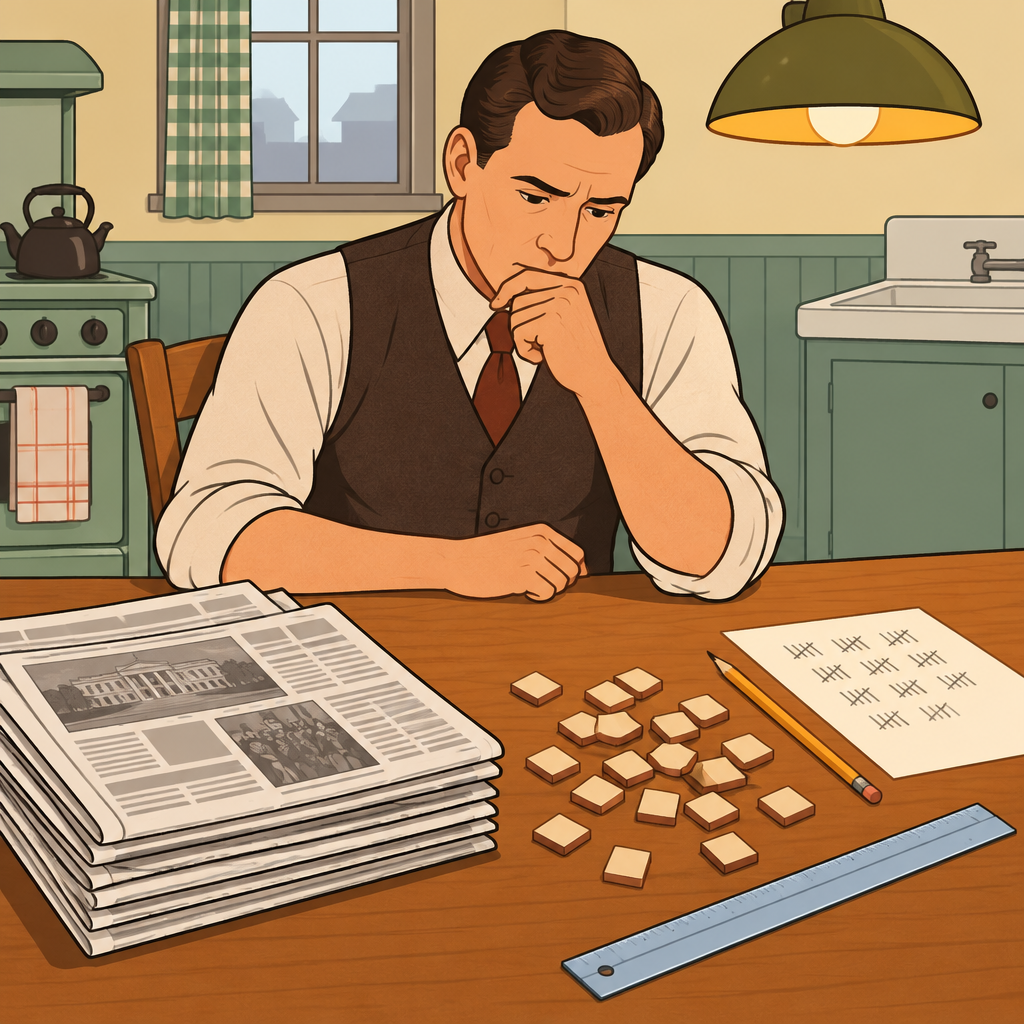
Notice how homemade everything is: a stack of newspapers and hand-cut tiles, far from any game company.
Decades later, that game sits in millions of homes. Every set carries the same verdict: a single Q, worth 10 points.
Someone made that call, and the answer explains why the game still feels fair.
But first, what exactly was Butts trying to build?
Butts wanted luck and skill together
Butts set out to mix two things: the luck of drawing tiles and the skill of building words.
He first called it Lexiko. Later he added a board where players linked words together the way a crossword does, and renamed it Criss-Crosswords.
- Core idea: Mix the luck of drawing tiles with the skill of building words.
- Lexiko: The first name Butts gave his game.
- Board added: Players now linked words together the way a crossword does.
- Criss-Crosswords: The new name for the board version.
That mix created a fairness problem: if luck hands you letters, every letter must be worth its trouble.
So how did he decide what each letter was worth?
Surely designers tuned the values by feel?
Many players assume a game company's designers picked the letter values by feel or by playtesting. That is how most modern board games get made, so it sounds right.
But no company was involved yet. Butts worked alone, and the big game makers would later turn him down.
- Common belief
- What happened
Butts set the values himself by counting how often letters appear in English, using front pages of The New York Times.
What does that counting actually produce?
Try it yourself: count, then price
Imagine you are Butts, deciding how many E and Q tiles to include and what each scores.
Suppose you count letters on New York Times front pages, as he did. E appears far more often than Q.
So you include 12 E tiles worth 1 point each. Q is rare, so it gets 1 tile worth 10 points.
You cap S at 4 tiles so players cannot turn every word plural too easily.
Rare letters become scarce and valuable; common letters become plentiful and cheap.
If the logic was this sound, why did no one want the game?
A fair game still got rejected
Major game companies turned Butts down. He made only a handful of sets by hand.
Then in 1948, James Brunot, an entrepreneur who knew Butts, got the rights. He adjusted the rules and board and trademarked the name Scrabble.
Good design was not enough; sales were still slow at first.
So what finally pushed the game into millions of homes?
A Macy's order changed everything
Look at the gap: Butts began in 1933, and Brunot trademarked Scrabble in 1948.
In 1952, the story goes, Jack Straus, head of Macy's, played the game on vacation. He was surprised his store did not stock it.
Macy's ordered it, and demand took off. In 1953, the established game maker Selchow & Righter took over production.
- Butts begins the game: An out-of-work architect starts inventing it.
- Brunot trademarks Scrabble: He adjusts the rules and board.
- Macy's orders it: Demand takes off after Jack Straus plays it.
- Selchow & Righter produce: An established game maker takes over production.
One executive's order turned a slow seller into a hit.
So, back to that kitchen table: who really decided a Q is worth 10?
Butts priced the Q, and it stuck
The Q's 10 points came from Butts himself, a jobless architect counting newspaper letters at home. No company tuned it.
Common letters got many cheap tiles; rare letters got few valuable ones. His game was turned down for years until a Macy's order made it a hit.
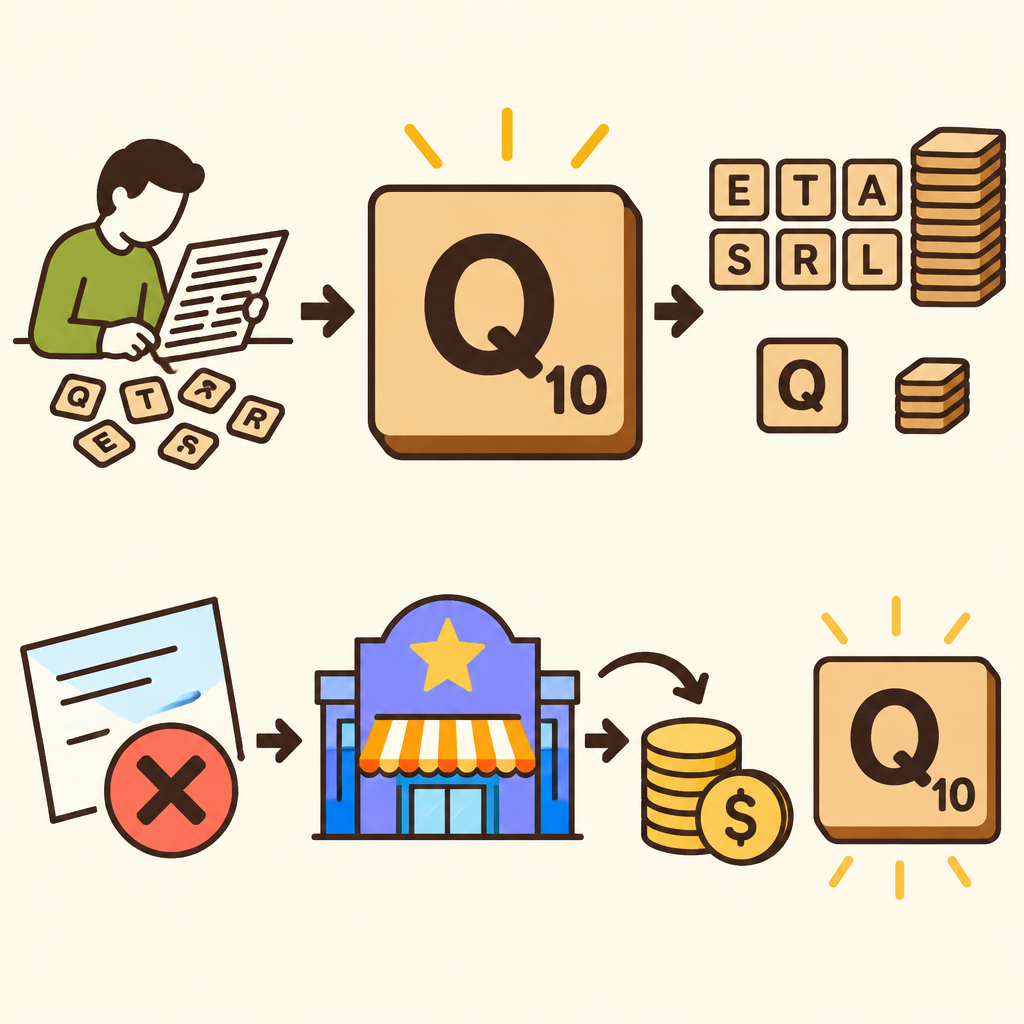
Butts's pricing, still printed on every Q
Butts earned a small royalty on each set sold. His letter values have barely changed since, so every Q you draw still carries his count.
Check yourself
Suppose a game maker uses Alfred Butts's method and finds that a letter shows up very often in newspaper text. That letter should get _____
- many tiles, each worth few points
- few tiles, each worth many points
Answer: many tiles, each worth few points
Butts made common letters plentiful and cheap, so a frequent letter gets many tiles worth few points. Few tiles worth many points is what rare letters such as Q and Z got.
Place the missing milestones back into the timeline of Scrabble's journey to success.
Answer: Brunot trademarks Scrabble, Macy's orders it
James Brunot refined the rules and trademarked the name Scrabble in 1948, and a surprise order from Macy's in 1952 triggered national demand.
A friend says: "A game company's design team picked Scrabble's letter values by playtesting until it felt right." What actually happened?
- Alfred Butts set them himself by counting letters in newspapers
- Designers at Selchow & Righter set them by playtesting
- James Brunot set them by feel when he trademarked Scrabble
- Macy's staff set them after watching customers play
Answer: Alfred Butts set them himself by counting letters in newspapers
Butts set the values himself by counting how often letters appeared in newspaper text. Many people assume company designers tested values by feel, because that is how most modern board games are made. But big game companies actually turned his game down.
Keep going
This is lesson 1 of 12 in Becoming a Scrabble Expert. Next up:
- Board Basics
- Tile Values
- Two-Letter Words
- Power Tiles
- Hooks
Wondering turns any topic into short lessons you can read, watch, or listen to, with practice questions and an AI tutor.