Free sample lesson · Backcountry Navigation and Off-Pavement Essentials
Tire Dynamics
Why does lowering your tire pressure suddenly make a bumpy trail feel like a paved highway?
Lesson 1 of the Wondering course Backcountry Navigation and Off-Pavement Essentials
The Problem with High Pressure
On paved roads, high tire pressure is excellent for fuel economy. It keeps the rubber stiff and reduces heat.
- Paved Roads
- Gravel & Dirt
However, high pressure is a disadvantage on gravel or dirt. The tires become hard like basketballs.
Instead of absorbing bumps, the vehicle bounces over every rock. This leads to a loss of traction and causes significant driver fatigue.
Expanding the Contact Patch
The contact patch is the specific area of the tire touching the ground.
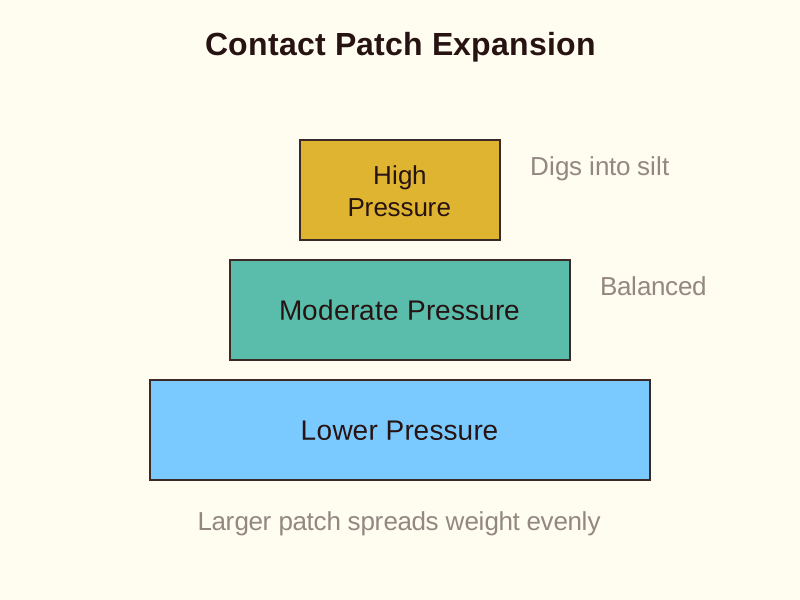
When you reduce air pressure, the tire flattens slightly. This increases the surface area in contact with the trail.
A larger patch distributes the weight of your vehicle more evenly. This prevents your tires from digging into soft silt or deep sand.
Grip and Secondary Suspension
Lowering your PSI allows the rubber to conform to obstacles. The tire wraps around rocks and roots rather than sliding over them.
- Lower PSI: Allows the rubber to conform and wrap around rocks and roots.
- Sidewall Flex: Softened sidewalls act as a secondary suspension system.
- Vibration Absorb: Absorbs high-frequency vibrations before reaching mechanical components.
Softened sidewalls also act as a secondary suspension system. They absorb high-frequency vibrations before they reach your mechanical components.
This protects your vehicle and makes the ride feel much smoother for passengers.
Mastering the Air Down
Airing down is a fundamental skill for backcountry travel. You must find the balance between grip and safety.
If the pressure is too low, the tire bead may detach from the rim. If it is too high, you risk wheel spin and trail erosion.
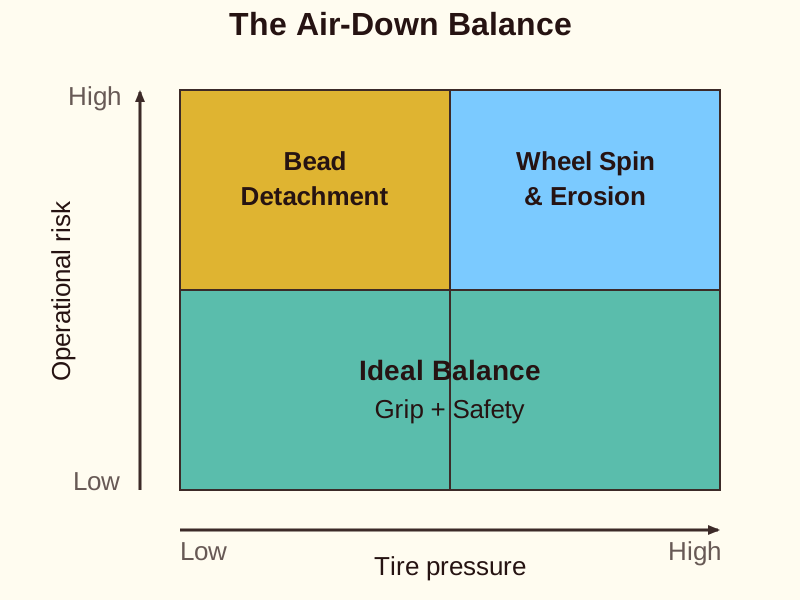
Proper management ensures you reach remote spots while protecting the environment and your equipment.
Check yourself
On gravel trails, lowering your tire pressure _____ the surface area of the contact patch touching the ground.
- increases
- decreases
Answer: increases
Lowering tire pressure flattens the rubber slightly, which expands the contact patch and distributes vehicle weight more evenly across unpaved surfaces.
In off-pavement driving, the _____ expands to distribute vehicle weight, while flexible sidewalls act as a _____ to absorb trail vibrations.
Answer: In off-pavement driving, the contact patch expands to distribute vehicle weight, while flexible sidewalls act as a secondary suspension to absorb trail vibrations.
The contact patch refers to the rubber touching the dirt, while flexible sidewalls serve as secondary suspension that filters out high-frequency bumps before they reach mechanical vehicle components.
Why is running high tire pressure a disadvantage when navigating loose dirt or gravel off-road?
- It makes tires hard, causing the vehicle to bounce over rocks and lose traction.
- It widens the contact patch excessively, causing tires to dig into deep sand.
- It instantly causes the tire bead to unseat and detach from the wheel rim.
- It increases rubber flexibility, causing severe tire overheating on dirt tracks.
Answer: It makes tires hard, causing the vehicle to bounce over rocks and lose traction.
High tire pressure keeps tires stiff like basketballs. On unpaved terrain, this causes the vehicle to bounce over rocks rather than conforming to them, reducing traction and increasing driver fatigue.
Keep going
This is lesson 1 of 15 in Backcountry Navigation and Off-Pavement Essentials. Next up:
- Vital Fluids
- Essential Gear
- Gravel Physics
- Mud Tactics
- Sand Navigation
Wondering turns any topic into short lessons you can read, watch, or listen to, with practice questions and an AI tutor.