Free sample lesson · AWS Cloud Practitioner Exam Mastery
Cloud Economics
Why would a CFO prefer paying monthly for servers instead of buying them upfront?
Lesson 1 of the Wondering course AWS Cloud Practitioner Exam Mastery
Why Cloud Economics Matters
Why might a CFO prefer paying monthly for servers instead of buying them upfront?
The answer begins with cloud economics: understanding how technology spending affects cash flow, flexibility, and business decisions.
Traditional infrastructure often requires large purchases before a system creates value. Cloud services can shift spending toward ongoing usage-based charges.
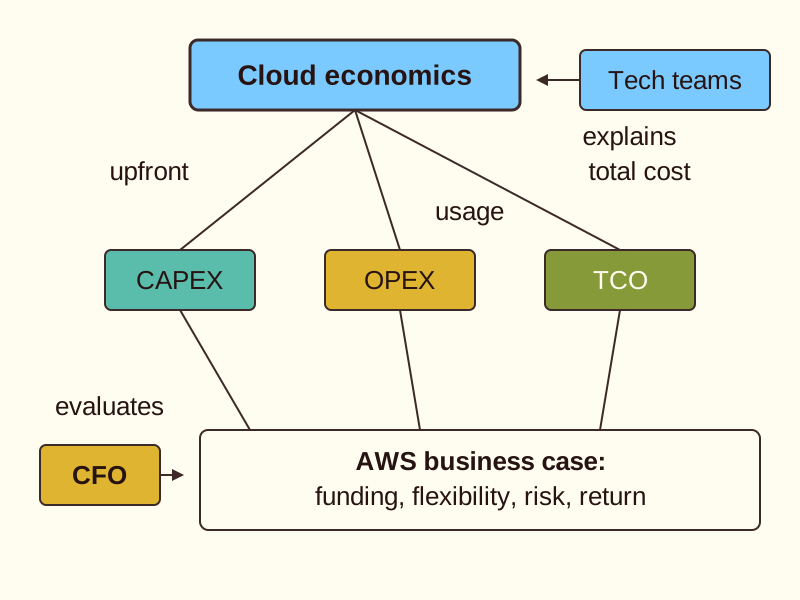
This difference matters when building an AWS business case. Technical teams can explain architecture, while finance leaders evaluate investment, risk, and return.
For the CLF-C02 exam, connect cloud economics to CAPEX, OPEX, and total cost of ownership.
CAPEX: Upfront Investment
CAPEX, or capital expenditure, is money spent acquiring long-term assets.
Buying physical servers, storage systems, and networking equipment usually creates an upfront investment. The organization pays before it knows exactly how much capacity it will need.
CAPEX can make sense when demand is stable and predictable. However, unused capacity still represents money tied up in infrastructure.
Planning also takes time. Teams may need to estimate future growth, purchase equipment, install it, and maintain it.
In an AWS discussion, describe CAPEX as ownership-oriented spending that can require significant initial funding.
OPEX: Ongoing Consumption
OPEX, or operational expenditure, covers ongoing costs required to run the business.
Cloud usage commonly fits this model because customers pay for services as they consume them. Costs can adjust as workloads grow, shrink, start, or stop.
This approach can reduce the need for large infrastructure purchases. It may also help teams launch projects without waiting for hardware procurement.
OPEX does not mean the service is free or automatically cheaper. Usage still requires monitoring, forecasting, and responsible management.
For stakeholders, explain OPEX as a spending model that supports flexibility and aligns costs with ongoing operations.
Understanding Total Cost
Total cost of ownership, or TCO, examines the full cost of a solution over its useful life.
A narrow comparison might look only at server prices. A TCO comparison considers related costs, such as infrastructure operations, maintenance, facilities, and staffing.
For AWS, the comparison should include cloud service charges and the costs of managing the cloud environment. The goal is a complete view rather than a single invoice.
TCO is useful when presenting options to finance and business leaders. It helps them compare ownership and consumption using the same overall cost perspective.
Comparing Spending Models
Imagine a company preparing for uncertain application demand. With owned infrastructure, it may purchase enough capacity for expected peaks.
That capacity can remain underused during quieter periods, while expansion may require another purchase. This creates a planning challenge for finance and technology teams.
With AWS, the company can select services based on current needs and adjust as demand changes. The financial pattern becomes more closely connected to usage.
The choice depends on the workload, operating model, and business goals. Cloud is a financial option to evaluate, not a guarantee of lower TCO.
- Owned infrastructure
- AWS services
Building The Business Case
A strong AWS business case connects technical choices with financial outcomes.
Start by identifying the current infrastructure model, expected workload behavior, and costs included in the existing environment. Then compare those costs with expected AWS consumption and operating requirements.
Explain assumptions clearly. For example, state whether demand is steady, variable, seasonal, or uncertain.
Enterprise stakeholders may value different outcomes. A CFO may focus on cash flow and predictability, while an engineering leader may focus on agility and capacity.
An AI Success Manager should translate these perspectives into one clear recommendation.
- Identify: Identify the current infrastructure model, expected workload behavior, and costs in the existing environment.
- Compare: Compare current costs with expected AWS consumption and operating requirements.
- State assumptions: Describe whether demand is steady, variable, seasonal, or uncertain.
- Recommend: Translate CFO concerns about cash flow and predictability and engineering concerns about agility and capacity into one recommendation.
Key Takeaways For CLF-C02
Remember the core definitions:
CAPEX is upfront spending for owned assets. OPEX is ongoing spending for operations and consumption. TCO evaluates the complete cost of a solution.
Cloud economics helps organizations assess more than technology performance. It supports decisions about funding, flexibility, capacity, and risk.
When answering an exam question, look for clues about upfront ownership, ongoing usage, or complete lifecycle cost.
When speaking with executives, avoid promising automatic savings. Explain the assumptions, compare the full costs, and connect AWS usage to business value.
Check yourself
In cloud economics, purchasing physical servers upfront represents _____ spending.
- CAPEX
- OPEX
Answer: CAPEX
CAPEX (capital expenditure) refers to upfront spending on long-term assets such as hardware, while OPEX covers ongoing operational costs.
In financial planning, _____ requires significant upfront investment for owned physical assets, whereas _____ involves ongoing usage-based payments for operational consumption.
Answer: In financial planning, CAPEX requires significant upfront investment for owned physical assets, whereas OPEX involves ongoing usage-based payments for operational consumption.
CAPEX focuses on upfront investments in owned infrastructure, whereas OPEX reflects flexible, pay-as-you-go operational expenditures.
When evaluating AWS infrastructure costs against traditional on-premises hardware, what should be included in a complete Total Cost of Ownership (TCO) calculation?
- Server hardware purchase price and software licensing fees only
- Server hardware, facilities, ongoing maintenance, staffing, and AWS service charges
- Monthly AWS service charges excluding internal administrative or operating effort
- Upfront hardware acquisitions and network equipment expenses exclusively
Answer: Server hardware, facilities, ongoing maintenance, staffing, and AWS service charges
A complete TCO analysis evaluates full lifecycle expenses including server hardware, facilities, maintenance, power, staffing, and ongoing AWS usage fees.
Keep going
This is lesson 1 of 25 in AWS Cloud Practitioner Exam Mastery. Next up:
- Service Models
- Cloud Architecture
- Migration Strategies
- AWS Geography
- Shared Responsibility
Wondering turns any topic into short lessons you can read, watch, or listen to, with practice questions and an AI tutor.