Free sample lesson · AWS Certified Solutions Architect – Associate (SAA-C03) — Complete
AWS Global Infrastructure: Regions, AZs, Edge Locations, and Shared Responsibility
Lesson 1 of the Wondering course AWS Certified Solutions Architect – Associate (SAA-C03) — Complete
Regions, Zones, Data Centers
AWS runs the cloud from physical sites spread around the world. Understanding that layout is the first step to designing anything on it.
A Region is a geographic area, such as Ireland or Northern Virginia. Each Region contains several Availability Zones.
An Availability Zone is one or more data centers with its own power, cooling, and networking.
- Region: A geographic area such as Ireland or Northern Virginia.
- Availability Zone: Several Zones sit inside one Region.
- Data center: One or more data centers make up a Zone.
Each layer is contained by the layer outside it
Why Availability Zones Matter
Availability Zones inside a Region sit miles apart, with separate power and cooling.
That distance is deliberate. One flood or power failure should not take down every Zone at once.
They are still close enough for fast private links between them, so you can run one application across two or more Zones and survive the loss of one.
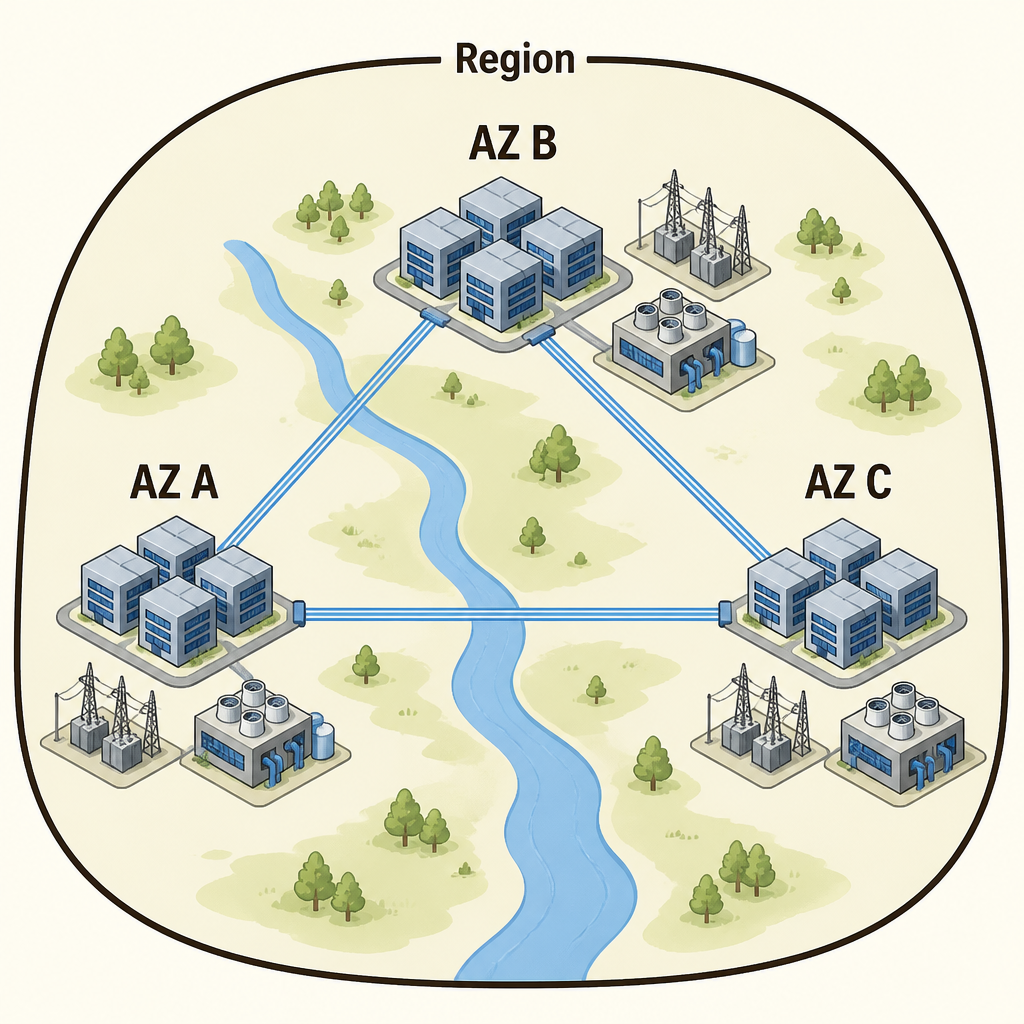
Notice that the campuses are far enough apart to fail independently, yet still wired together inside the same Region boundary.
Edge Locations and Local Zones
Sometimes the nearest Region is still too far from your users.
Edge locations sit in many cities and cache content close to end users for services like CloudFront.
Local Zones go further. They place compute and storage in a large metro area, so nearby users get single-digit millisecond latency to your own servers.
- Edge locations
- Local Zones
Check yourself
An AWS Region contains multiple Availability Zones.
- True
- False
Answer: True
Correct. A Region is a geographic area, and each Region contains several Availability Zones.
AWS infrastructure uses geographic _____, independent infrastructure groupings called _____, and city-based _____ that cache content near users.
Answer: AWS infrastructure uses geographic Regions, independent infrastructure groupings called Availability Zones, and city-based edge locations that cache content near users.
Regions are broad geographic areas, Availability Zones contain independently supported data centers, and edge locations cache content near end users.
Why are Availability Zones within the same Region placed miles apart but connected by fast private links?
- To reduce correlated failures while supporting fast cross-Zone application communication
- To place every application in one isolated data center
- To move cached content closer to users in many cities
- To provide compute only in large metropolitan areas
Answer: To reduce correlated failures while supporting fast cross-Zone application communication
The separation helps prevent one flood or power failure from affecting every Zone, while fast private links support applications spanning multiple Zones.
Keep going
This is lesson 1 of 65 in AWS Certified Solutions Architect – Associate (SAA-C03) — Complete. Next up:
- IAM Core Concepts: Users, Groups, Roles, and Policies
- IAM Advanced: Cross-Account Access, STS, and Identity Federation
- AWS Organizations, Control Tower, and Multi-Account Strategy
- EC2 Instance Types, Purchase Options, and Placement Groups
- EC2 Storage: EBS Volumes, Instance Store, and EBS Snapshots
Wondering turns any topic into short lessons you can read, watch, or listen to, with practice questions and an AI tutor.