Free sample lesson · Autonomous Dialysis Research Lab
Kidney Functions
How does an external machine replace a vital human organ?
Lesson 1 of the Wondering course Autonomous Dialysis Research Lab
The Kidney as Filter
How can an external machine replace a vital human organ?
The kidneys continuously filter blood, removing unwanted substances while keeping useful materials in balance.
Think of each kidney as a natural API for the blood. It receives changing inputs and helps maintain a stable internal state.
This stable state is called homeostasis.
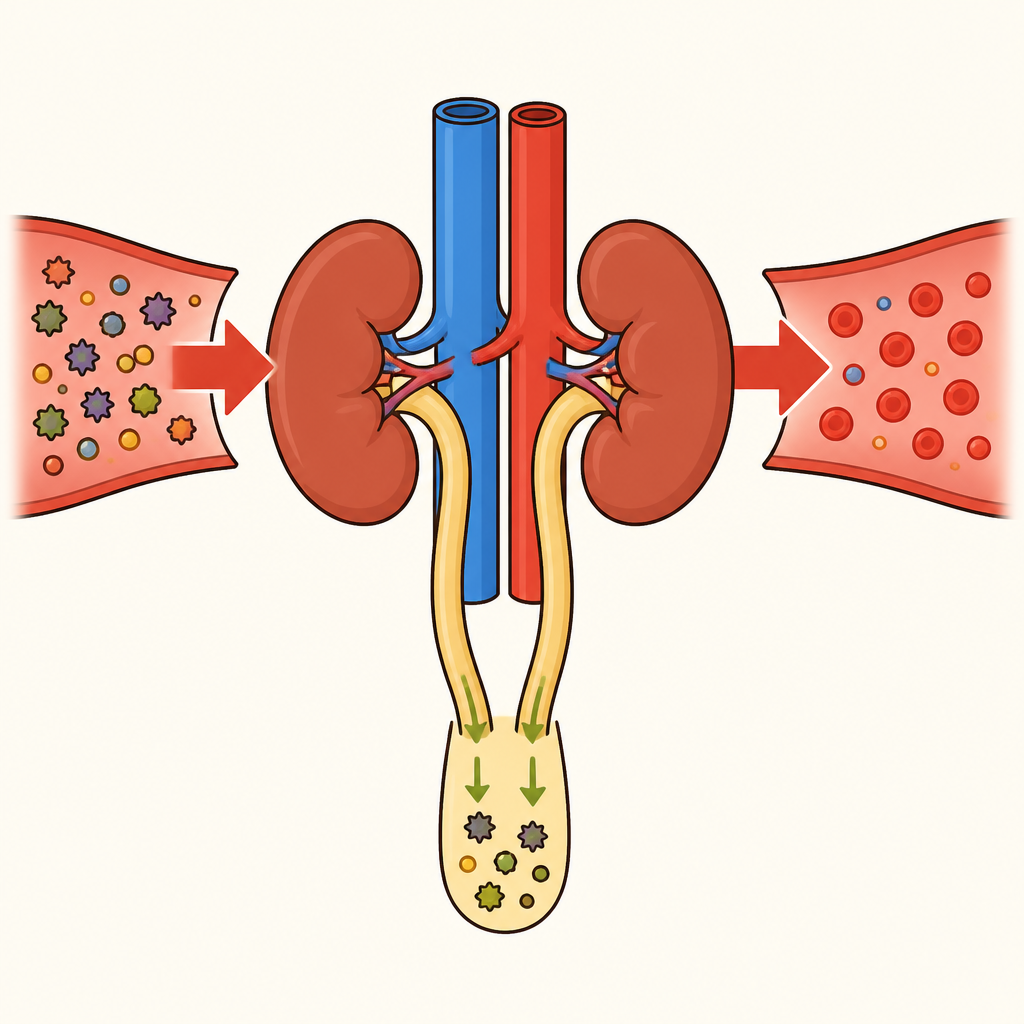
Notice how changing blood inputs pass through kidney filtration while useful materials remain balanced, producing a more stable internal state.
Selective Filtering
Kidney filtration depends on selective permeability. This means the filtering system allows some substances through while limiting others.
Waste products can leave the blood, while important substances remain available to the body.
The process is continuous rather than occasional. The kidneys process the entire blood volume multiple times a day, responding to the body’s changing needs.
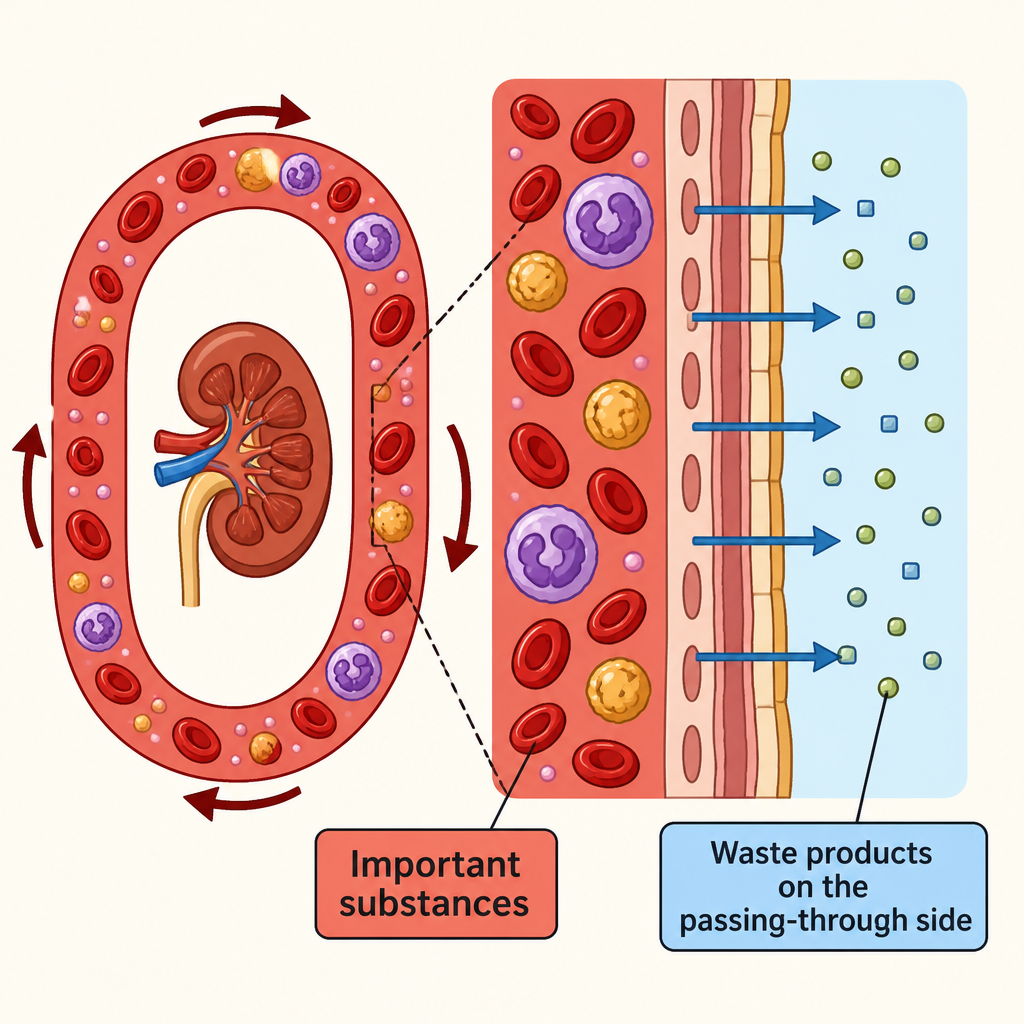
Notice that the filter lets waste products pass while limiting the passage of important substances, and that blood keeps circulating through the process.
Removing Metabolic Waste
Cells produce waste as the body uses energy. The kidneys remove waste products such as urea and creatinine from the blood.
These substances are useful signals about kidney function, but they should not keep accumulating in circulation.
Effective filtration lowers their buildup and helps protect the body’s internal environment.
Balancing Fluids and Electrolytes
The kidneys also regulate electrolytes, which are dissolved substances the body needs for normal function.
Important examples include sodium and potassium. The kidneys help keep their levels within a workable balance.
They also help manage fluid balance. Filtering waste without regulating fluids and electrolytes would leave the body unstable.
When Kidney Function Fails
If the kidneys fail, filtration becomes inadequate. Urea, creatinine, and other wastes can build up in the bloodstream.
Fluid and electrolyte balance can also become disrupted. These changes affect the body broadly because blood carries materials throughout the system.
Without support, severe buildup can lead to systemic failure, meaning the whole body is affected.
- Filtration fails: Kidney filtration becomes inadequate.
- Wastes build up: Urea, creatinine, and other wastes accumulate in the bloodstream.
- Balance disrupts: Fluid and electrolyte balance can also become disrupted.
- Body is affected: Because blood carries materials throughout the system, severe buildup can affect the whole body.
- Systemic failure: Without support, severe buildup can lead to systemic failure.
Dialysis and Closed-Loop Control
Dialysis is a mechanical proxy for kidney filtration. It supports the removal of wastes and helps manage the blood’s internal balance.
In an autonomous research lab, software agents can monitor clinical data and adjust machine parameters in real time.
This creates a closed-loop control system: measure the patient’s state, make an adjustment, and continue monitoring the response.
- Measure state: Monitor clinical data about the patient.
- Adjust parameters: Software agents change machine parameters in real time.
- Continue monitoring: Observe the response after the adjustment.
Check yourself
What is the stable internal state that healthy kidneys help maintain?
- Homeostasis
- Systemic failure
Answer: Homeostasis
The stable internal state is called homeostasis. Kidney filtration supports homeostasis by balancing wastes, fluids, and electrolytes.
Kidney filtration uses _____ to allow some substances through, helps maintain _____, and can be mechanically supported by _____.
Answer: Kidney filtration uses selective permeability to allow some substances through, helps maintain homeostasis, and can be mechanically supported by dialysis.
Selective permeability describes controlled passage through the filter. Homeostasis is the stable internal state, and dialysis mechanically supports kidney filtration.
A kidney filter removes waste from blood but keeps useful materials available. Which feature makes this selective rather than unrestricted filtration?
- Selective permeability
- Continuous blood production
- Systemic failure
- Random substance movement
Answer: Selective permeability
Selective permeability allows some substances through while limiting others. This lets waste leave while useful materials remain available to the body.
Keep going
This is lesson 1 of 8 in Autonomous Dialysis Research Lab. Next up:
- Dialysis Metrics
- Paper Ingestion
- Expert Tracking
- Agent Coordination
- Validating Findings
Wondering turns any topic into short lessons you can read, watch, or listen to, with practice questions and an AI tutor.