Free sample lesson · Attention Is All You Need
RNN Limitations
What if we could train models faster by processing all words simultaneously instead of one at a time?
Lesson 1 of the Wondering course Attention Is All You Need
Reading One Word at a Time
Imagine reading a sentence through a keyhole that shows one word at a time.
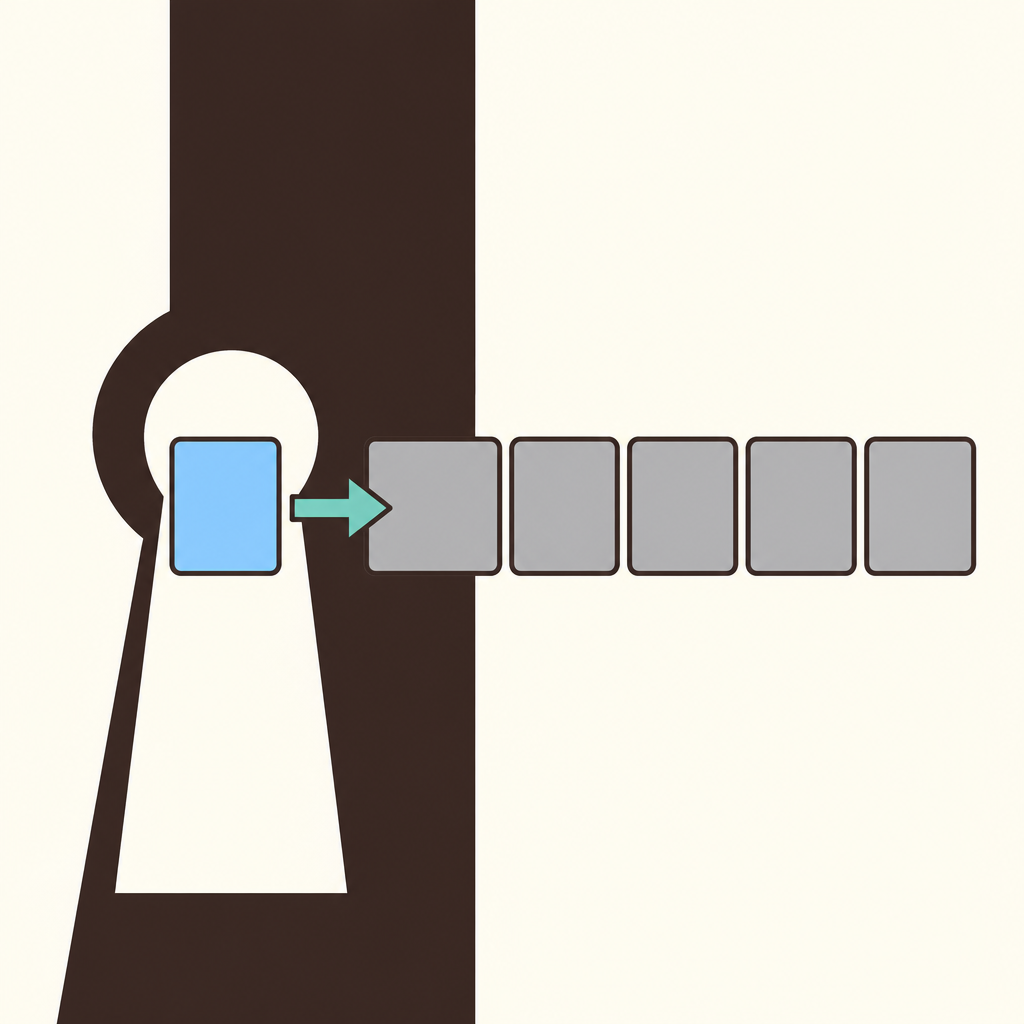
Notice that only one word sits inside the opening while every later word waits its turn behind it.
That is how a recurrent model works. It is a type of machine that reads a sequence step by step, passing a small memory forward from each position to the next.
Position two cannot be handled until position one finishes.
This step-by-step habit is the source of almost every problem in this lesson.
Why Sequential Means Slow
Computers are fast because they can do many small jobs at the same time. That is called parallel work.
Recurrent models block this. Since each step needs the result of the step before it, the machine has to wait.
- Sequential
- Parallel
Training a model means feeding it enormous amounts of text. Waiting at every single position adds up to very long training times.
Long Sequences Make It Worse
Short sentences hide the problem. Long ones expose it.
A 10-word input needs 10 waiting steps. A 500-word document needs 500.
- 10 words: 10
- 500 words: 500
The usual escape route is batching: processing several examples side by side. But long sequences eat up memory, so fewer examples fit into a batch at once.
So the trick that normally rescues speed stops working exactly when you need it most.
Distant Words Lose Touch
The second limitation is about meaning, not speed.
Related words are often far apart. In "The keys that I left on the kitchen table this morning are missing", keys and are must agree.
In a recurrent model, information has to travel through every position in between. The distance between related words grows step by step with how far apart they sit.
- Start: The model reads the word 'keys' and stores it in memory.
- Carry: That memory is passed through 'that I left on the kitchen table'.
- Fade: Every extra position adds another hop the signal must survive.
- Arrive: Only then does the model reach 'are' and try to match it with 'keys'.
The longer the path, the harder that connection is to learn.
Two Problems, One Cause
Both weaknesses trace back to the same design choice.
Because computation is arranged along the positions of the sequence, work cannot be spread out, and information cannot take a shortcut.
- No parallelization: Work cannot be spread out across positions.
- Slow training: Long sequences force long waits.
- Growing distance: Information cannot take a shortcut between positions.
- Weak long-range links: Distant related words are harder to connect.
- Memory limits: Long sequences shrink how much can be batched.
Speed and long-range understanding suffer together.
Attention Removes the Distance
Attention is a mechanism that lets a model link two positions directly.
With attention, dependencies can be modelled without regard to their distance in the input or output sequence. The word keys can reach are in one move.
Attention has become an integral part of strong sequence models for exactly this reason.
Why This Sets Up Transformers
Keep two ideas from this lesson.
First, sequential computation blocks parallel work and slows training, especially on long inputs where memory limits batching.
Second, distance between related words grows with position, weakening long-range learning.
- Recurrent model
- Attention model
A design built on attention alone can process positions simultaneously and connect any two words directly. That design is the Transformer.
Check yourself
Can a recurrent model handle position two before position one has finished?
- Yes
- No
Answer: No
No. Each position needs the result and memory from the previous position, so the model must wait.
For recurrent models, _____ causes waiting between positions, while _____ make distant word connections harder to learn.
Answer: For recurrent models, sequential computation causes waiting between positions, while long-range dependencies make distant word connections harder to learn.
Sequential computation creates the speed problem because positions cannot be handled together. Long-range dependencies create the meaning problem because distant information must travel through many positions.
In the sentence “The keys that I left on the table are missing,” why is the relationship between “keys” and “are” difficult for an RNN?
- The words must be connected through intervening positions
- The two words always have opposite meanings
- The sentence contains too few words to process
- The model can directly connect only adjacent words
Answer: The words must be connected through intervening positions
An RNN must carry information through every position between “keys” and “are.” The longer this path, the harder the connection is to learn.
Keep going
This is lesson 1 of 21 in Attention Is All You Need. Next up:
- Attention-Only Model
- Encoder-Decoder Stack
- Encoder Layers
- Decoder Masking
- Attention Basics
Wondering turns any topic into short lessons you can read, watch, or listen to, with practice questions and an AI tutor.