Free sample lesson · Atomic Habits
Compound Effect
If you improve by 1% daily for a year, you'll be 37 times better—not 365% better.
Lesson 1 of the Wondering course Atomic Habits
Small Changes, Big Results
The compound effect describes how small actions grow stronger through repetition.
A tiny improvement may feel invisible today. Repeated over months or years, it can create an enormous difference.
Improving by 1% daily for one year can make you about 37 times better, rather than 365% better.
This idea applies to learning, health, work, and personal growth. Progress does not require one dramatic transformation.
It requires actions small enough to repeat consistently. Each action becomes part of a larger pattern, and that pattern shapes your results over time.
- Small action: A tiny improvement may feel invisible on a single day.
- Repeat: Repeating the action over months or years makes its effect accumulate.
- Larger pattern: Each action becomes part of a pattern that shapes results over time.
- Big result: A 1% daily improvement for one year can become about 37 times better, not 365% better.
How Compounding Works
Compounding means that each improvement builds on the improvements before it.
If you improve by 1%, your next improvement starts from a slightly higher level. The gains begin multiplying instead of simply adding.
The daily comparison shows the difference: 1% repeated for 365 days produces about 37 times the starting result.
Adding 1% for 365 days would suggest 365%. Compounding follows a different path because every gain strengthens the next one.
- Compounding
- Adding
This mechanism explains why progress can look slow at first, then become much more noticeable later.
Atomic Habits Begin Small
An atomic habit is a tiny change that creates a marginal gain and compounds over time.
Its small size makes it easier to repeat. Repetition gives the habit more chances to produce value.
For example, improving one small part of a routine can support broader self-improvement. The daily action may seem too minor to matter, especially during the first few days.
However, habits behave like compound interest. Money grows when interest repeatedly earns more interest; habits grow when repeated actions create stronger results.
The key is choosing a useful action and continuing long enough for its effects to accumulate.
- Choose: Select one useful action that represents a tiny change.
- Repeat: Keep the action small enough to repeat consistently.
- Accumulate: Repeated actions create stronger results over time.
- Continue: Give the habit enough time for its effects to compound.
The Power of Marginal Gains
Marginal gains are small improvements made across different areas.
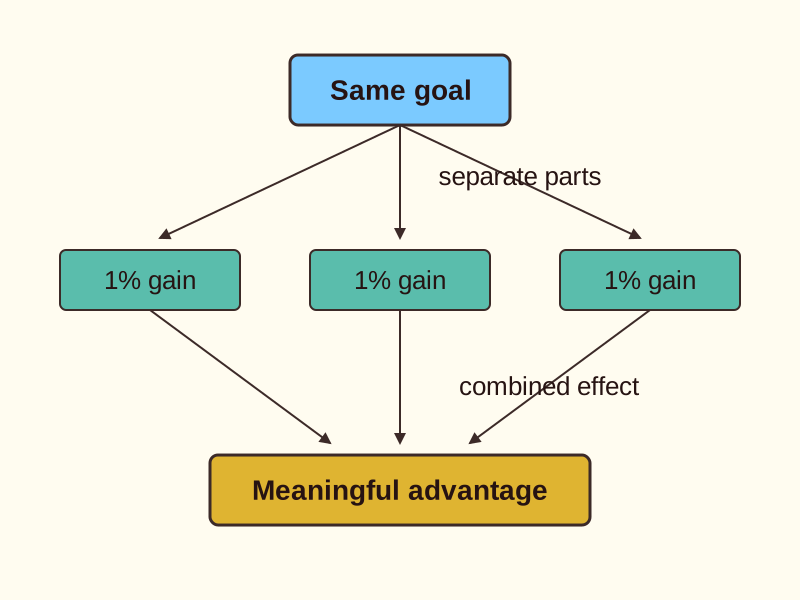
Success can come from the aggregation of many 1% gains rather than one dramatic change. Each improvement may address a separate part of the same goal.
A single gain might seem insignificant. Several gains working together can create a meaningful advantage.
This approach changes the question you ask. Instead of searching for one perfect solution, look for small improvements in everything connected to the result.
The strength comes from the collection of gains. Their combined effect can become much larger than any individual change.
British Cycling Example
Dave Brailsford introduced the idea of the aggregation of marginal gains to British Cycling.
The team searched for tiny 1% improvements in everything connected to performance. The focus was broad rather than limited to one dramatic change.
This example shows how many small gains can work together. Each improvement contributed to a larger system of progress.
Just five years later, British cyclists dominated the 2008 Olympics.

The lesson is clear: sustained improvement can come from examining many small details. A group, team, or individual can apply the same mindset by looking for repeatable gains across multiple areas.
Progress May Feel Invisible
The compound effect can be difficult to trust because early results may appear small.
A 1% improvement on one day rarely feels dramatic. Even several repeated actions may seem ordinary while they are building momentum.
This creates a common misconception: visible results must come from a major effort. The source idea points elsewhere, toward consistent habits and accumulated gains.
Compounding also does not mean every day produces a perfect result. Missing one opportunity does not erase all previous progress, but repeated inconsistency weakens the pattern.
Focus on returning to the small action. Long-term accumulation matters more than making every single day look impressive.
- Begin pattern
- Small action: Focus on returning to the small action rather than making every day impressive.
- What happened?: Consider whether an opportunity was missed or inconsistency has repeated.
- Return: Return to the small action and continue.
- Weakened pattern: Repeated inconsistency weakens the pattern.
- Accumulate: Long-term accumulation continues to matter.
- does not erase progress
- continue the pattern
- weakens the pattern
- supports accumulation
Apply The Compound Effect
Start by choosing one area where a small improvement would help.
Define a simple action that represents a 1% gain. Keep it small enough to repeat without requiring a dramatic change.
Next, examine other connected areas. The marginal-gains approach asks where several small improvements could support the same goal.
Track repetition over time rather than judging one day. The important pattern may emerge across months and years, not immediately.
Remember the central numbers: 1% daily, 365 days, and about 37 times the result. Small habits become powerful when repetition gives them time to compound.
- Choose an area: Start with one area where a small improvement would help.
- Define a 1% gain: Set a simple action small enough to repeat without a dramatic change.
- Find connected gains: Examine other areas where small improvements could support the same goal.
- Track repetition: Judge the pattern across months and years rather than judging one day.
- Remember the result: 1% daily for 365 days can become about 37 times the result.
Check yourself
Which statement best describes the compound effect?
- Small actions become powerful through repeated accumulation
- One dramatic action produces immediate transformation
Answer: Small actions become powerful through repeated accumulation
The compound effect means that small actions can create very large results when repeated over months or years. A single small action may seem unimportant, but repetition allows its effects to accumulate.
A tiny change designed to be easy to repeat is an _____. The improvement it creates is a _____.
Answer: A tiny change designed to be easy to repeat is an atomic habit. The improvement it creates is a marginal gain.
An atomic habit is deliberately small so it is easier to repeat. Repetition gives its marginal gain more opportunities to accumulate over time.
A cycling team wants to use marginal gains to improve performance. Which approach best fits this idea?
- Improve several connected parts by small amounts
- Search for one perfect solution
Answer: Improve several connected parts by small amounts
Marginal gains involve improving several parts of a system. The combined improvements can create a meaningful advantage without requiring one dramatic transformation.
Keep going
This is lesson 1 of 25 in Atomic Habits. Next up:
- Trajectory Over Position
- Breakthrough Through Patience
- Systems Over Goals
- Identity-Based Habits
- Habit Loop
Wondering turns any topic into short lessons you can read, watch, or listen to, with practice questions and an AI tutor.