Free sample lesson · Astronomy 2e IV — Exoplanets and the Search for Life
Planetary Systems Rewrite the Template
How did giant planets end up skimming their stars every few days?
Lesson 1 of the Wondering course Astronomy 2e IV — Exoplanets and the Search for Life
Giants That Skim Their Stars
Some giant planets circle their stars in only a few days.
These hot Jupiters sit far closer to their star than any planet in our system sits to the Sun.
The inner disk there is hot and poor in solid material, so building a giant on the spot is hard to explain.
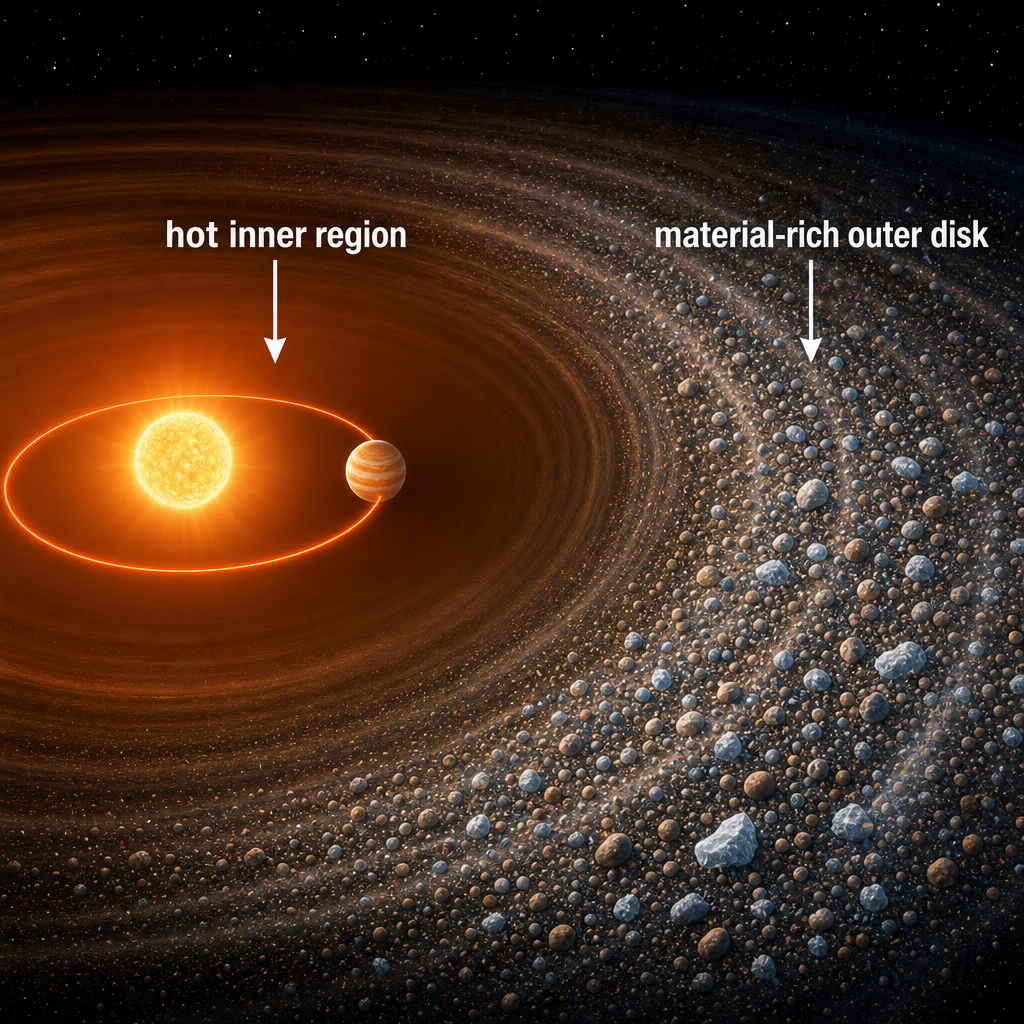
Notice how little solid material surrounds the giant's present orbit compared with the cold outer disk, which is why in-place building is hard to explain.
Disks Are Still The Start
Planetary systems still begin the same way, with a disk of gas and dust around a young star.
Solids condense, grains stick, and cores grow by accretion.
A large core in a cold, material-rich region can then capture gas and become a giant.
- Disk forms: Gas and dust settle into a disk around a young star.
- Solids condense: Material condenses into grains that stick together.
- Cores accrete: Grains build up into growing planetary cores.
- Gas capture: A large core in a cold, material-rich region captures gas.
Formation explains what a planet is made of. It does not fix where that planet stays.
Orbits Do Not Stay Fixed
Planets do not stay parked after accretion.
Torques from the surrounding disk can drag a young planet inward.
Orbital resonances can lock neighbours together and shift them as a pair.
Close encounters and scattering can fling planets onto tight or stretched orbits.
In Place Or Moved In?
Take a giant planet skimming its star. Two explanations compete.
In-place formation struggles, because the hot inner disk offers little material for building a giant.
Inward migration fits better. The planet likely formed farther out, where more material was available, and then moved in.
- In-place formation
- Inward migration
Architectures Beyond Our Template
Rocky worlds inside and giants outside is our arrangement, not a rule.
Some systems hold a giant on an orbit lasting only days.
Compact systems pack several planets tightly near their star.
- Solar System
- Hot Jupiter system
- Compact system
Each layout reflects formation ingredients plus later orbital evolution.
Splitting The Story In Two
When you meet a new architecture, ask two questions in order.
First, could the planet have formed where it now orbits, given the material available there?
If yes, in-place formation is plausible. If no, later evolution such as migration or scattering must carry part of the story.
Then state both parts of the history together.
- Note the orbit: Start from where the planet sits now.
- Enough local material?: Could it have formed where it now orbits?
- In-place formation: Formation alone can carry the explanation.
- Add later evolution: Migration or scattering carries part of the story.
- State both parts
- Yes
- No
Holding The Claim Carefully
Migration is a family of mechanisms, not one guaranteed path.
One unusual system does not falsify disk formation as a whole.
Exoplanet systems test which of our arrangements are common and which are simply contingent.
Check yourself
Do planetary systems begin from gas-and-dust disks around young stars?
- Yes
- No
Answer: Yes
Yes. Solids condense in these disks, grains stick together, and cores grow by accretion.
After formation, disk torques can drag a young planet _____, orbital resonances can _____, and close encounters can _____.
Answer: After formation, disk torques can drag a young planet inward, orbital resonances can lock neighbours, and close encounters can scatter planets.
Different mechanisms change orbits in different ways: disk torques move planets inward, resonance links neighboring orbits, and scattering can produce tight or stretched orbits.
A giant planet completes an orbit around its star every three days. The nearby disk had little solid material. Which history best explains this system?
- It formed farther out and later migrated inward.
- It formed easily in the hot inner disk and never moved.
- It formed from rocky worlds that moved outward and became gas giants.
- It formed after the star lost all gas from its disk.
Answer: It formed farther out and later migrated inward.
The planet likely formed farther out, where the disk contained more material, and later migrated inward. Its present orbit does not have to be its formation location.
Keep going
This is lesson 1 of 8 in Astronomy 2e IV — Exoplanets and the Search for Life. Next up:
- Catch a Planet Crossing
- Hear a Star’s Doppler Wobble
- Find Worlds without a Transit
- A Catalog Is Not a Census
- Read an Alien Atmosphere
Wondering turns any topic into short lessons you can read, watch, or listen to, with practice questions and an AI tutor.