Free sample lesson · Astronomy 2e III — Galaxies and the Evolving Universe
Map the Milky Way from Within
How can dust hide the Galactic center but reveal its gravity?
Lesson 1 of the Wondering course Astronomy 2e III — Galaxies and the Evolving Universe
Mapping from the Inside
We live inside the Milky Way's dusty disk. There is no external vantage point.
So every map is a reconstruction built from tracers: light at many wavelengths, plus the motions of gas and stars.
That bright band across the sky is only the part of the disk we can see. It is not the whole Galaxy.
- External photo
- Reconstruction
- A foggy-city analogy
Dust Blocks Visible Light
Dust in the disk absorbs and scatters visible light. Looking toward the Galactic center in visible light, we see very little.
Infrared light passes through much of that dust, revealing the central stellar region.
Radio waves bypass the obscuration entirely and map gas across the whole disk.
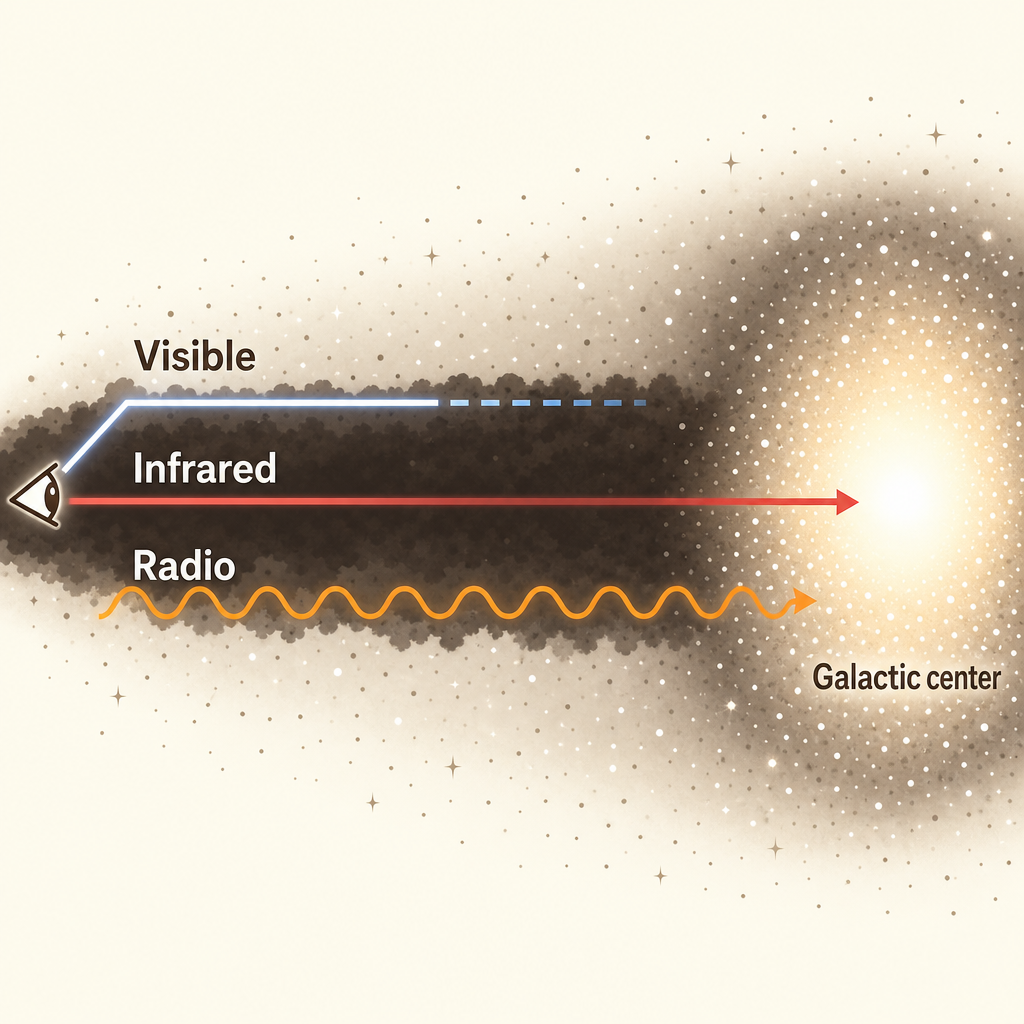
Notice that all three sightlines cross the same dust lane, yet only the visible beam is stopped short of the center.
Which Tracer Shows What
Different components announce themselves through different tracers.
Gas and young stars mark the thin disk and its spiral arms. Old stars and globular clusters spread through the bulge and halo.
Match the component to the observation, and the Galaxy's shape appears: a barred disk with a bulge and a wide halo.
Nested Structure of the Galaxy
The components are not scattered at random. They nest.
A thin star-forming disk with spiral arms sits inside a rounder bulge region crossed by a bar. Around both lies a sparse halo of old stars and globular clusters.
Beyond all of it, gravity keeps acting.
- Extended mass: Gravitating mass reaching past the visible material.
- Halo: Old stars and globular clusters in broad orbits.
- Bar and bulge: Crowded central stellar region best seen in infrared.
- Thin disk: Gas, dust, and young stars tracing spiral arms.
Each layer surrounds the one inside it
Motion Reveals Hidden Mass
Light shows where matter shines. Motion shows where mass is.
Measured orbital speeds and stellar motions demand more gravitating mass than the visible stars, gas, and dust supply.
So dust can hide the center while orbits still register the gravity of material we cannot see.
- Measure motions: Orbital speeds of gas and stars at various radii.
- Infer gravitating mass
- Visible matter enough?
- Light traces mass
- Mass beyond visible: More gravitating mass than visible material supplies.
- remeasure
Boundaries and Cautions
Two limits keep the reconstruction honest.
A tracer's distribution does not have to equal the total mass distribution. Gas maps arms, not everything.
And the central black hole does not dominate the Galaxy's gravity at every radius. Its pull matters near the center, not across the halo.
Choosing Your Tool
Pick the tracer that fits the question.
For dust, watch visible starlight dim. For spiral gas, use radio. For the crowded central region, use infrared. For halo stars, use their positions and orbits. For extended gravitating mass, use motion.
Hold the reconstruction loosely. It is a model built from tracers, each with its own reach and its own blind spots.
- Visible light: Dimming of starlight shows where dust lies.
- Infrared: Penetrates dust to the central stellar region.
- Radio: Maps neutral and molecular gas through the disk.
- Orbits and motions
- Dust
- Central region
- Spiral arms
- Extended mass
Check yourself
Astronomers have photographed the entire Milky Way from outside the Galaxy.
- True
- False
Answer: False
False. We live inside the Milky Way's dusty disk, so astronomers reconstruct its structure using light, gas, and stellar motions rather than an external photograph.
Choose from: radio, infrared, positions and orbits. Neutral and molecular gas across the disk is mapped with _____; the central stellar region through dust is revealed with _____; and old stars in the halo are traced by _____.
Answer: Choose from: radio, infrared, positions and orbits. Neutral and molecular gas across the disk is mapped with radio; the central stellar region through dust is revealed with infrared; and old stars in the halo are traced by positions and orbits.
Radio observations map neutral and molecular gas across the disk. Infrared observations reveal the central stellar region through dust. Halo stars are identified by their positions and orbits.
Gas and stars orbit the Milky Way faster than the visible matter alone can explain. What does this evidence suggest?
- The Galaxy contains mass beyond its visible matter
- The Galactic center contains no stars
- The Milky Way has no halo
- Visible light has already shown every part of the Galaxy
Answer: The Galaxy contains mass beyond its visible matter
The measured motions require more gravitating mass than visible stars, gas, and dust provide. This indicates extended mass beyond the visible material. Motion reveals gravity even when the mass does not shine or is hidden by dust.
Keep going
This is lesson 1 of 8 in Astronomy 2e III — Galaxies and the Evolving Universe. Next up:
- Galaxies Are More Than Shapes
- Distance Turns Redshift into History
- Small Nuclei Outshine Galaxies
- Galaxies Grow Through Encounters
- The Cosmic Web Reveals Missing Mass
Wondering turns any topic into short lessons you can read, watch, or listen to, with practice questions and an AI tutor.