Free sample lesson · Astronomy 2e II — Stars, Remnants, and Spacetime
Inside the Sun
How do neutrinos reveal a solar core no probe can reach?
Lesson 1 of the Wondering course Astronomy 2e II — Stars, Remnants, and Spacetime
A Star Held in Balance
Gravity is always trying to crush the Sun inward.
Something pushes back. Hot gas in the interior creates a pressure gradient, and each layer supports the weight above it.
This standoff is called hydrostatic equilibrium. It is a dynamic balance, not stillness. Plasma churns constantly while the overall structure holds steady.
- Gravity
- Pressure gradient
The Sun is stable only as long as the two forces stay matched.
Fusion, Not Burning
The Sun does not burn like a fire. There is no oxygen and no chemical reaction supplying its light.
In the core, hydrogen nuclei fuse into helium through the proton-proton chain.
The helium produced weighs slightly less than the hydrogen that went in. That small mass difference is released as energy.
- Chemical burning
- Contraction
- Core fusion
Gravitational contraction cannot power the Sun for its full lifetime either. Fusion can.
The Long Trip Outward
Energy made in the core does not fly straight out.
It first crosses the radiative zone, where photons are absorbed and re-emitted again and again.
Above that sits the convective zone, where hot plasma physically rises, cools, and sinks back down.
- Photosphere: The visible layer where energy escapes; a layer of gas, not a solid surface.
- Convective zone: Hot plasma rises, cools, and sinks back down.
- Radiative zone: Photons are absorbed and re-emitted again and again.
- Core: Hydrogen fuses into helium and releases energy.
Each layer sits inside the one above it
Finally the energy escapes near the photosphere, the visible layer we see. It is a layer of gas, not a solid surface.
Neutrinos Versus Photons
Here is the trick that lets us test the core.
A neutrino made by fusion escapes the Sun almost immediately. It barely interacts with matter on the way out.
Photon energy takes a far more indirect path, repeatedly absorbed and re-emitted before reaching the surface.
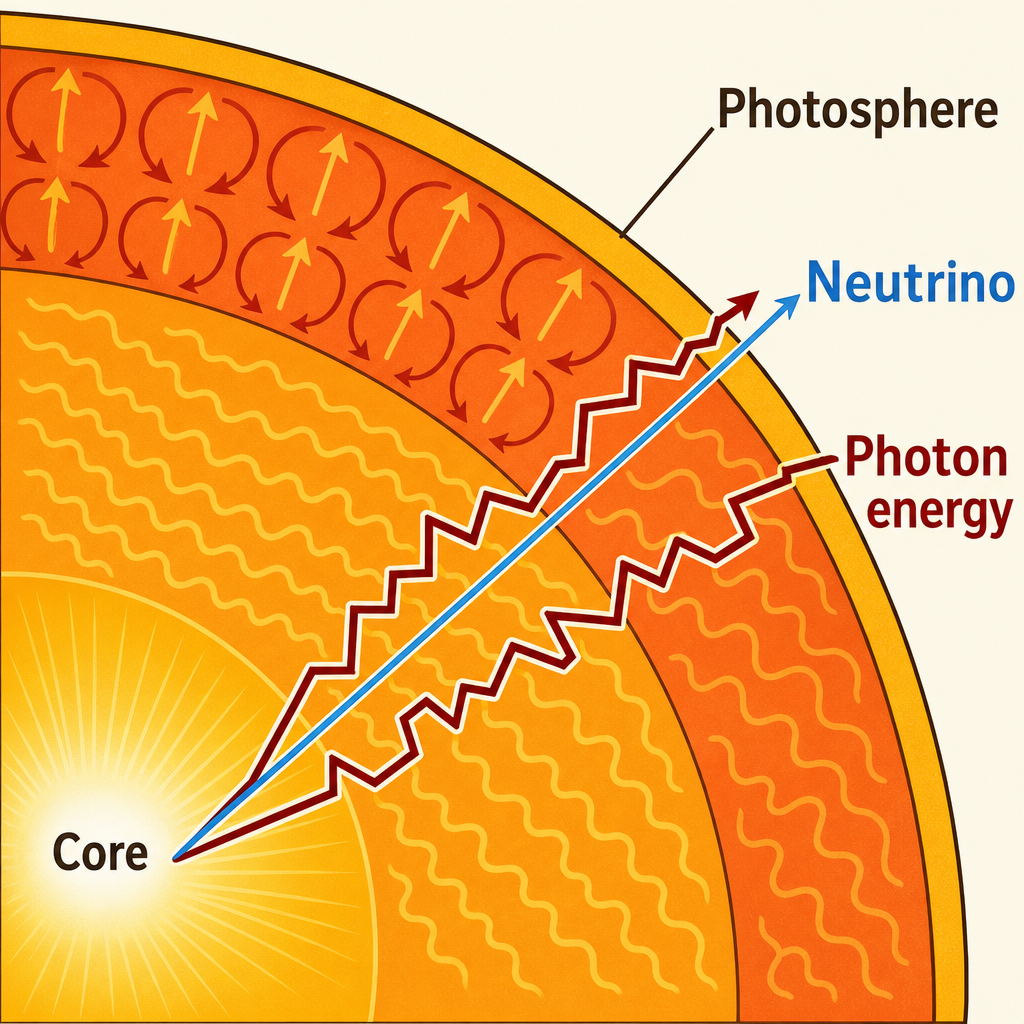
Notice how the neutrino path runs almost straight out while the photon path zigzags through countless absorptions.
So neutrinos carry fresh news from the core. Sunlight carries an old, heavily reprocessed message.
Probing the Hidden Interior
No spacecraft can reach the fusion core.
Sunlight tells us mainly about the photosphere. Neutrino detections and solar oscillations, studied through helioseismology, test the deep interior independently.
- Parker at record distance
- A load-bearing analogy
Tracing Energy End to End
Put the whole chain together in one line.
Gravity compresses the gas. Core fusion releases energy. Pressure gradients push back and hold the balance. Energy crosses the radiative and convective zones and escapes at the photosphere.
Two exports leave the Sun: light that has been reprocessed for a long time, and neutrinos that left the core directly.
- Compression: Gravity compresses the Sun and heats the core.
- Fusion: Hydrogen fuses into helium and releases energy.
- Balance: Pressure gradients push back and hold the balance.
- Transport: Energy crosses the radiative and convective zones.
- Escape: Light escapes at the photosphere while neutrinos left the core directly.
That distinction is what makes the core testable.
Check yourself
In the Sun, hydrostatic equilibrium means that gravity and the pressure gradient are balanced.
- True
- False
Answer: True
This balance keeps gravity from collapsing the Sun inward. It is dynamic: the plasma continues moving even while the overall structure remains stable.
From the Sun's energy source outward, energy moves from the _____, through the _____, then the _____, and out near the _____.
Answer: From the Sun's energy source outward, energy moves from the core, through the radiative zone, then the convective zone, and out near the photosphere.
Fusion occurs in the core. Photons cross the radiative zone by repeated absorption and re-emission, hot plasma transports energy through the convective zone, and energy escapes near the photosphere.
What process supplies most of the Sun's long-lasting energy?
- Chemical burning with oxygen
- Gravitational contraction alone
- Core hydrogen fusion
- Light absorbed by the photosphere
Answer: Core hydrogen fusion
In the core, hydrogen nuclei fuse into helium through the proton-proton chain. The small mass difference is released as energy. Chemical burning requires a chemical reaction and oxygen, while gravitational contraction cannot power the Sun for its full lifetime.
Keep going
This is lesson 1 of 8 in Astronomy 2e II — Stars, Remnants, and Spacetime. Next up:
- Measure Stellar Luminosity and Mass
- The H–R Diagram Organizes Stars
- Build the Distance Ladder
- Clouds Collapse into Stars
- Mass Sets the Stellar Clock
Wondering turns any topic into short lessons you can read, watch, or listen to, with practice questions and an AI tutor.