Free sample lesson · Astronomy 2e I — Reading the Sky and Solar System
Sky Cycles from Earth
Why does Orion rise earlier each month but keep its shape?
Lesson 1 of the Wondering course Astronomy 2e I — Reading the Sky and Solar System
The Sky as a Model
Stand outside long enough and the sky seems to turn around you.
Astronomers describe that view with the celestial sphere: a coordinate model for placing objects on the sky. It is a map, not a real shell.
Constellations like Orion group sightlines, not neighbors. Their stars sit at wildly different distances and only look connected from here.
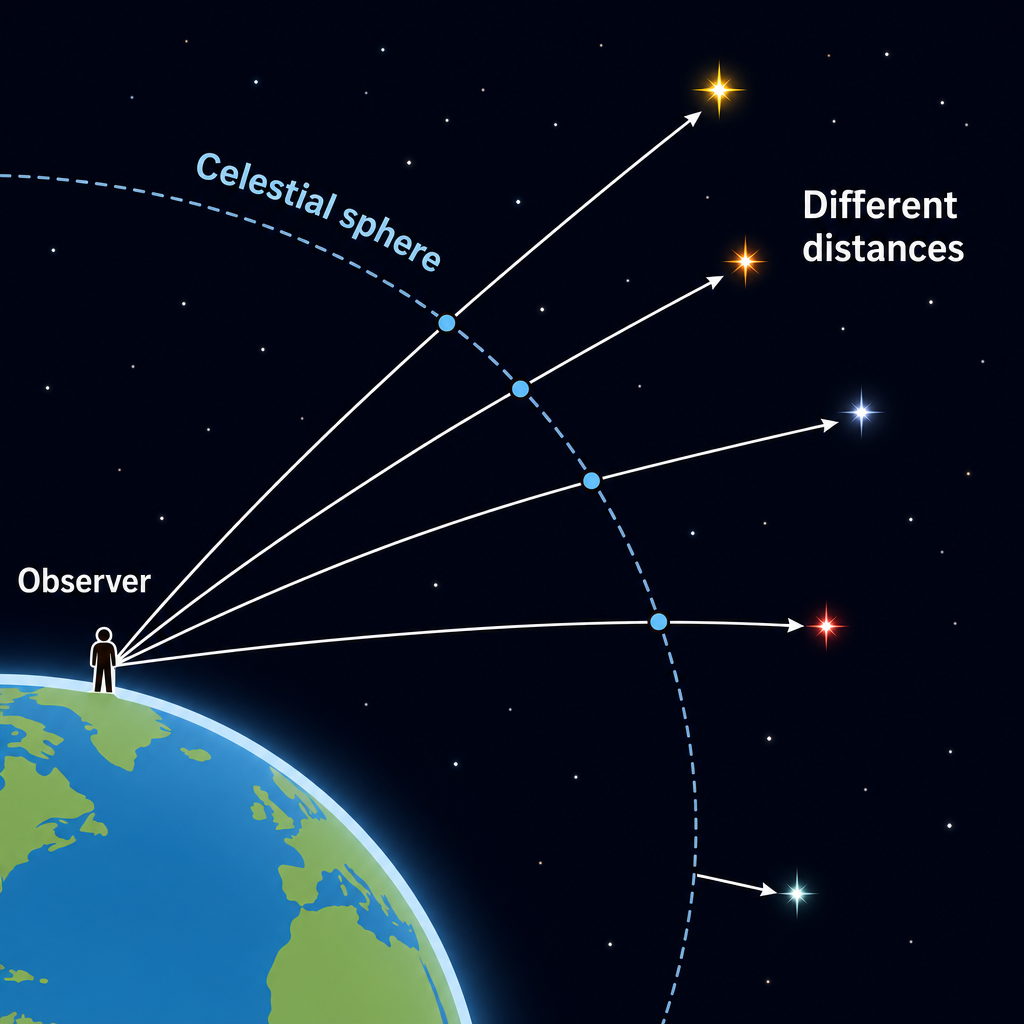
Notice that the stars forming one neat pattern sit at very different depths, so the shape exists only along the observer's sightlines.
Rotation Runs the Day
Earth spins once a day, and that spin creates all daily sky motion.
The Sun, Moon, and stars appear to rise and set because you are the one turning. Northern stars seem to circle the north celestial pole, tracing tight circles overnight.
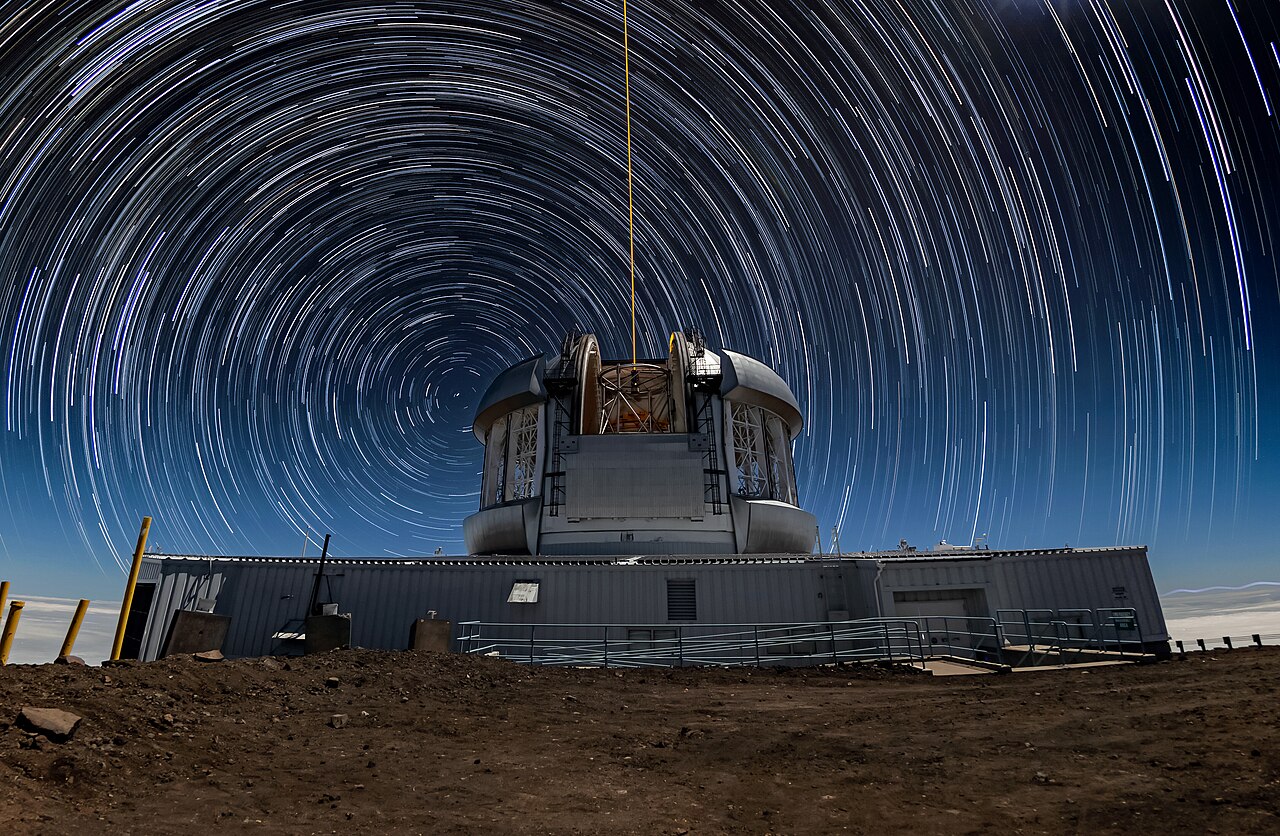
Star Trails Above Gemini North (iotw2506a) · International Gemini Observatory/NOIRLab/NSF/AURA/T. Matsopoulos · CC BY 4.0 · Wikimedia Commons
- A turning-platform analogy
Revolution Changes the Year
Orion rises earlier each month, yet its shape never changes.
That happens because Earth revolves around the Sun. As Earth moves along its orbit, the nighttime side faces different directions in space.
So the constellation is fixed. Your viewing direction is what shifts across the year.
- Rotation
- Revolution
Tilt, Not Distance
Here is the most common error in all of sky science.
Summer does not happen because Earth moves much closer to the Sun. Earth's axial tilt changes the Sun's angle in the sky and the length of daylight.
Distance has a minor seasonal effect, but it cannot explain why the two hemispheres have opposite seasons at the same moment.
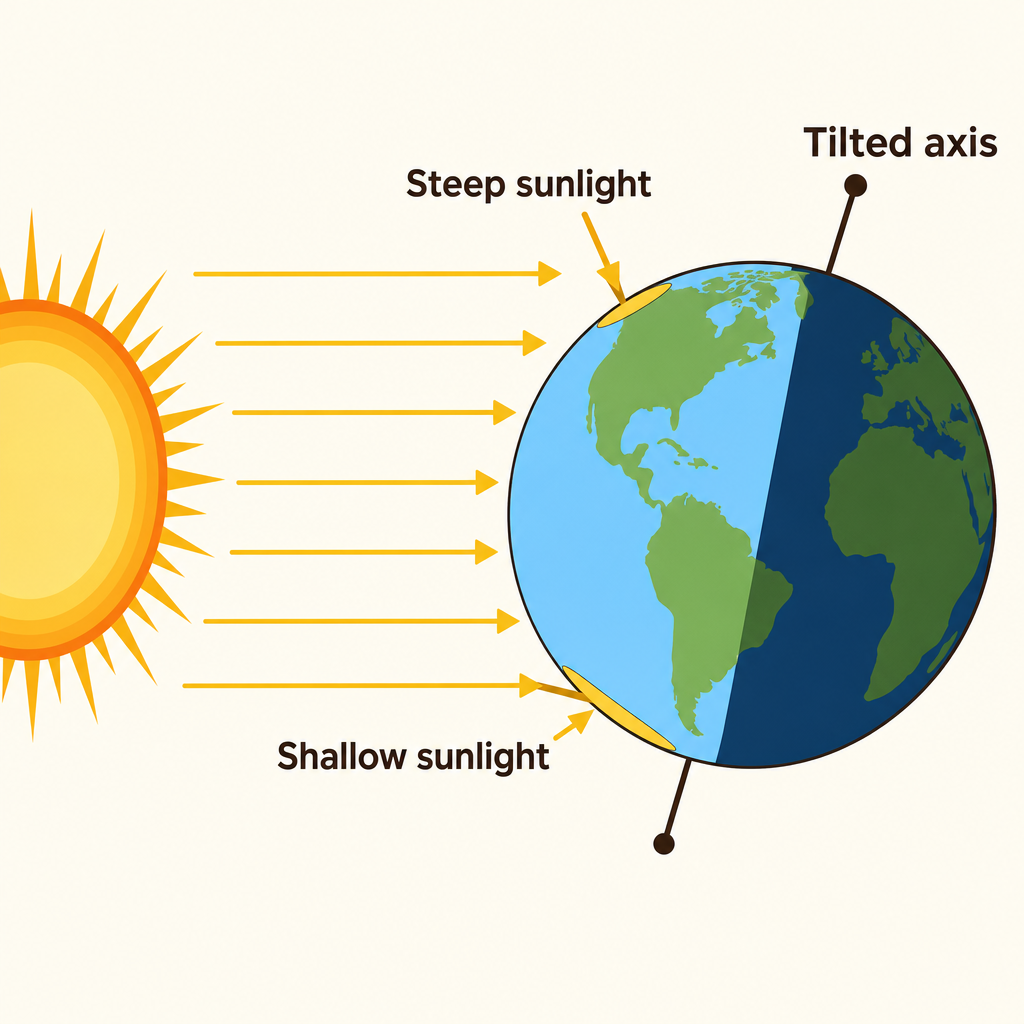
Notice that sunlight strikes one hemisphere steeply and the other at a shallow angle at the same instant, which is why the hemispheres have opposite seasons.
Phases Every Month
The Moon's phases come from geometry between Earth, the Moon, and the Sun.
As the Moon orbits, you see changing amounts of its sunlit half. That cycle repeats every lunar month.
Phases are not Earth's shadow falling on the Moon. Sunlight and viewing angle do all the work.
- Moon orbits Earth: The Moon moves along its orbit around Earth.
- Sunlit half fixed: One half of the Moon is always lit by the Sun.
- Viewing angle shifts: Observers on Earth see a changing slice of that lit half.
- Phase changes: The visible shape grows and shrinks.
- Cycle repeats: After one lunar month the same phase returns.
Why Eclipses Are Rare
If phases repeat monthly, why is there no eclipse every month?
Because the Moon's orbit is tilted relative to Earth's orbital plane. An eclipse needs the Moon near an orbital node, where the two planes cross.
A full Moon can slide above or below Earth's shadow entirely. Alignment, not phase, is the deciding condition.
- Full Moon occurs: The Moon reaches full phase this month.
- Near orbital node?: Is the Moon close to where the two orbital planes cross?
- Eclipse possible: The Moon can enter Earth's shadow.
- Shadow missed: The Moon passes above or below Earth's shadow.
- next month
Classify Any Sky Cycle
When you notice a repeating sky pattern, ask which cause fits.
Daily rising and setting points to rotation. Seasonal constellations point to revolution. Changing daylight and Sun angle point to axial tilt. An eclipse points to node alignment.
Keep the ecliptic separate from Earth's equator, and never blame phases on Earth's shadow.
Check yourself
The daily rising and setting of the Sun, Moon, and stars is mainly caused by Earth's rotation.
- True
- False
Answer: True
Earth spins once each day, making sky objects appear to rise and set. Earth's revolution produces annual changes instead.
Daily star motion is caused by Earth's _____. Annual changes in nighttime constellations are caused by Earth's _____. Opposite seasons in the hemispheres are caused by Earth's _____.
Answer: Daily star motion is caused by Earth's rotation. Annual changes in nighttime constellations are caused by Earth's revolution. Opposite seasons in the hemispheres are caused by Earth's axial tilt.
Rotation produces the daily cycle. Revolution changes the nighttime viewing direction during the year. Axial tilt changes sunlight angle and daylight length, producing seasons.
Why can a full Moon occur without a lunar eclipse?
- The Moon's orbit is tilted, so the full Moon can pass above or below Earth's shadow.
- The Moon produces its own light during a full Moon.
- Earth's rotation prevents the Moon from entering its shadow.
- Moon phases are caused by Earth's shadow every month.
Answer: The Moon's orbit is tilted, so the full Moon can pass above or below Earth's shadow.
A full Moon happens when the visible side of the Moon is fully sunlit. An eclipse additionally requires the Moon to be near an orbital node, where the orbital planes cross, so it can pass through Earth's shadow.
Keep going
This is lesson 1 of 8 in Astronomy 2e I — Reading the Sky and Solar System. Next up:
- Why Orbits Keep Falling
- Light Carries Physical Clues
- Choose Depth, Detail, and Cadence
- A Disk Becomes Worlds
- Rocky Worlds Diverge
Wondering turns any topic into short lessons you can read, watch, or listen to, with practice questions and an AI tutor.