Free sample lesson · Art & Science of Digital Marketing & Advertising
Digital Marketing Overview
Why has digital marketing become the foundation of every successful business strategy?
Lesson 1 of the Wondering course Art & Science of Digital Marketing & Advertising
What Digital Marketing Means
Digital marketing is any marketing that uses electronic devices or the internet to reach customers.
Businesses use online platforms like social media, email, search engines, and websites to connect with current customers and with people who might buy later.
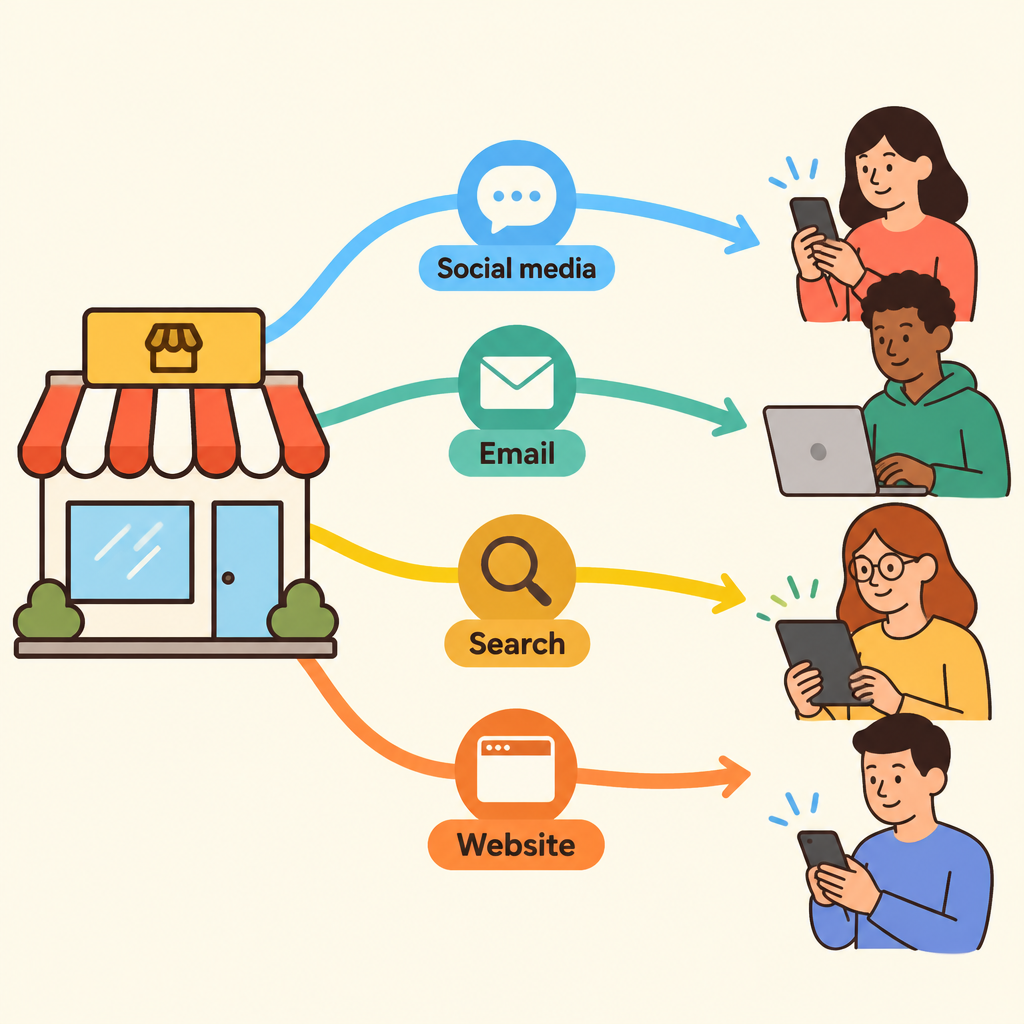
Notice how one business reaches the same customers through several platforms, each running on an everyday device.
Why does this matter? Consumers now spend most of their time online.
If a business is not visible there, it misses the place where its customers actually are. That is why digital marketing has become the foundation of modern business strategy.
Search Channels: SEO and PPC
Two channels focus on helping people find you when they search.
SEO (search engine optimization) means improving your content so it ranks well in search results, without paying for each visit.
PPC (pay-per-click) means buying ads that appear in results. You pay each time someone clicks.
- SEO
- PPC
A common mistake is treating them as rivals. SEO earns visibility over time, while PPC can put you in front of searchers quickly.
Five More Channels to Know
Beyond search, five more channels help businesses reach and engage people: social media, email, content, influencer, and video marketing.
Social media meets people where they scroll. Email lands directly in an inbox.
Content and video teach or entertain. Influencer marketing borrows trust from creators an audience already follows.
Together with SEO and PPC, these form the digital marketing ecosystem: seven channels spread across many platforms.
Search Happens Everywhere
Search used to mean one thing: typing into a search engine.
Today, search happens everywhere. People look for answers on traditional search engines, social media platforms, shopping sites, and AI-powered assistants.
- Search: It happens everywhere.
- Search engines: The traditional starting point.
- Social media: Where products get discovered.
- Shopping sites: Where prices get compared.
- AI assistants: Where people ask for advice.
A customer might discover a product on social media, compare prices on a shopping site, then ask an AI assistant for advice.
Being findable in only one place is no longer enough.
Integration Beats Isolation
Here is the key idea: successful marketing integrates channels into one cohesive strategy.
Treating each channel in isolation leads to mixed messages and missed connections. Integrated channels pass customers from one touchpoint to the next.
Imagine a made-up small bakery launching a new cake. A social media video sparks interest, a blog post ranks in search, and an email brings followers in-store.
- One message: The bakery picks one story for its new cake.
- Spark interest: A short social media video gets people curious.
- Get found: A blog post ranks in search when people look it up.
- Bring them in: An email invites followers to visit the store.
Each channel does a different job, but all tell the same story.
Let Data Drive Decisions
What separates successful campaigns from failures? In 2025, it is data-driven decision-making.
Digital channels let you track user behavior, measure campaign performance, and optimize in real time.
- Track behavior: Watch what people do online.
- Measure performance: Check which efforts are working.
- Optimize in real time: Adjust while the campaign runs.
This works as a cycle. You watch what people do, check what is working, adjust, and then watch again.
Integration makes this stronger, because insights from one channel can guide choices in another.
Key Takeaways
Digital marketing reaches customers through devices and the internet, using seven core channels: SEO, PPC, social media, email, content, influencer, and video.
The real power comes from integration. Channels work best as one coordinated strategy.
Search now happens everywhere, so plan to be found across many platforms.
Finally, let data guide every adjustment.
Check yourself
A shoe store uses email, social media, and video. Successful marketing treats these channels as _____
- parts of one connected strategy
- separate efforts that each run on their own
Answer: parts of one connected strategy
Successful marketing integrates multiple channels into one cohesive strategy. Running each channel in isolation is the common mistake.
Writing helpful blog posts and guides is _____ marketing. Paying a popular creator to show your product to their followers is _____ marketing. Sending newsletters straight to customers' inboxes is _____ marketing.
Answer: Writing helpful blog posts and guides is content marketing. Paying a popular creator to show your product to their followers is influencer marketing. Sending newsletters straight to customers' inboxes is email marketing.
Each activity matches a different channel in the digital marketing ecosystem: blog posts are content, creators are influencers, and inbox messages are email.
A small bakery wants to attract more customers. Which of these activities counts as digital marketing?
- Sending a weekly email newsletter to subscribers
- Placing printed flyers on parked cars nearby
- Putting a paper sign in the shop window
- Running an ad in the printed local newspaper
Answer: Sending a weekly email newsletter to subscribers
Digital marketing is any marketing that uses electronic devices or the internet to reach customers, so an email newsletter qualifies. Flyers, window signs, and printed newspaper ads are all offline.
Keep going
This is lesson 1 of 38 in Art & Science of Digital Marketing & Advertising. Next up:
- Data-Driven Marketing
- Consumer Decision Journey
- Power of Social Proof
- Behavioral Psychology
- Scarcity and Urgency
Wondering turns any topic into short lessons you can read, watch, or listen to, with practice questions and an AI tutor.