Free sample lesson · Architecting Agentic AI Systems
Cognitive Architectures
How do we move beyond simple prompting to autonomous reasoning loops?
Lesson 1 of the Wondering course Architecting Agentic AI Systems
From Chatbots to Agents
A chatbot usually responds to one request at a time. An autonomous agent works through a changing situation.
This shift moves from static inference toward dynamic reasoning loops. The system can inspect results, revise its approach, and continue toward an outcome.
- Chatbot
- Autonomous agent
For product leaders, the key change is architectural: capability comes from coordinating models, tools, memory, and feedback.
The Agentic Progression
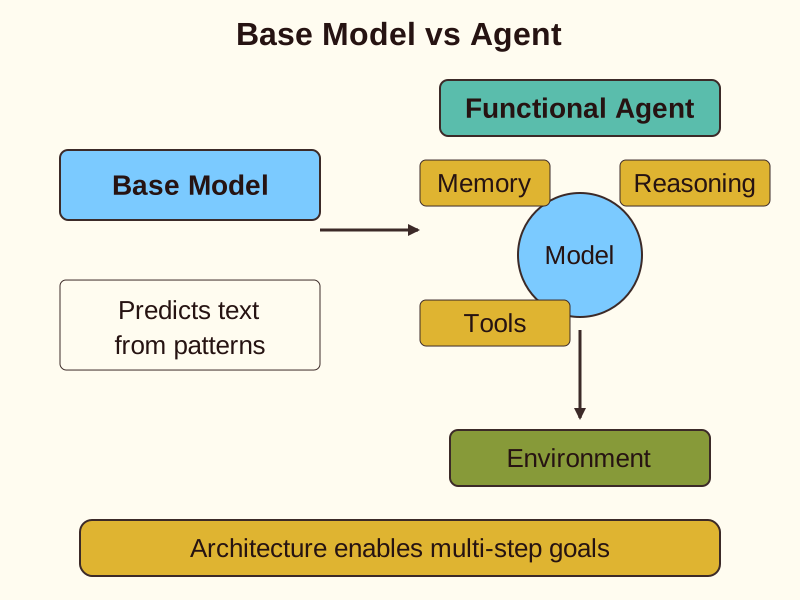
A raw base model predicts likely text from patterns learned across massive text corpora.
A functional agent adds memory, specialized reasoning, and access to tools. These additions let it interact with an environment instead of producing isolated text.
The model remains central, but the surrounding architecture determines whether it can pursue multi-step goals.
Static Versus Dynamic Inference
Static inference follows a simple pattern: receive a prompt, generate an answer, and stop.
Dynamic inference creates an ongoing cycle. The model takes an action, receives new information, and adjusts its next decision.
A useful non-example is a single generated answer with no tool use, result checking, or follow-up reasoning. It may be capable, but it is not operating as an agentic loop.
- Static inference
- Dynamic inference
The Four-Step Agentic Loop
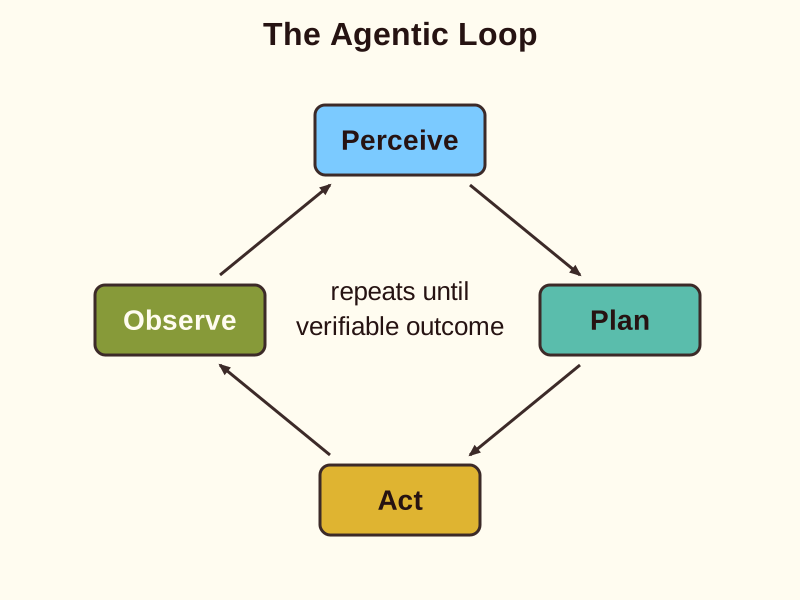
An agent follows four connected stages: Perceive, Plan, Act, Observe.
It first gathers relevant information, then selects a strategy. Next, it uses an available capability, such as a tool, and observes the result.
That observation becomes input for the next cycle. The loop can continue until the agent reaches a useful, verifiable outcome.
ReAct in Practice
ReAct, meaning Reason plus Act, gives the loop a practical structure.
The model generates a Thought, chooses an Action, and waits for the tool to execute it. The resulting Observation informs the next thought.
For example, an agent may identify missing information, call an external tool, inspect the returned result, and then choose a better next step.
- Thought: The model identifies missing information or frames the next reasoning step.
- Action: It chooses an action, such as calling an external tool.
- Observation: The tool executes and returns a result for inspection.
- Next thought: The resulting observation informs a better next step.
Tools, Memory, and Knowledge
The core language model does not work alone. The agentic loop connects it with external knowledge, memory, and tools.
External knowledge supplies information beyond the current conversation. Memory preserves relevant context, while tools let the agent act within an environment.
Together, these components turn reasoning into an operational capability that can produce and verify intermediate results.
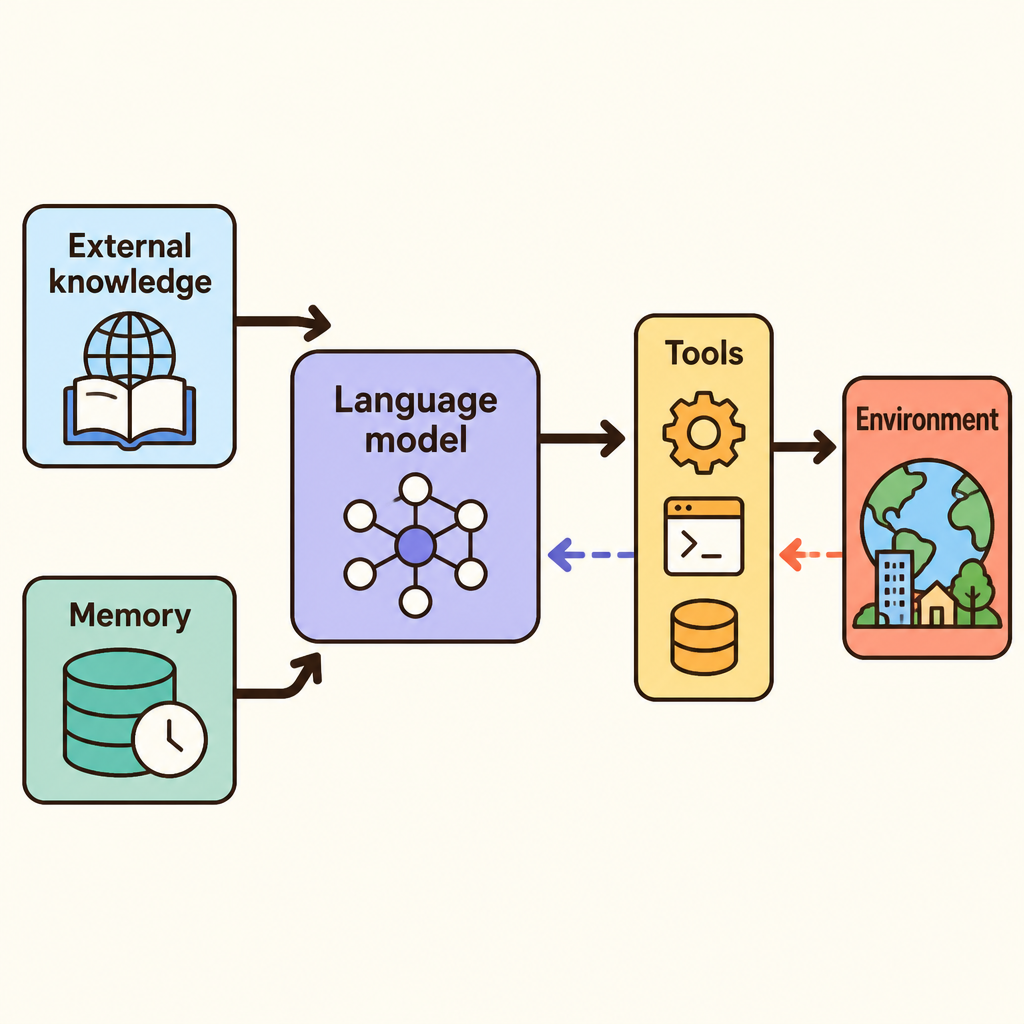
See how the language model becomes operational by receiving knowledge and memory while using tools to act in an environment and verify intermediate results.
Feedback Changes Strategy
Observation is what separates an iterative agent from a one-shot generator.
A tool result may confirm the plan, reveal missing information, or show that an action failed. The agent then revises its strategy rather than repeating the original response.
This feedback does not mean the model automatically improves permanently. It means the current loop uses outcomes to guide subsequent decisions.
- Plan
- Take action: The agent performs an action using a tool or other capability.
- Receive result: The agent receives the result of the action.
- Outcome?: The result can confirm the plan, reveal missing information, or show that the action failed.
- Proceed: The agent proceeds with a confirmed plan.
- Revise strategy: The agent changes its strategy instead of repeating the original response.
- confirmed
- missing information
- failed
- revises strategy
Designing Agentic Products
Agentic systems combine advanced language models, reasoning training, standardized tool access, and orchestration.
When evaluating a product, ask where the system perceives information, how it plans, which actions it can take, and what observations guide revision.
The strategic question is whether a loop creates reliable value. Autonomy without useful feedback, suitable tools, or verifiable outcomes can add complexity without improving the product.
Check yourself
What best distinguishes an autonomous agent from a chatbot that answers one request at a time?
- It can continue acting as the situation changes.
- It always produces shorter responses.
Answer: It can continue acting as the situation changes.
A one-shot chatbot generates an answer and stops. An autonomous agent continues through a cycle, using results to guide later actions.
In the Agentic Loop, the system _____s relevant information, _____s a strategy, _____s with a capability, and _____s the result.
Answer: In the Agentic Loop, the system Perceives relevant information, Plans a strategy, Acts with a capability, and Observes the result.
Each blank is determined by the distinctive role of that stage: gathering information, selecting a strategy, using a capability, and checking the result.
An agent’s tool action fails. What is the main role of the resulting Observation?
- It helps the agent revise its strategy.
- It permanently retrains the model after each action.
- It removes the need for tools and memory.
- It guarantees that the original plan was correct.
Answer: It helps the agent revise its strategy.
Observation supplies feedback from the environment. If an action fails or information is missing, the agent can revise its strategy rather than repeat the original response.
Keep going
This is lesson 1 of 8 in Architecting Agentic AI Systems. Next up:
- Reasoning Patterns
- Multi-Agent Coordination
- Tool Integration
- Memory Management
- Evaluation Frameworks
Wondering turns any topic into short lessons you can read, watch, or listen to, with practice questions and an AI tutor.