Free sample lesson · Analog Integrated Circuit Design
MOSFET Physics
How do microscopic silicon gates control continuous analog voltages?
Lesson 1 of the Wondering course Analog Integrated Circuit Design
Why MOSFET Physics Matters
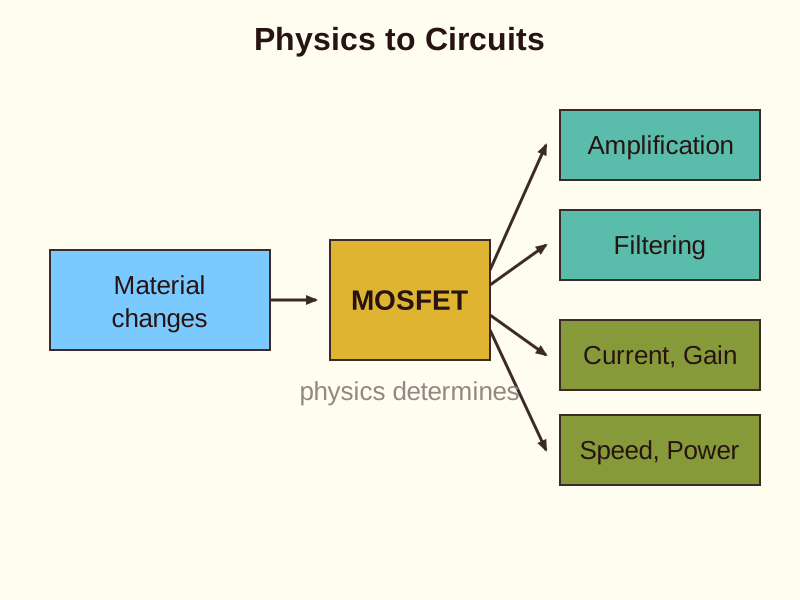
Modern analog integrated circuits rely on the MOSFET, a transistor controlled by voltage.
It connects microscopic material changes to familiar circuit behavior, such as amplification and filtering.
For someone moving from discrete components to chip-level design, this device is a key bridge. Its physics determines how circuits control current, gain, speed, and power consumption.
Meet the Four Terminals
A MOSFET has four terminals: gate, source, drain, and body.
The source and drain connect to the semiconductor region where current may flow. The body supports and surrounds this region.
The gate controls the channel without directly contacting it. This separation allows a voltage at the gate to influence the semiconductor beneath.

The four MOSFET terminals
The Gate Creates An Electric Field
Apply a voltage between the gate and source, called the gate-source voltage.
This voltage creates an electric field across a thin silicon dioxide insulating layer. The field reaches into the semiconductor surface.
The oxide blocks direct electrical contact, while the field still affects nearby charge. This is the physical control mechanism behind the MOSFET.
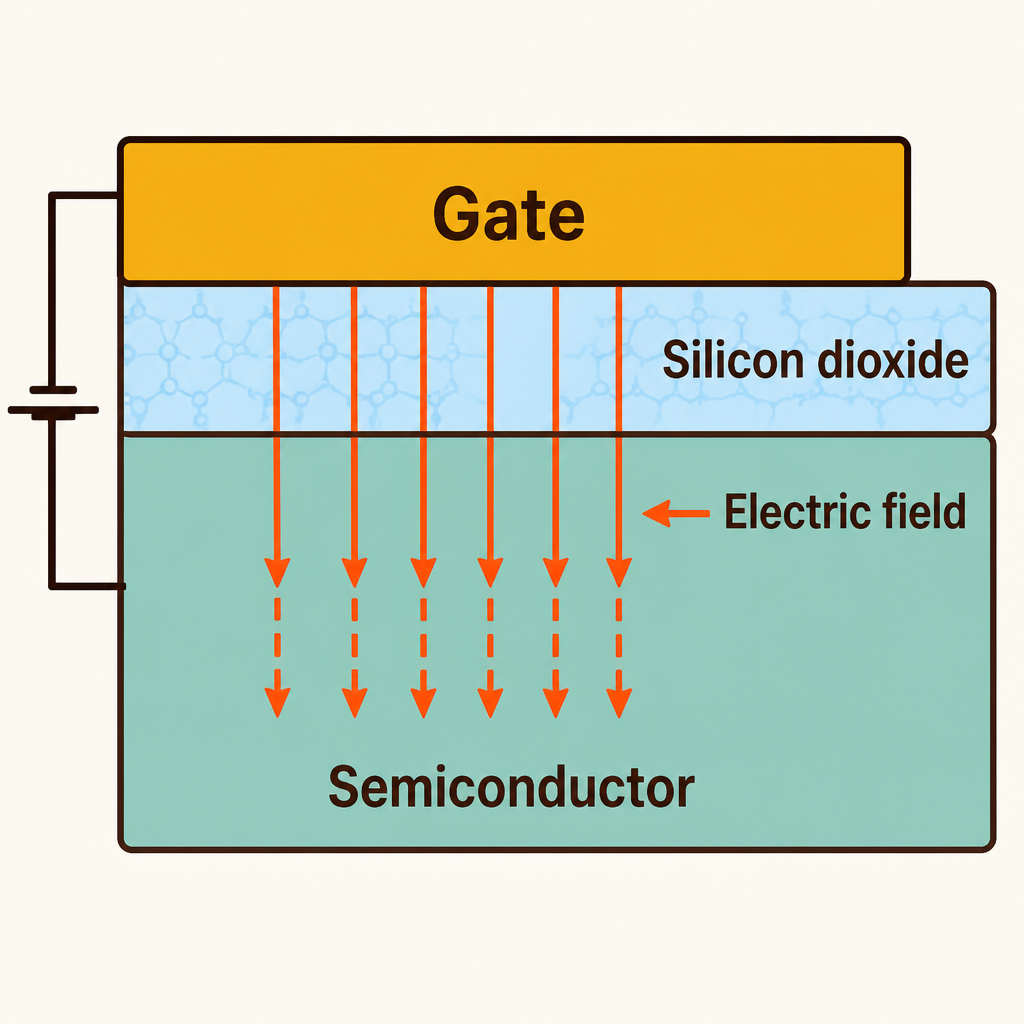
The cross-section makes the control mechanism visible: the gate voltage creates a field across the oxide without making direct electrical contact with the semiconductor.
Charge Builds A Channel
The electric field attracts charge carriers toward the semiconductor surface beneath the gate.
In an n-channel MOSFET, the attracted carriers are electrons. They gather into an inversion layer, creating a conductive channel.
The channel forms a path between source and drain. Without this carrier modulation, the device cannot provide the same controlled route for current.
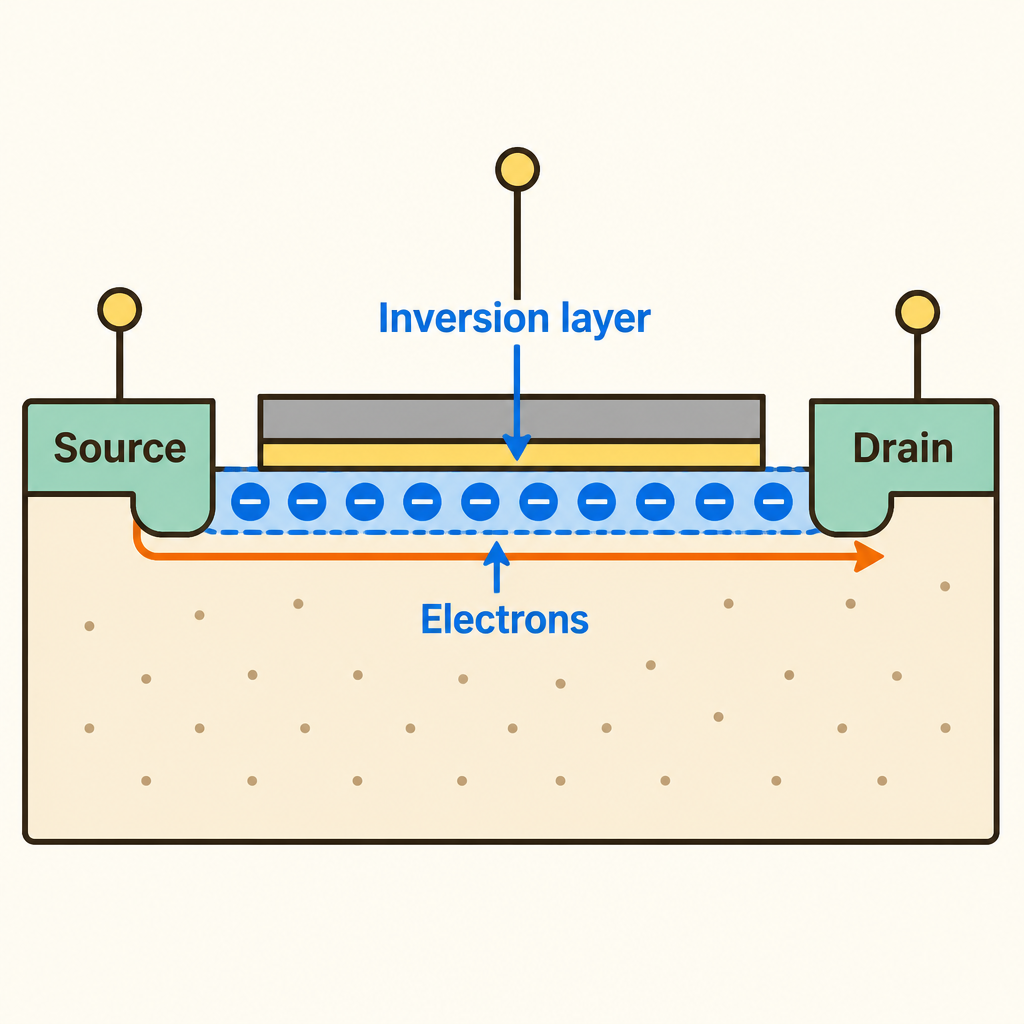
The cross-section shows electrons gathering beneath the gate to form an inversion layer that connects source and drain into a conductive path.
Voltage Controls Drain Current
Once a channel forms, current can flow from the drain to the source through the inversion layer.
The gate-source voltage influences the channel and therefore the resulting drain current. This links a voltage input to a current response.
That behavior lets the MOSFET act as a voltage-controlled current source, a useful model for analog circuit design.
- Channel forms: An inversion layer provides a path between the drain and source.
- Voltage influences: The gate-source voltage influences the channel and the resulting drain current.
- Circuit model: This voltage-to-current relationship lets the MOSFET act as a voltage-controlled current source.
From Physics To Analog Design
Amplifiers and filters exploit the relationship between gate-source voltage and drain current.
A small voltage change at the gate can adjust channel charge and alter the current used by the circuit.
When designing hardware prototypes or integrated circuits, remember the chain: electric field, charge carriers, conductive channel, and drain current. Understanding this chain helps explain limits on gain, speed, and power.
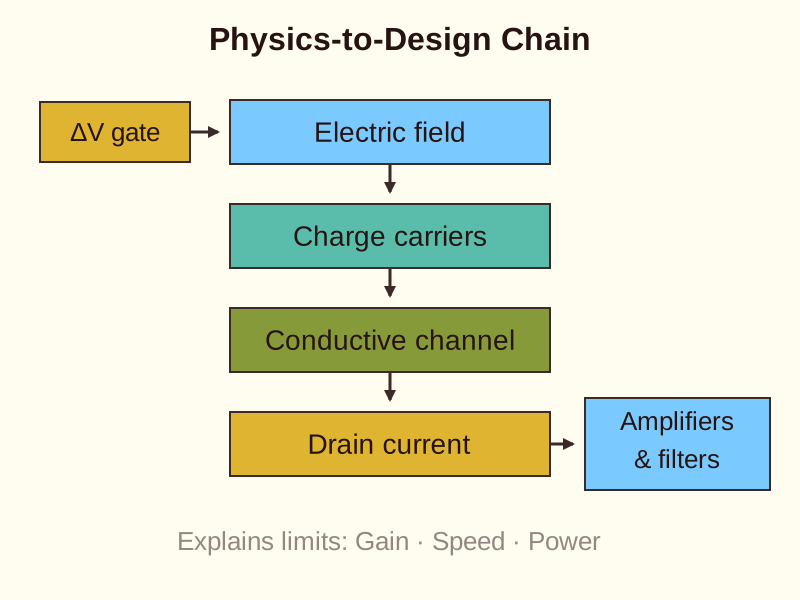
Using the MOSFET Control Chain
- Input: Identify the gate-source voltage as the electrical input.
- Field: Track how the gate-source voltage creates the controlling field without direct contact.
- Carriers: Use carrier modulation to identify the conductive channel-forming step.
- Response: Connect the channel change to the resulting current response used in analog circuits.
Check yourself
A _____ creates an _____ across the oxide. In an n-channel MOSFET, the field attracts _____ toward the semiconductor surface.
Answer: A gate-source voltage creates an electric field across the oxide. In an n-channel MOSFET, the field attracts electrons toward the semiconductor surface.
The gate-source voltage creates the electric field, and the field attracts electrons in an n-channel MOSFET. These electrons form an inversion layer beneath the gate.
In a MOSFET, does the gate control the semiconductor channel through direct electrical contact?
- Yes, through a direct metal-semiconductor contact
- No, through an electric field across the oxide
- Yes, through a wire touching the channel
Answer: No, through an electric field across the oxide
The gate controls the channel through an electric field across the insulating oxide. It does not need to make direct electrical contact with the semiconductor.
Which explanation best describes how a gate voltage produces drain current in an n-channel MOSFET?
- The gate directly injects current into the semiconductor.
- The field attracts electrons, forming a channel between source and drain.
- The body removes carriers so the source and drain disconnect.
- The oxide carries drain current between the terminals.
Answer: The field attracts electrons, forming a channel between source and drain.
The electric field attracts electrons to the surface, forming an inversion layer. That layer becomes a conductive channel between source and drain, allowing drain current to flow. This is why a gate voltage can control current without directly carrying the channel current.
Keep going
This is lesson 1 of 11 in Analog Integrated Circuit Design. Next up:
- Biasing Circuits
- Single-Stage Amps
- Differential Pairs
- Current Mirrors
- Silicon Layout
Wondering turns any topic into short lessons you can read, watch, or listen to, with practice questions and an AI tutor.