Free sample lesson · AMIRAMET Placement Test Prep
Context Clues
Can a missing word reveal itself without a dictionary?
Lesson 1 of the Wondering course AMIRAMET Placement Test Prep
The Blank Already Has Hints
A sentence-completion item is never a blind guess.
The words around the blank carry information: examples, definitions, causes, effects, and contrast signals. Read them first and the sentence tells you what kind of word belongs.
On the AMIRAMET test, this saves seconds on every item.
Your job is to understand the sentence's overall meaning before you look closely at the answer choices.
- Read fully: Read the whole sentence before touching the answer choices.
- Find clues: Mark examples, definitions, cause-effect links, and contrast words.
- Predict: Decide the meaning or type of word the blank needs.
- Eliminate: Cut choices that fail logically, grammatically, or in tone.
Predict Before You Choose
Prediction is the core habit.
Before reading the options, say in your own words what the blank means. Even a rough guess like "something negative" or "a verb meaning to grow" works.
Why this matters: distractors are written to look attractive.
If you enter the choices with a prediction already formed, a tempting wrong answer loses most of its pull.
- Choices first
- Predict first
Examples As Clues
Some sentences hand you the answer through examples.
Look for such as, like, including, or a list after a comma. The examples define the missing word by showing its members.
Try this: "The museum displays ancient ______, such as coins, pottery, and tools."
The examples are all old objects, so the blank means artifacts. You never needed a dictionary.
- Signal: such as: Words like such as, like, or including introduce examples.
- Coins
- Pottery
- Tools
- Artifacts: The shared quality of the examples becomes your prediction.
Definitions Hidden In The Sentence
Sometimes the sentence quietly defines the missing word for you.
Watch for commas, dashes, that is, in other words, or a which clause restating the idea.
"Her ______, a strong wish to succeed, pushed her through long nights of study."
The phrase between commas is the definition. The blank means ambition. Restatement clues make the answer almost mechanical.
Contrast Words Flip Meaning
However, although, despite, but, and while tell you the second half opposes the first.
When you see one, predict the opposite of the idea nearby.
"Although the instructions looked simple, the task proved ______."
Although signals contrast, so the blank must oppose simple. Predict complicated. A choice like easy is now clearly wrong.
Missing a contrast word is the most common way learners lose these points.
- Read sentence
- Contrast word?: Look for however, although, despite, but, while.
- Predict opposite: The blank must oppose the nearby idea.
- Predict same direction: Keep the meaning in line with the surrounding words.
- Match a choice
Cause And Effect Logic
Because, so, therefore, since, and as a result link a reason to an outcome.
The known half tells you the direction of the missing half.
"Because the road was flooded, traffic came to a complete ______."
Flooding causes stopping, so predict halt. Sentence logic, not vocabulary knowledge, gets you there.
These clues also protect you when the correct word is unfamiliar: you can still confirm it fits the logic.
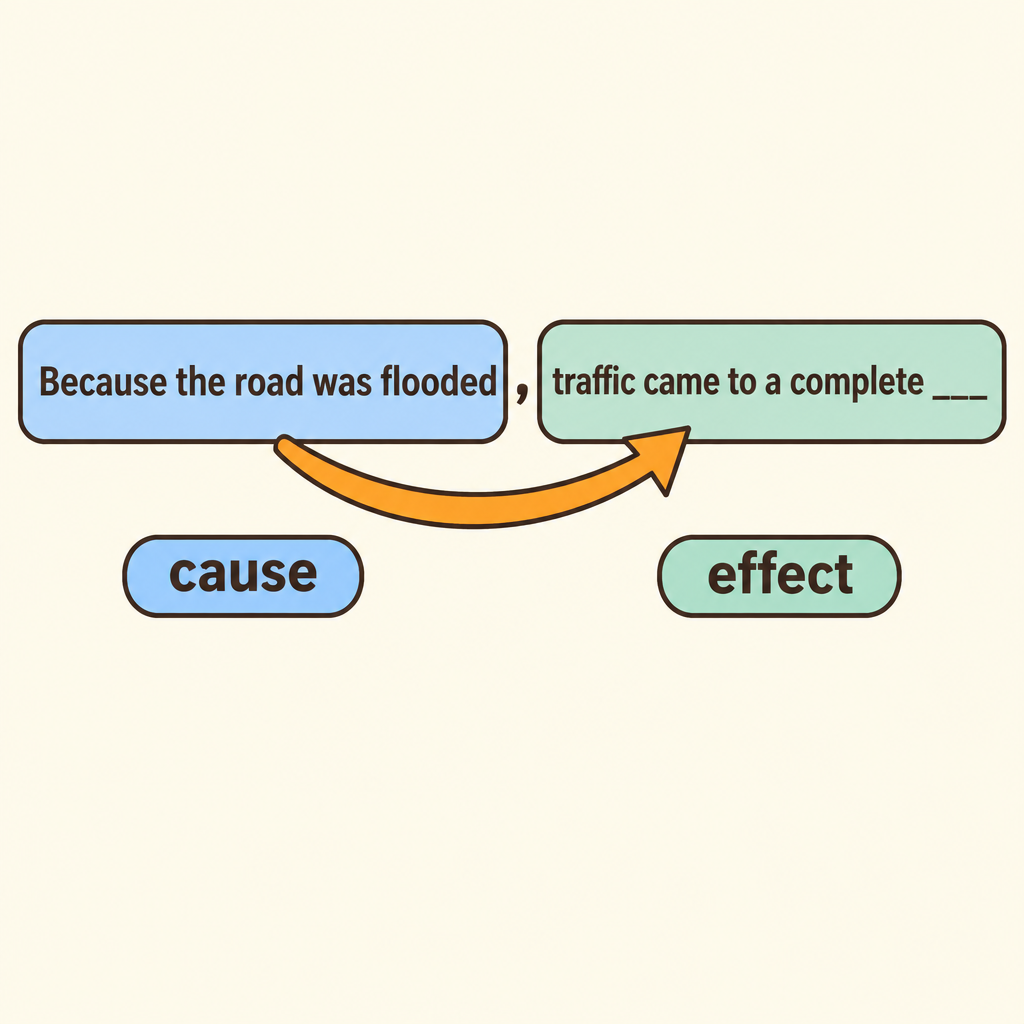
Notice how the known cause on the left fixes the direction of the blank on the right.
Eliminate On Three Grounds
Once you have a prediction, cut choices on three separate tests.
Logic: does the word match the sentence's meaning and direction?
Grammar: does the part of speech fit the slot?
Tone: does the register match, formal or casual, positive or negative?
A choice only needs to fail one test to be gone.
- Logic: Cut choices that contradict the sentence's meaning or direction.
- Grammar: Cut choices whose part of speech cannot fit the slot.
- Tone: Cut choices whose register or charge clashes with the sentence.
Failing any one filter removes the choice.
Traps That Cost Points
Three habits slow accurate readers down.
Reading only the words touching the blank. The clue often sits in the other clause.
Ignoring a contrast word and picking a synonym of the nearby idea.
Choosing a word you recognize instead of the word that fits. Familiar is not the same as correct.
- Narrow reading
- Missed contrast
- Familiar word
Speed Comes From The Routine
Under timed conditions, the temptation is to skim and guess.
The opposite works better. A five-second read of the full sentence usually beats thirty seconds of comparing four choices.
The routine is fixed: read, find the clue, predict, eliminate.
Repeat it until it runs without effort. That is where both speed and accuracy come from.
Your Working Checklist
Carry four questions into every sentence-completion item.
What is the sentence about overall? Which clue type is present: example, definition, cause-effect, or contrast?
What word would I write in the blank myself?
Which choices fail on logic, grammar, or tone? Answer those four and the blank tends to reveal itself.
- Clue types
- Examples: Introduced by such as, like, or including
- Definitions: Restated between commas or after that is
- Cause and effect: Linked by because, so, therefore, as a result
- Contrast: Signalled by however, although, despite
- Elimination grounds
- Logic: Meaning and direction must match
- Grammar: Part of speech must fit the slot
- Tone: Register and charge must match
Read, find the clue, predict, eliminate.
Check yourself
A contrast word such as “although” usually signals that the missing word should oppose a nearby idea.
- True
- False
Answer: True
This is true. Words such as “although,” “however,” and “but” signal contrast, so predict an opposing meaning.
The phrase “such as” introduces an _____, while “although” introduces a _____.
Answer: The phrase “such as” introduces an example, while “although” introduces a contrast.
“Such as” points to specific examples. “Although” signals that one idea opposes another.
Because the road was flooded, traffic came to a complete ____. Which word best fits the blank?
- halt
- celebration
- decoration
- beginning
Answer: halt
Flooding causes traffic to stop, so “halt” matches the sentence logic. The other choices do not describe the effect of a flooded road.
Keep going
This is lesson 1 of 8 in AMIRAMET Placement Test Prep. Next up:
- Target Vocabulary
- Core Meaning
- Distractor Traps
- Active Skimming
- Inference Questions
Wondering turns any topic into short lessons you can read, watch, or listen to, with practice questions and an AI tutor.