Free sample lesson · Algorithms to Live By: The Computer Science of Human Decisions
The 37% Rule: Look, Then Leap
You have 30 days to find an apartment. On which day should you stop looking?
Lesson 1 of the Wondering course Algorithms to Live By: The Computer Science of Human Decisions
When Should You Stop?
You have 30 days to find an apartment. On which day should you stop looking?
The 37% rule divides a fixed search into a look phase and a leap phase. For a 30-day hunt, the look phase is the first 11 days: view places without signing.[[1]](https://algorithmstoliveby.com/excerpt.html)
From day 12 onward, commit to the first place better than every place already seen. If no place beats that benchmark, the search may still run to the last option.
- Look phase: View places without signing anything.
- Leap phase begins: Commit to the first place better than every place already seen.
- Search time ends: If no place beat the benchmark, the search may run to this last option.
Beat the Best So Far
Day 12 begins the leap phase, but it does not lower your standard.
Your benchmark is the single best apartment from days 1 through 11. If that was a sunny one-bedroom, a later place qualifies only if it is better overall.[[1]](https://algorithmstoliveby.com/excerpt.html)
Do not choose something merely above average, or better than the first place. The condition is better than the best so far.
- Benchmark set: The single best apartment from days 1 through 11.
- View next place
- Better than best so far?: Above average or better than the first place is not enough.
- Commit to it
When the Rule Fits
Does every choice fit? No.
The rule assumes options arrive one at a time, in random order. You must accept now or lose that option, and you want the single best choice.[[4]](https://en.wikipedia.org/wiki/Secretary_problem)
Computer science calls this an optimal stopping problem. Parking, house offers, and dating can create similar tension.[[1]](https://algorithmstoliveby.com/excerpt.html)
A menu visible all at once is different. You can compare everything before choosing.
- One at a time
- Menu at once
Balancing Two Mistakes
Why not look for 10% or 80%?
Look too briefly and your benchmark may be weak, so you settle before the best appears. Look too long and the best may fall inside the no-commitment phase.[[5]](https://commons.wikimedia.org/wiki/File:Secretary_problem.svg)
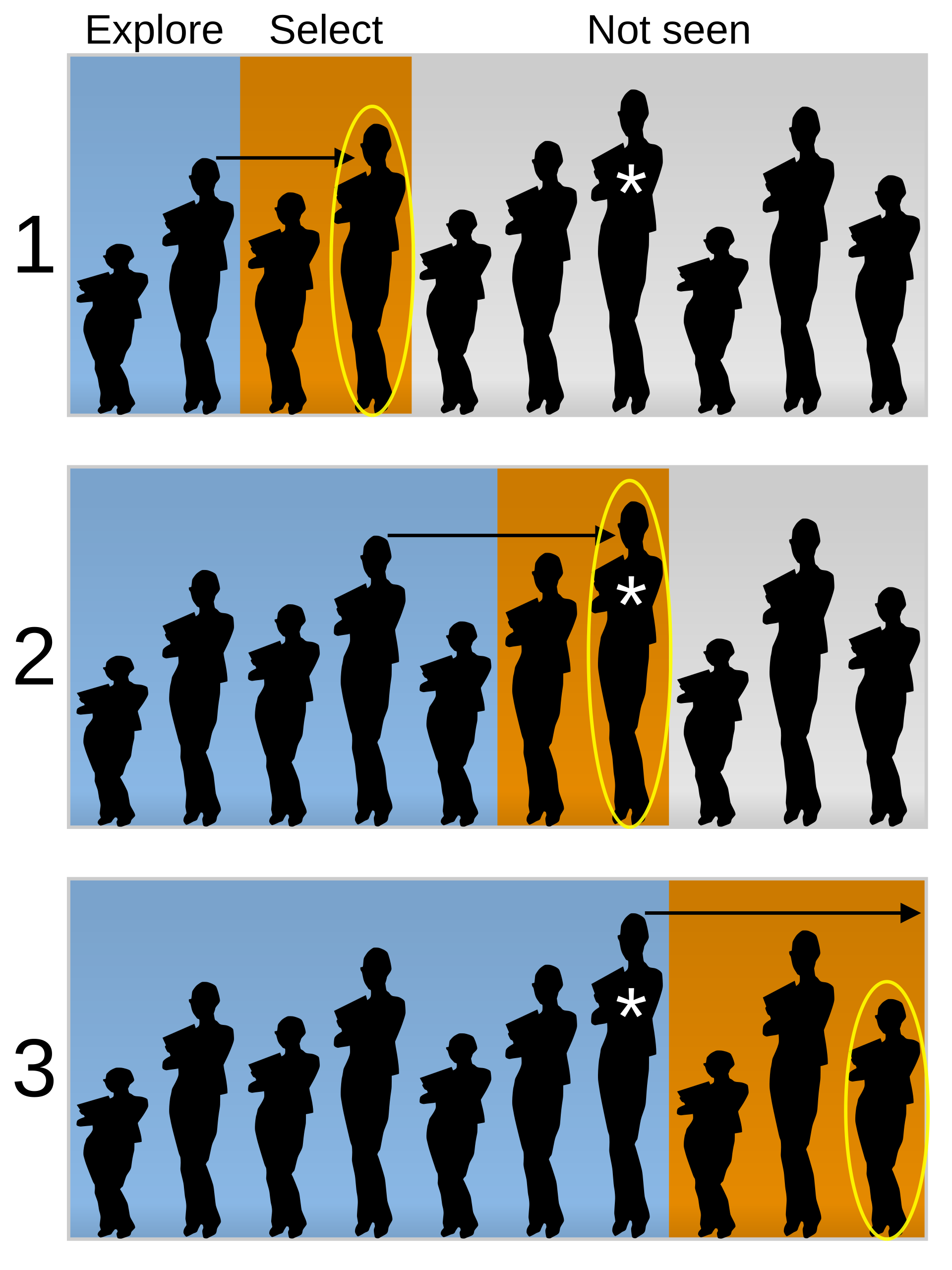
Look too briefly and you settle early; look too long and the best has already passed, leaving you with whoever comes last. · cmglee (CMG Lee), "Secretary problem.svg", Wikimedia Commons, CC BY-SA 4.0 · CC BY-SA

The three rows show both mistakes and a middle case that catches the best.
A 37% cutoff balances “the one that got away” against “the stone left unturned.”[[1]](https://algorithmstoliveby.com/excerpt.html)
Optimal Still Usually Misses
With 100 applicants, interview the first 37 without hiring. Starting with applicant 38, hire the first person who beats all of those first 37.[[4]](https://en.wikipedia.org/wiki/Secretary_problem)
Even then, you miss the single best applicant about 63 times in 100.[[3]](https://80000hours.org/podcast/episodes/brian-christian-algorithms-to-live-by/)
- Applicants in the pool: 100
- Interviewed without hiring: Hiring can start with applicant 38.
- Times the best is missed: Odds stay roughly the same with 10 options or a million.
Optimal means the highest available success chance, not a guarantee.
The odds stay roughly the same with 10 options or a million.[[3]](https://80000hours.org/podcast/episodes/brian-christian-algorithms-to-live-by/) Optimal means the highest available success chance, not a guarantee.[[2]](https://www.ted.com/talks/tom_griffiths_3_ways_to_make_better_decisions_by_thinking_like_a_computer/transcript)
Know When to Leap
What if the best option appears during the first 37%? You deliberately pass it in the look phase, and you cannot go back.
Because nothing later can beat that benchmark, the search runs to its final option.[[5]](https://commons.wikimedia.org/wiki/File:Secretary_problem.svg) This is one reason the rule usually misses.
Before using it, ask: Is the search fixed? Do options arrive separately and disappear? Is their order random?
If yes, look for 37%, then leap when an option beats the best so far.
Check yourself
During the leap phase, the benchmark is _____.
- the average of the options seen so far
- the single best option from the looking phase
Answer: the single best option from the looking phase
The rule uses the single best option seen during the looking phase, not the average or merely the first option.
You have 30 days to find an apartment. Using the 37% rule, when should you begin committing, and what should you choose?
- Begin on day 2; choose the first apartment better than the average so far.
- Begin on day 12; choose the first apartment better than the best from days 1–11.
- Begin on day 12; choose the first apartment better than the first one seen.
- Wait until day 30; choose the best apartment you remember.
Answer: Begin on day 12; choose the first apartment better than the best from days 1–11.
Spend the first 11 days looking only. Starting on day 12, choose the first apartment that is better than the best one from days 1–11.
Which situation best fits the assumptions of the 37% rule?
- Choosing one meal from a menu with every dish listed at once
- Choosing a house when offers arrive one at a time and rejected offers disappear
- Choosing the best laptop after comparing every model in a store
- Choosing a movie after reviewing a complete list of available films
Answer: Choosing a house when offers arrive one at a time and rejected offers disappear
The rule fits when options arrive one at a time, their order is random, you must accept or lose each option, and you want the single best one. A menu visible all at once lets you compare everything directly.
Keep going
This is lesson 1 of 11 in Algorithms to Live By: The Computer Science of Human Decisions. Next up:
- When the 37% Rule Moves
- Time Left Decides: Explore or Exploit
- Optimism Minimizes Regret
- Keep What You Used Last Nearby
- When Sorting Costs More Than It Saves
Wondering turns any topic into short lessons you can read, watch, or listen to, with practice questions and an AI tutor.