Free sample lesson · AI World Models
Mental Simulators
Why can a batter swing before conscious vision catches up?
Lesson 1 of the Wondering course AI World Models
The Batter's Head Start
A 100mph fastball reaches the plate faster than conscious vision can process it.
Yet batters swing, and sometimes connect.
The nervous system is not waiting for full information. It is running a learned prediction about where the ball will be.
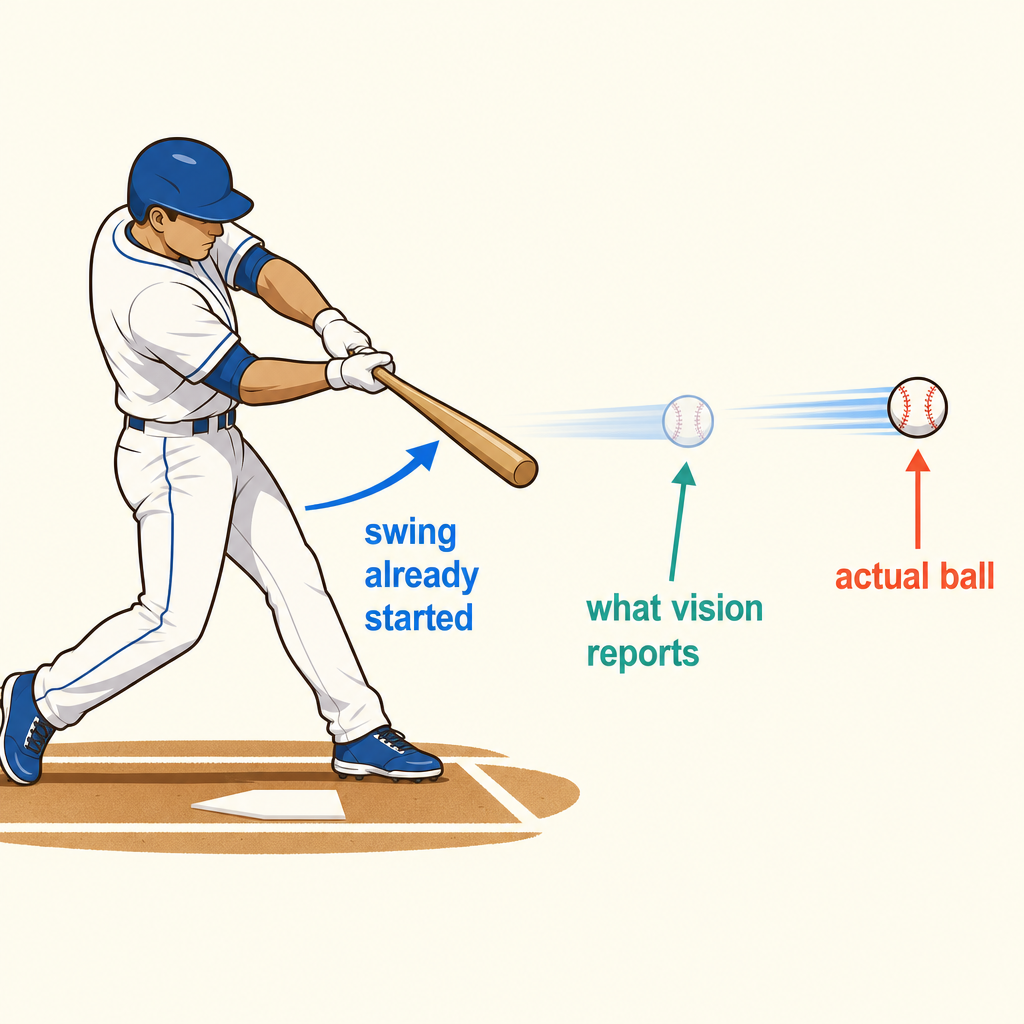
Notice that the swing is already committed while the ball is still mid-flight, so the decision rests on prediction rather than on seeing the ball arrive.
That predictive machinery is what we call a world model.
What A World Model Is
A world model is an internal representation of states, objects, relations, and dynamics.
It lets an agent anticipate what may happen next.
Jay Forrester made the point plainly: nobody carries the whole world in their head. We hold selected concepts and relationships.
- States: The situation the agent is currently in.
- Objects: The entities the agent tracks.
- Relations: How the selected concepts connect.
- Dynamics: How things change over time.
- Anticipation: Guessing what may happen next.
- Action: The model is built for action.
The model is built for action, not for completeness.
Not A Copy Of Reality
The most common mistake is treating a world model as a full replica of the world.
A batter does not simulate every molecule of a pitch. That would be slower and useless.
Compression is the point. The model keeps what changes the decision and drops the rest.
- Full replica
- Useful compression
Ask which abstraction serves the goal, not how much detail it holds.
Maps, Simulators, Latents
Three familiar things behave like world models.
A map omits almost everything, yet preserves the spatial relations you need to travel.
A flight simulator drops physical realism it can afford to lose while keeping the dynamics a pilot must learn.
- Map
- Flight simulator
- Latent model
A reinforcement learning latent dynamics model compresses observations into a compact state and predicts how it evolves.
Where The Line Falls
Not every capable model qualifies.
A static classifier that recognizes objects is not a world model. Recognition alone says nothing about what happens next.
The requirement is structure: encoded relationships or dynamics that can inform prediction or planning.
- A trained model
- Encodes relations or dynamics?: Does anything change over time or depend on an action?
- Informs prediction or planning?
- Not a world model: A static classifier stops here.
- World model
If nothing in the model changes over time or depends on an action, there is nothing to simulate.
Three Questions To Ask
Given any system, you can test your understanding with three questions.
First, what state is actually modeled? Second, what detail is deliberately omitted? Third, what action-relevant prediction does it produce?
- Modeled state: Name what state the system actually represents.
- Omitted detail: Name what detail is deliberately left out.
- Prediction: Name the action-relevant prediction it produces.
- Fit check: Judge whether that abstraction fits the goal.
Run these on a self-driving car, a video generator, or a robot arm.
The answers tell you whether the abstraction fits the goal.
Prediction Before Action
World models matter because intelligence often depends on predicting consequences before acting.
AI systems borrow the batter's trick: learn enough structure from experience to guide decisions under uncertainty.
Completeness was never the aim.
The useful question is always the same one.
Check yourself
A world model is a useful abstraction that keeps selected concepts and relationships rather than a complete copy of reality.
- True
- False
Answer: True
Correct. A world model compresses information, preserving what supports prediction and action while leaving out irrelevant detail.
Different systems preserve different decision-relevant information: a map preserves _____ for travel, a flight simulator preserves _____ for pilot control, and a latent dynamics model preserves a _____ for agent planning.
Answer: Different systems preserve different decision-relevant information: a map preserves spatial relations for travel, a flight simulator preserves flight dynamics for pilot control, and a latent dynamics model preserves a compact evolving state for agent planning.
Each system omits detail but preserves the structure needed for its goal. Maps support routing, flight simulators support control, and latent dynamics models support planning.
Why can a batter sometimes hit a 100-mph fastball before conscious vision fully processes it?
- It simulates every molecule of the ball and air
- It predicts the ball’s future location from learned patterns
- It waits until the ball reaches the plate, then reacts
- It stores a complete copy of the entire stadium
Answer: It predicts the ball’s future location from learned patterns
The nervous system uses a learned world model to predict where the ball will be and begins the swing before complete visual processing.
Keep going
This is lesson 1 of 16 in AI World Models. Next up:
- Latent State Compression
- Action-Conditioned Dynamics
- Planning by Imagination
- Model-Based Control
- MuZero's Planning Targets
Wondering turns any topic into short lessons you can read, watch, or listen to, with practice questions and an AI tutor.