Free sample lesson · AI Product Management: Scope, Evals, Launch
When a Rule Beats a Model
Why does Google's machine learning rulebook say to launch without machine learning?
Lesson 1 of the Wondering course AI Product Management: Scope, Evals, Launch
Launch Without the Model
Google's guide to machine learning opens with a surprise. Rule #1: do not be afraid to launch without machine learning.[[2]](https://developers.google.com/machine-learning/guides/rules-of-ml)
The reason is practical. Machine learning needs data, and a brand new feature usually has none.[[2]](https://developers.google.com/machine-learning/guides/rules-of-ml)
Google's PAIR team adds that a rule-based solution often works as well as an AI version, or better.[[1]](https://pair.withgoogle.com/chapter/user-needs/)
It is also easier to build, explain, debug, and maintain. So when does a model actually earn its place?
Signals That AI Fits
Credit card fraud is rare for any one person, and it keeps evolving. A fixed rule list struggles to keep up.
PAIR lists where AI is probably better: personalization, recommending different content to different users, and predicting future events.[[1]](https://pair.withgoogle.com/chapter/user-needs/)
Add natural language understanding, recognizing a whole class of things such as faces, and detecting rare events that change over time, like fraud.[[1]](https://pair.withgoogle.com/chapter/user-needs/)
The common thread: the right answer differs by person, changes over time, or involves messy input.
- AI fit signals
- Differs by person
- Personalization
- Different content per user
- Changes over time
- Predicting future events
- Rare evolving events: Such as credit card fraud.
- Messy input
- Language understanding
- Whole class of things: Such as faces.
Signals That a Rule Wins
Now compare fraud spotting with a credit card entry form. The form asks for the same fields every time, so the information is static.[[1]](https://pair.withgoogle.com/chapter/user-needs/)
- Fraud spotting
- Card entry form
AI is probably not better when predictability is the core value. A Home or Cancel button should stay put, never move based on a prediction.[[1]](https://pair.withgoogle.com/chapter/user-needs/)
Rules also win when costly errors outweigh small gains, complete transparency is required, or speed to market matters most.[[1]](https://pair.withgoogle.com/chapter/user-needs/)
And when people say they do not want the task automated or augmented with AI, that settles it.
Sort the Feature, Name the Signal
Take support ticket routing. The same goal can land on either side.
If customers pick a category from a dropdown, a stable rule routes it. The input never changes shape.
If customers write free-text emails in many styles, routing needs language understanding. That points to AI.
The same test sorts the earlier cases. Fraud spotting goes to AI, while a Home button and a card form stay rules.
Adding AI does not improve every feature. The deciding signal comes from the task itself.
Ask the Problem, Then Fake It
Many teams start with "Can we use AI to ___?" That question assumes the answer.
PAIR suggests asking "How might we solve ___?" and then "Can AI solve this problem in a unique way?"[[1]](https://pair.withgoogle.com/chapter/user-needs/)
Before building, run a Wizard of Oz test, where people try a simulated automated version.[[1]](https://pair.withgoogle.com/chapter/user-needs/)
Picture a teammate secretly sorting tickets behind a "smart" inbox. You learn whether users even want automatic routing before anyone builds a model.
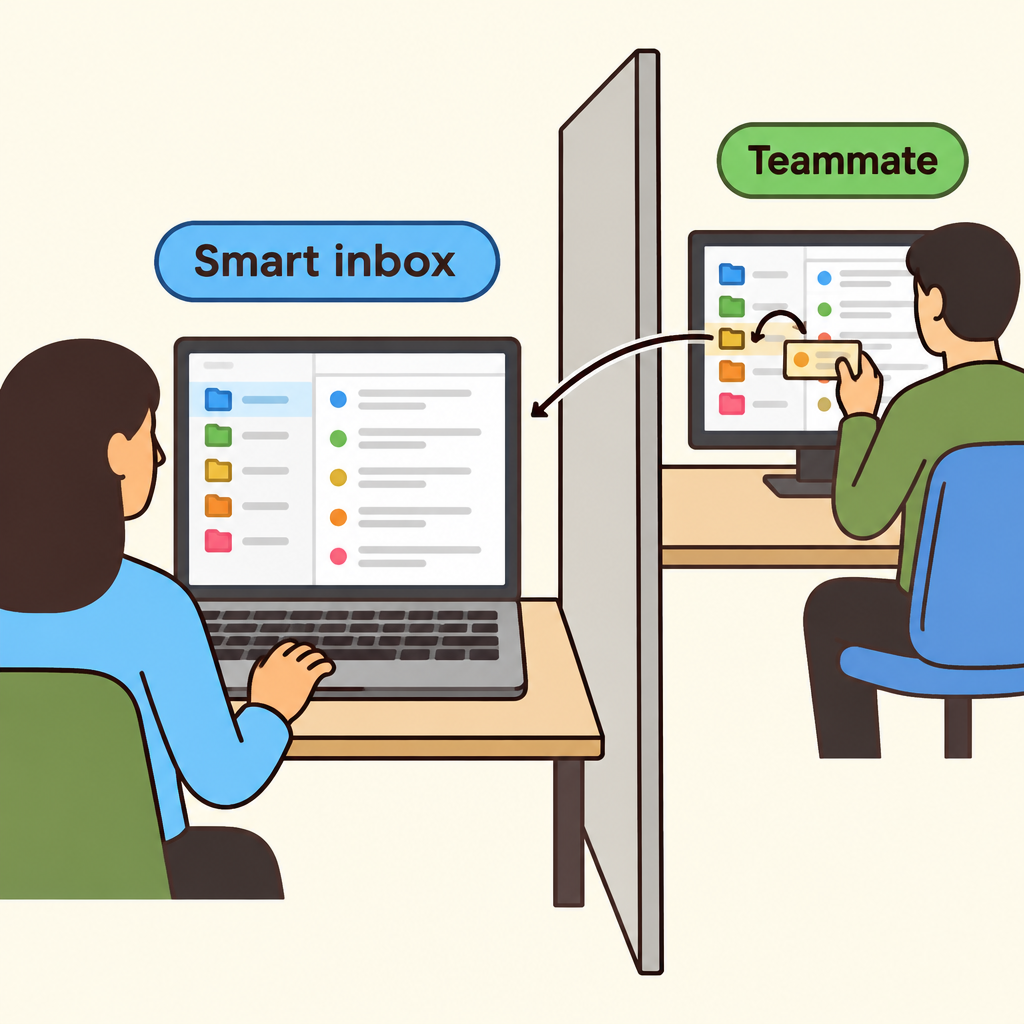
The user only sees a smart inbox sorting tickets, while a hidden teammate does the sorting by hand, so the team learns if users want routing before building anything.
Ship the Heuristic First
Need contacts ranked this week? Sort them by most recently used. That is a heuristic, a simple rule of thumb.[[2]](https://developers.google.com/machine-learning/guides/rules-of-ml)
Google's Rules of Machine Learning puts a number on it. If a model gives a 100% boost, a heuristic gets you 50% of the way.[[2]](https://developers.google.com/machine-learning/guides/rules-of-ml)
- Model: Needs data the team may not have yet.
- Heuristic: Can ship this week, like most recently used.
Another stand-in: filter spam from publishers who spammed before.[[2]](https://developers.google.com/machine-learning/guides/rules-of-ml)
A heuristic launch is a real product, not a failed AI project. It ships value now while the team collects the data a model needs.
Know When to Switch
Picture the contact ranking after many fixes: hundreds of exceptions, each one patching the last.
Rule #3 says a simple heuristic gets a product out the door, but a complex heuristic becomes unmaintainable. Then machine learning is the better choice.[[2]](https://developers.google.com/machine-learning/guides/rules-of-ml)
- Ship simple heuristic: For example, most recently used contacts.
- Collect usage data
- Rules unmaintainable?: Is the rule list piling up exceptions?
- Keep the heuristic: Data alone is not a reason to switch.
- Replace with model
- No
- Keep learning
- Yes
The switch signal is complexity. Having data alone does not mean a model will beat the rule.
A huge rule set is a cue to move on, not proof that rules were wrong from the start. Next: how much of the task should the AI take over?
Check yourself
Does adding AI automatically improve every product feature?
- Yes
- No
Answer: No
No. AI fits tasks involving personalization, prediction, messy input, or rare events that change over time. Predictable, static, transparent, or speed-critical tasks may be better served by rules.
Match each feature with its deciding signal: _____ involves rare, evolving events; _____ uses the same fields every time; _____ requires language understanding.
Answer: Match each feature with its deciding signal: fraud spotting involves rare, evolving events; card entry form uses the same fields every time; free-text email routing requires language understanding.
Fraud spotting fits AI because fraud is rare and evolves. A card entry form fits rules because its information is static. Free-text email routing can benefit from AI because it requires language understanding.
A team needs to rank contacts this week, has no usage data yet, and can sort contacts by most recently used. What should the team do first?
- Ship the heuristic and collect usage data
- Delay the feature until a model can be trained
- Build hundreds of exceptions before launch
- Use a model immediately without collecting usage data
Answer: Ship the heuristic and collect usage data
The team should ship the simple heuristic and collect usage data. A heuristic can provide useful value immediately while creating the data needed to evaluate or train a later model.
Keep going
This is lesson 1 of 8 in AI Product Management: Scope, Evals, Launch. Next up:
- Automate, Augment, or Agent
- Pricing the Cost of Errors
- Success Metrics With Guardrails
- Evals Beyond Vibe Checks
- Building Your First Eval Set
Wondering turns any topic into short lessons you can read, watch, or listen to, with practice questions and an AI tutor.