Free sample lesson · AI: Origins to Frontiers
Turing's Question
Why did Turing replace 'Can machines think?' with a game?
Lesson 1 of the Wondering course AI: Origins to Frontiers
A Question That Went Nowhere
In 1950, Alan Turing published a paper in the journal Mind. It opened with a blunt question: can machines think?
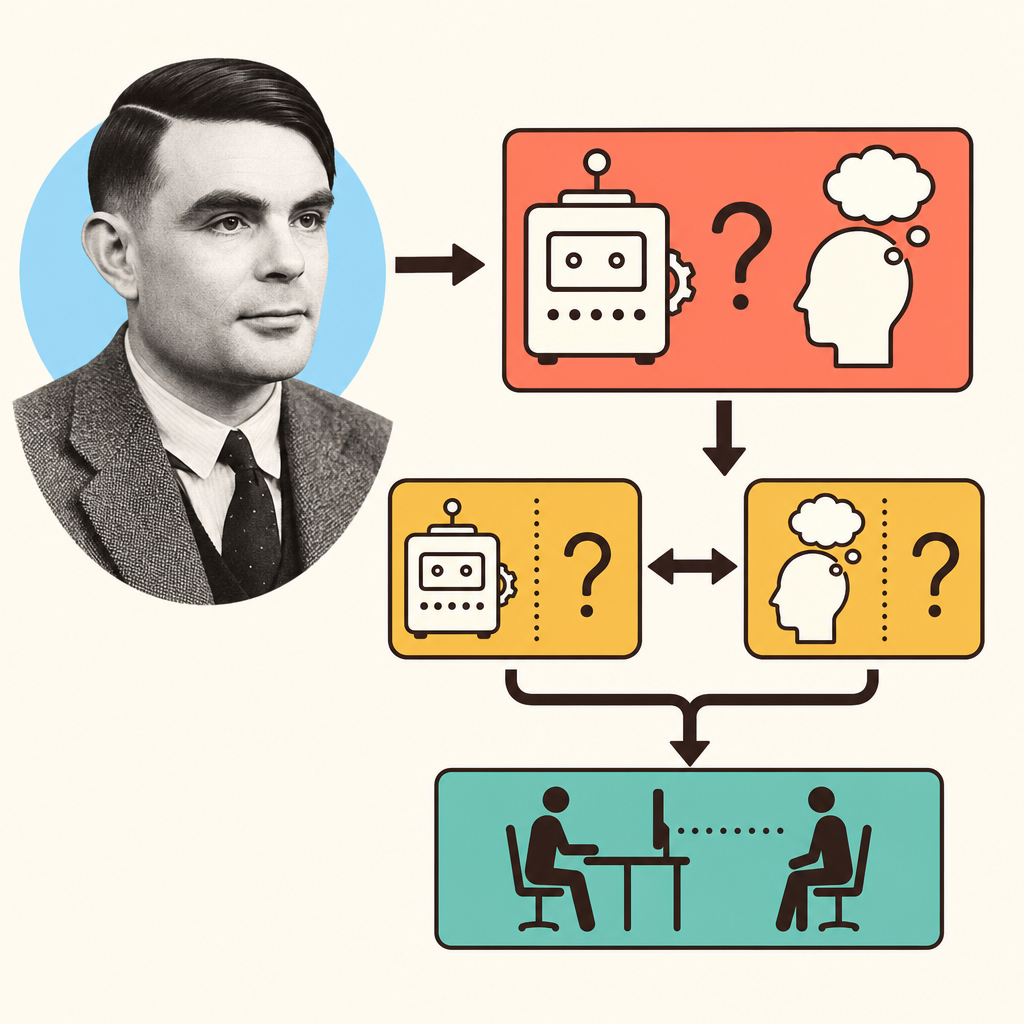
Alan Turing, author of the 1950 paper that opened with 'Can machines think?
He did not answer it.
Instead, he pointed out a problem. To answer it, you first have to define "machine" and "think", and those definitions invite endless disagreement.
So he replaced the question with something else.
The Imitation Game
Turing's replacement was a game.
An interrogator sits at a text-only interface and asks questions. Two hidden respondents answer: one human, one machine.
- Hide respondents: One human and one machine answer from behind a text-only interface.
- Ask questions: The interrogator poses questions to both hidden respondents.
- Read answers: Only the text of the replies is available for judgement.
- Decide: The judge names which respondent is the machine.
The judge must decide which is which.
If the machine's answers cannot be reliably separated from the human's under controlled conditions, it has passed a meaningful test.
From Vague Word to Procedure
This move has a name: an operational definition.
It turns a vague concept into a procedure that can be run, compared, and criticised.
"Think" is a word people argue about forever. A question-and-answer game is something you can set up, repeat, and disagree about concretely.
- Philosophical definition
- Operational test
That shift is what let AI become a research programme rather than a debate.
What Counts, What Does Not
A chatbot giving fluent answers in a text interview fits the surface form of Turing's game.
A calculator does not. It produces arithmetic answers, which is useful computation, but it does not meet the broad conversational challenge Turing described.
- Chatbot
- Calculator
The difference is not usefulness. It is whether the system can hold up across open questioning.
What the Test Does Not Prove
Here is the most common misreading: passing the test proves a machine has a mind like ours.
It does not.
The imitation game is not a theory of consciousness, emotion, embodiment, or moral status. It also does not require the machine to reason the way a human reasons.
Learners often go further and conclude the test is only about deception. A better reading is that Turing moved a vague question into a measurable arena.
Behaviour Over Definitions
Turing's real contribution was a method.
Instead of asking what a machine is on the inside, he asked what its behaviour supports as a practical judgement.
The key distinction: not whether the machine thinks internally like a person, but whether its answers can be told apart from a person's.
- Can machines think?: The 1950 paper opens with this question.
- Operational definition: A vague concept turned into a testable procedure.
- Observable behaviour: Answers are judged, not inner processes.
- Human-like mind: Consciousness and moral status stay outside the test.
- AI research programme: A testable arena replaced an endless debate.
This is why the 1950 paper stayed a landmark for both philosophers and engineers.
Using Turing's Move Yourself
The lesson generalises well beyond machines.
When a debate stalls on definitions, ask what procedure would settle it, or at least make the disagreement sharper.
But keep the limit in view. An operational test does not close every philosophical question behind the concept.
It gives you somewhere concrete to stand while the argument continues.
Check yourself
Does passing Turing’s imitation game prove that a machine has a human-like mind?
- Yes, it proves a human-like mind
- No, it measures distinguishable behavior
Answer: No, it measures distinguishable behavior
No. The test measures whether the machine’s answers can be distinguished from a human’s. It does not establish consciousness, emotion, embodiment, or moral status.
In Turing’s setup, the _____ uses a text-only judge to compare hidden respondents. An _____ turns a vague idea into a repeatable procedure.
Answer: In Turing’s setup, the imitation game uses a text-only judge to compare hidden respondents. An operational definition turns a vague idea into a repeatable procedure.
The imitation game is the specific question-and-answer test. An operational definition is the broader method of replacing a vague idea with a procedure that can be run and criticized.
Why did Turing replace “Can machines think?” with a question-and-answer game?
- To avoid studying machine behavior
- To make a vague debate testable
- To prove that machines are conscious
- To limit machines to arithmetic tasks
Answer: To make a vague debate testable
The words “machine” and “think” invite endless disagreement. A testable procedure makes disagreements more concrete because people can run, compare, and criticize the test.
Keep going
This is lesson 1 of 10 in AI: Origins to Frontiers. Next up:
- Dartmouth Names AI
- Symbols First
- Expert Systems Boom
- Winters and Statistics
- Deep Learning Returns
Wondering turns any topic into short lessons you can read, watch, or listen to, with practice questions and an AI tutor.